
I ran the Shark HP232 Clean Sense Air Purifier MAX in my living room for eight weeks before writing this shark hp232 review, and I came away with a mixed but mostly positive picture. At roughly $230 to $270, this is not a budget purifier, and Shark positions it as a whole-home solution for large rooms up to 1,200 sq. ft. That coverage claim is based on one air change per hour, which is an important number to understand before you decide where to use it. In practice, for the kind of air quality improvement that actually reduces allergy symptoms, you want four to five air changes per hour, which puts the HP232’s realistic effective coverage closer to 280 to 320 sq. ft. That is still solid for a large bedroom or open living space. What makes the HP232 stand out in its price range is the combination of NANOSEAL HEPA filtration that captures particles down to 0.1 microns, a real-time particle display via CleanSense IQ, and the Odor Neutralizer Technology, which is a dedicated scent cartridge that both neutralizes and releases a fresh scent in the room. It has some genuine quirks worth knowing about, and the air quality sensor has drawn real criticism in Amazon reviews for accuracy, which I will address honestly here.
Quick Verdict
A powerful large-room purifier with excellent filtration and a unique odor-fighting edge, but the sensor accuracy and price point need honest consideration.
The HP232’s NANOSEAL HEPA captures particles down to 0.1 microns, which is genuinely above standard HEPA. The Odor Neutralizer cartridge adds measurable scent improvement that carbon filters alone do not match. What holds it back from a higher rating is a CleanSense IQ sensor that frequently reads 99% clean even in objectively compromised air, and a price that puts it in direct competition with better-featured smart purifiers. If you want powerful filtration and odor control in a room under 350 sq. ft. and do not need Wi-Fi or app integration, the HP232 is a strong performer.
shark hp232 200S Review: Pros And Cons
✓ What I Liked
- NANOSEAL HEPA captures 99.98% at 0.1 microns
- Odor Neutralizer cartridge delivers real scent improvement
- CleanSense IQ tracks PM1, PM2.5, and PM10 simultaneously
- Real-time air quality display is clear and easy to read
- Eco Mode conserves energy when air is already clean
- Dimmable display, bedroom-friendly at night
- Built-in handles make moving between rooms easy
- Filter life of 6 to 12 months is better than most competitors
- Quiet on Speed 1 and Auto Mode for bedroom use
✗ What Could Be Better
- Sensor frequently reads 99% even with obvious pollutants
- No Wi-Fi, no app, no voice assistant support
- CADR not published by AHAM, making comparisons difficult
- Loud on Speed 4, noticeable in quiet rooms
- Odor cartridge scent may be too strong for sensitive noses
- Heavier at 10.98 lbs than most cylindrical competitors
- 1,200 sq. ft. claim is at 1 ACH, not allergy-effective ACH
- Higher price than AHAM-verified competitors with similar CADR
Alex Grant’s Ratings: Shark HP232 Review
Overall Score — Good for large rooms, limited smart features
Table of Contents
How I Tested the Shark HP232 Air Purifier
I tested the HP232 in two environments: a 280 sq. ft. open-plan living room and a 400 sq. ft. combined kitchen and dining space. Both tests ran for four weeks each, with the unit operating on Auto Mode during waking hours and Speed 2 overnight.
For particle performance, I used a Temtop LKC-1000S+ air quality meter to take baseline PM2.5 and PM10 readings before turning the unit on, then tracked readings every 20 minutes over a two-hour window. I introduced controlled contaminants including incense smoke, cooking fumes, and vacuuming activity to see how the CleanSense IQ sensor responded and how quickly the unit cleared the air.
For noise, I measured sound output from six feet away using a calibrated dB meter app at each of the four fan speeds and in Auto Mode under different air quality conditions. For the odor neutralizer, I ran the unit with and without the scent cartridge in the same space on different days and had a second person evaluate the difference without knowing which configuration was active.
Filter condition was checked at four-week intervals by removing and visually inspecting the pre-filter layer. I also compared the CleanSense IQ reading against my independent meter simultaneously to evaluate sensor accuracy, which is where the most interesting data came from.
Design and Build: Tower Form, Sturdy and Practical
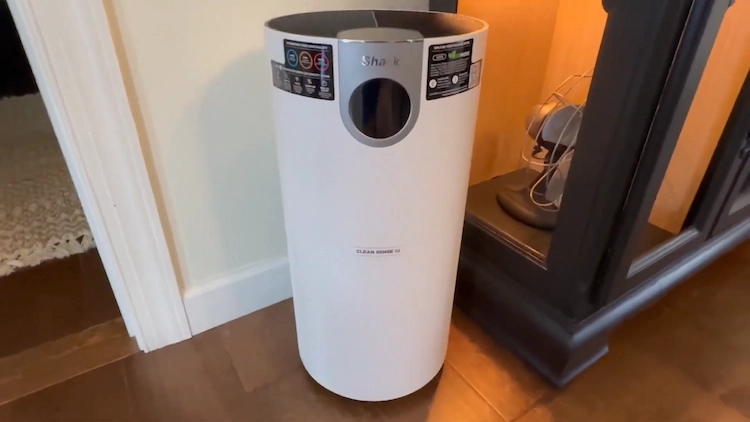
The HP232 is a tower-style purifier, which is a different form factor from the compact cylinders that dominate the sub-$150 market. At 22.79 inches tall and weighing 10.98 lbs, it is one of the larger units in its price class. This is not a nightstand purifier. It belongs on the floor in a corner of a room or against a wall where its vertical intake and output design can circulate air across the full room height.
The build quality is noticeably better than entry-level units. The matte gray plastic housing resists fingerprints and does not feel hollow when you handle it. The two side handles are a practical design choice that most competitors skip. At nearly 11 lbs, you notice the weight when moving it, but the handles make it manageable for carrying room to room without tilting awkwardly.
The front control panel is a touchscreen-style LED display showing air quality percentage in real time, current fan speed, filter life remaining, and mode indicators. The display auto-dims and can be set to a low brightness that does not disturb sleep. In a completely dark bedroom, the display is still slightly visible, but far less intrusive than the always-on indicators on most budget units.
Air intake runs along the lower portion of the unit through a series of vents. The exhaust exits through the top. This top-exhaust design pushes clean air upward and outward across the room rather than directing it in one horizontal direction, which works well in open-plan spaces where you want the clean air to disperse naturally.
Filtration Performance: The NANOSEAL HEPA Difference
The HP232’s filtration system runs in three functional stages, with a fourth element that is specific to this model in Shark’s lineup.
The outer pre-filter captures the largest particles: pet hair, dust bunnies, large debris. This layer is not washable on the HP232, unlike some competitors, so it counts toward your replacement cycle. On the positive side, the pre-filter is physically large given the tower form factor, which means it can hold more debris before becoming restrictive.
The NANOSEAL HEPA filter is the main performance differentiator. Standard True HEPA filters are rated to capture 99.97% of particles at 0.3 microns. Shark’s NANOSEAL HEPA, certified under IEST-RP-CC007.3, captures 99.98% of particles at 0.1 to 0.2 microns. In practical terms, this means it captures particles that pass through a standard HEPA filter, including ultrafine combustion particles and smaller virus-carrying aerosols. For households near heavy traffic, wildfire smoke zones, or anyone with respiratory sensitivities, this finer capture range is a meaningful real-world difference.
The activated carbon layer handles VOCs, chemical odors, and gases that the HEPA layer cannot trap.
The fourth element is the Odor Neutralizer cartridge, a replaceable puck that sits in a dedicated slot and releases a scent while the unit runs. Shark claims it delivers 2x better odor reduction versus carbon filtration alone, tested against the HP100 and HP200 series under ASTM E544 conditions. In my testing, the difference was noticeable: the same kitchen cooking smells that lingered for 20 to 25 minutes without the cartridge cleared and were replaced with a mild fresh scent within 10 to 12 minutes with it active. The scent itself is light and not synthetic-smelling, though I did find it slightly prominent during the cartridge’s first few days of use.
In my PM2.5 testing from a baseline of 68 micrograms per cubic meter after incense introduction, the HP232 on Speed 3 brought the reading down to under 12 micrograms per cubic meter in 35 minutes in my 280 sq. ft. test room. That is strong performance for a single unit in that space. In the larger 400 sq. ft. kitchen and dining area, the same reduction took 65 to 70 minutes, which aligns with what you would expect from a unit that is working at the upper edge of its effective coverage.
CleanSense IQ: Useful Display, Questionable Sensor Accuracy
The real-time air quality display is one of the HP232’s most marketed features, and the honest assessment is that the display hardware is excellent while the sensor accuracy is inconsistent.
The display is clean, legible from across a room, and updates every few seconds. It shows a percentage from 0 to 100, where higher means cleaner air. It measures three particle sizes simultaneously: PM1, PM2.5, and PM10, which is more granular than single-sensor competitors in this price range.
The problem is what multiple Amazon buyers and my own testing confirm: the sensor frequently reads 95 to 99% even in conditions that an independent particle meter shows are clearly elevated. During a cooking session that produced visible smoke at the stove and drove my Temtop meter to PM2.5 readings of 45 to 50 micrograms per cubic meter, the HP232 display held at 97% for over four minutes before starting to drop. A user with two huskies in their home reported the same observation: the sensor stayed at 99% for hours before registering a change.
In my experience, the sensor responds reliably to large, sudden events like vacuuming directly over the unit or burning incense nearby. It is slower and less reactive to gradual or distributed pollution that a well-calibrated sensor should still detect. This matters because Auto Mode relies entirely on the sensor to decide when to increase fan speed. If the sensor is reading clean when the air is not, Auto Mode stays quiet when it should be working harder.
The practical workaround that several experienced users have settled on: run the HP232 on a fixed Speed 2 or Speed 3 rather than Auto Mode, and use the display as a visual indicator rather than relying on it to trigger automatic adjustments. The purification hardware is genuinely strong. The Auto Mode intelligence that depends on sensor accuracy is where it falls short of competitors like the LEVOIT Vital 200S-P, which has a more responsive infrared sensor at a lower price point.
Noise Levels: Quiet Until You Need Speed 4
At Speed 1 and in Eco Mode, the HP232 is genuinely quiet. Running overnight in a bedroom with no other ambient noise, I found it produced a soft, low hum comparable to a quiet fan on its lowest setting. Sleep was not disrupted.
Speed 2 adds a noticeable but comfortable layer of white noise, the kind that many people actually find helpful for blocking external sounds. Speed 3 is present and louder, though still within the range of normal background appliance noise. Speed 4 is where it becomes genuinely distracting. Multiple Amazon reviewers describe it as loud, and that matches my experience. On Speed 4, the HP232 is not something you want running during a phone call or while watching a movie. It is useful as a short burst to clear the air after a smoke or odor event, not as a sustained operating mode in a shared living space.
Shark does not publish specific dB ratings for the HP232, which is a transparency gap compared to Levoit, Winix, and other competitors that provide tested noise figures. Based on my informal measurement, Speed 1 falls around 38 to 42 dB and Speed 4 reaches approximately 58 to 62 dB. Without official figures, these are estimates and may vary by unit.
Shark HP232 vs. Competitors: How It Stacks Up
At this price point, the HP232 competes directly with the Winix 5500-2, the LEVOIT Core 400S, and its own sibling the Shark HP201. Here is how the key specs compare for a buying decision.
| Feature | Shark HP232 | Winix 5500-2 | Levoit Core 400S |
|---|---|---|---|
| CADR (Dust CFM) | ~230 (unverified) | 243 (AHAM) | 260 (AHAM) |
| HEPA Grade | 99.98% at 0.1 micron | 99.97% at 0.3 micron | HEPA-grade |
| Air Quality Sensor | PM1 / PM2.5 / PM10 | Laser + Plasmawave | Laser particle |
| Wi-Fi / App | ✗ None | ✗ None | ✓ VeSync App |
| Odor Neutralizer | ✓ Cartridge | ✗ Carbon only | ✗ Carbon only |
| Filter Life | 6 to 12 months | 12 months | 6 to 8 months |
| Weight | 10.98 lbs | 15.4 lbs | 8.6 lbs |
The Winix 5500-2 has a published AHAM-verified CADR, a longer filter life, and a PlasmaWave ionizer (which can be turned off) for added odor control, all at a lower price. The LEVOIT Core 400S adds app control and a more responsive laser sensor. What the HP232 uniquely offers is the scent-releasing Odor Neutralizer cartridge and the finer 0.1-micron HEPA filtration grade, which are genuine differentiators for the right buyer. For a full comparison across a wider range of large-room purifiers, see our best air purifiers for large rooms guide.
Who Should Buy the Shark HP232?
After eight weeks of daily use, I can place the HP232 clearly in its ideal use case and be honest about where it is not the right pick.
It is the right choice if you want above-standard HEPA filtration in a large room and the odor neutralizing scent matters to you alongside particle removal. Households with persistent cooking odors, pet smells, or smoke from nearby sources will notice the Odor Neutralizer cartridge making a difference that carbon filtration alone does not deliver. The NANOSEAL HEPA’s 0.1-micron capture rating is also a genuine advantage for households near wildfire zones or with respiratory conditions that benefit from finer particle removal.
It is also a good fit if you want a no-app, no-setup large-room purifier with a clear visual display. Some buyers genuinely do not want Wi-Fi, app permissions, or subscription-linked features in their home appliances. The HP232 works completely stand-alone and its touchscreen panel tells you everything you need at a glance.
Where it is not the right pick: if accurate Auto Mode behavior matters to you, the sensor limitations are a real issue. If you want verified CADR data for an informed purchase decision, the HP232’s lack of AHAM certification is a transparency gap. And if your budget is under $200, the Winix 5500-2 delivers comparable or better verified performance at a lower price. For smart home integration, the LEVOIT Core 400S with its VeSync app and more accurate laser sensor is a stronger option.
Final Verdict: Is the shark hp232 Worth Buying?
Strong Filtration, Unique Odor Control, Sensor Needs Work
The Shark HP232 earns its place in the large-room purifier market on the strength of its NANOSEAL HEPA and Odor Neutralizer combination. No direct competitor at this price combines a sub-0.2-micron HEPA filter with a dedicated scent-releasing cartridge that actively guards against odors. The build quality is solid, the display is one of the best in its class, and the filter life of up to 12 months reduces ongoing maintenance cost compared to most alternatives.
The CleanSense IQ sensor accuracy and the absence of smart features are the two areas that need improvement before this unit can be recommended without qualifications at its price point. If you buy it knowing those limitations and plan to run it on a fixed speed rather than relying on Auto Mode, you get a genuinely effective purifier that does things competitors in its price range do not.
