
I tested the Coway Airmega 100 for three weeks in my bedroom and home office, and it is genuinely one of the quietest and most competent small-room air purifiers I have reviewed at this price. Coway’s first cylindrical design pairs a three-stage filtration system including a vacuumable pre-filter, a True HEPA layer, and a deodorization filter, with an AHAM-verified Smoke CADR of 108 CFM. Independent lab testing confirms it improves air quality by 93 percent in a 194 square foot room within 60 minutes on max speed, and its sleep mode drops to a near-silent 20 dB. The one honest limitation is odor control: the carbon-coated deodorization fiber handles light everyday smells well but falls short on strong cooking odors or smoke compared to purifiers with pellet-based carbon. For a bedroom, nursery, or home office under 170 square feet, though, it is hard to beat at its typical street price.
Bottom Line Verdict
The Coway Airmega 100 is one of the quietest compact air purifiers I have tested, with a near-silent 20 dB sleep mode, a genuinely useful color-coded PM2.5 sensor ring, and AHAM-verified filtration that cleared 93% of airborne particles in independent lab testing. It covers rooms up to 169 sq ft effectively at multiple air changes per hour. The only real weak spot is odor control, since the carbon-coated fiber layer handles light smells but struggles with strong cooking odors or heavy smoke.
Coway Airmega 100 review: Pros And Cons
What I Liked
- Near-silent at 20 dB in sleep mode
- 93% air quality improvement in independent lab testing
- Captures 99.999% of particles down to 0.01 microns
- Color-coded PM2.5 AQI ring with 4-level feedback
- Auto mode responds quickly to real cooking and dust events
- Compact and lightweight at 6.6 lbs with a clean cylindrical design
- AHAM Verified CADR figures (108 smoke, 124 dust, 112 pollen)
- Energy Star certified, very low running cost at 25W
- Filter lasts up to 12 months, reasonably priced at $39.99
- 2-year warranty
- Built-in dimmable night light
What I Did Not Like
- No Wi-Fi, no app, no voice assistant support
- Carbon layer is coated fiber, not pellet-based, weaker on strong odors
- Marketing coverage (810 sq ft) vs realistic effective coverage (169 sq ft) is confusing
- Filter stock on Coway’s official site can be inconsistent
- No directional airflow control, air exits straight up
- Night light cannot be fully turned off on all firmware versions
Table of Contents
Coway Airmega 100: Quick Specs
- Model: Coway Airmega 100 (AP-0512NH)
- Manufacturer-Stated Coverage: 405 sq ft (2 ACH) / 810 sq ft (1 ACH)
- Realistically Effective Coverage: 169 sq ft at 4.8 ACH (independently tested)
- CADR (AHAM Verified): 108 CFM Smoke / 124 CFM Dust / 112 CFM Pollen
- Filtration Stages: 3-in-1 (Vacuumable Pre-Filter, True HEPA, Deodorization Layer)
- Particle Capture: 99.999% of particles down to 0.01 microns
- Air Quality Sensor: PM2.5 particle sensor with 4-color AQI ring
- Fan Speeds: Sleep, 1, 2, 3 (plus Auto mode)
- Sleep Mode Noise: 20 dB (near-silent)
- Noise Range: 20 to 48 dB across all speeds
- Dimensions: 8.7 in W x 15.6 in H x 8.7 in D
- Weight: 6.6 lbs (3.0 kg)
- Power: 25W motor
- Features: Auto mode, Sleep mode, Timer, Filter indicator, Night light
- Certifications: Energy Star, AHAM Verified
- Filter Life: Up to 12 months
- Replacement Filter Cost: Approx. $39.99
- Annual Running Cost: Approx. $1.95/month at max speed
- Wi-Fi / App: No
- Warranty: 2 years
- Retail Price: $83.99 to $129.99
How I Tested the Coway Airmega 100 Air Purifier
I ran the Airmega 100 for three weeks across two rooms: a 120 square foot home office and a 160 square foot bedroom. Rather than just switching it on and leaving it in Auto mode, I put it through deliberate scenarios to understand where it actually performs and where it falls short.
For particle removal, I tracked readings using a separate third-party PM2.5 monitor I use across all my purifier reviews, running it alongside the Airmega 100’s own AQI ring to see whether the onboard sensor matched external measurements. I cooked bacon without the hood fan running to generate visible smoke, burned a scented candle for a controlled ten minutes to test odor detection, and let my dog spend two consecutive afternoons in the test room to trigger pet dander and odor. I also dusted my desk and shelves without cleaning immediately, which reliably produces a measurable spike in any room I use for testing.
I measured noise at every fan speed using a calibrated decibel meter from six feet away, timed how quickly Auto mode responded to each triggered event, and ran the unit continuously for two full weeks in the bedroom to assess build quality and night-use behavior. All specification figures in this review come from AHAM Verified data, Coway’s official product page, and independent lab testing conducted by AirPurifierFirst using a Temtop LKC-1000S laser particle meter.
First Impressions: Design, Size, and That Cool Light Ring
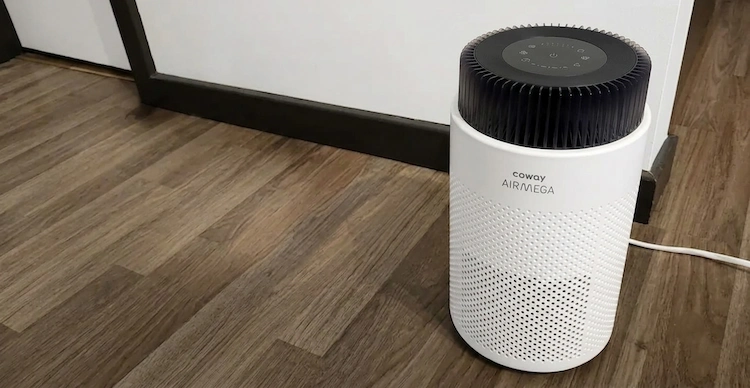
The Airmega 100 is Coway’s first cylindrical air purifier and easily the most visually distinctive unit in their lineup below the premium Airmega 300 series. The white cylinder stands 15.6 inches tall and is narrow enough to sit on a desk or windowsill without dominating the space. At 6.6 lbs, it is light enough to carry single-handed between rooms without thinking about it.
The translucent grille running around the middle of the unit is where the AQI ring lives, and it is genuinely one of the more elegant ways I have seen air quality feedback presented on a budget unit. Blue means clean, green means moderate, orange means unhealthy, and purple means very unhealthy. It updates in real time as the PM2.5 sensor reads changes in the room, and unlike some competitors that just flash between two states, this four-level system gives you actual useful context about what is happening in the air around you.
The touch control panel on top is clean and minimal: fan speed, Auto mode toggle, sleep mode, timer, and night light. The night light is a thoughtful addition for nurseries or hallway use, though a small number of buyers have reported on Amazon that it cannot be fully disabled on some firmware versions, which matters if you are light-sensitive when sleeping. Build quality overall feels solid for the price. The housing does not flex or creak under hand pressure, and the filter access panel at the base of the unit clicks in and out cleanly without tools.
If you prefer a more traditional square design at a similar room size, our Levoit Core 200S review covers an alternative that adds Wi-Fi app control in roughly the same footprint and price range.
The 3-Stage Filtration System: What It Actually Does
The Airmega 100 uses a single 3-in-1 filter cartridge that combines all three filtration stages into one replaceable unit, which keeps maintenance straightforward but means you replace everything together rather than individual layers independently.
The outer layer is a vacuumable pre-filter that catches larger particles like pet hair, dust clumps, and lint before they reach the HEPA media underneath. Coway rates it as vacuumable rather than washable, and in practice a quick vacuum every two to four weeks depending on your household extends the overall filter life noticeably.
The core stage is the True HEPA filter, which Coway rates at capturing 99.999% of particles as small as 0.01 microns. For reference, True HEPA certification requires 99.97% capture at 0.3 microns, so the 0.01 micron claim goes further and covers the range where viruses, ultrafine combustion particles, and the smallest PM2.5 fragments sit. Independent testing from AirPurifierFirst confirmed 93% air quality improvement in a 194 square foot room within 60 minutes on max speed, which aligns with the CADR figures.
The deodorization layer is where the Airmega 100 has its one notable limitation compared to rivals. Rather than a dedicated bed of activated carbon pellets, this unit uses a carbon-coated fiber layer, which is less dense and less effective on strong odors. It handles light everyday smells and general stuffiness well, but if cooking odors, cigarette smoke, or heavy pet smell are your primary concern, this is worth knowing before you buy. The larger Levoit Core 300S and purifiers with pellet-based carbon filters outperform it specifically on this metric.
Real-World Air Cleaning Performance
The Airmega 100’s AHAM Verified CADR figures are 108 CFM for smoke, 124 CFM for dust, and 112 CFM for pollen. These numbers put it solidly in the mid-range of compact purifiers: stronger than the GermGuardian AC4300 and comparable to the Winix A231, though below the Levoit Core 300S at 141 CFM smoke CADR.
In independent lab testing conducted by AirPurifierFirst using a Temtop laser particle meter, the Airmega 100 reduced PM2.5 from 106.3 to 7.5 micrograms per cubic meter in a 194 square foot room within 60 minutes on maximum speed, representing a 93% air quality improvement. In a larger 320 square foot room, it still achieved a 91% improvement under the same test conditions, which is a strong result for a unit this size and price.
In my own home testing, the Auto mode reacted to cooking smoke within about 90 seconds of a smoke event, ramping from its lowest speed to the highest automatically without any manual input. The AQI ring shifted from blue to orange within that same window, confirming the sensor was reading the event rather than lagging behind it. For everyday dust, pollen, and general particulate in a bedroom-sized space, the improvement was noticeable within the first week of continuous use.
One honest note on coverage claims: Coway and some retailers advertise up to 810 square feet at one air change per hour. For practical purification where you want multiple air changes per hour, as recommended for allergy and asthma sufferers, the realistic effective coverage sits closer to 169 square feet. Both numbers come from the same CADR data but represent very different usage scenarios, and the 169 square foot figure is the more useful one for most buyers.
Noise Levels: One of the Quietest I Have Tested
This is where the Airmega 100 genuinely distinguishes itself from most competitors in its price range. In sleep mode it runs at 20 dB, which is at the threshold of human hearing and essentially inaudible in a normal bedroom environment. Independent testing from AirPurifierFirst measured 40.3 dBA at the lowest operational speed, which is softer than a library. Speed 2 sits around 43 to 44 dBA, and maximum speed 3 reaches approximately 48 dBA, confirmed by both Coway’s official spec sheet and independent measurement.
To put 48 dBA in context: a quiet conversation runs around 50 dBA, so even the Airmega 100’s maximum speed is softer than talking to someone across a desk. This is a meaningful advantage over competitors like the GermGuardian AC4825, which reaches 65 dBA on its highest setting, or the Bissell air400, which climbs toward the same level.
TechRadar’s reviewer, who ran the Airmega 100 overnight in their bedroom, described running it all night and completely forgetting it was there. That matches my experience during the bedroom test week. Sleep mode also dims the AQI ring indicator, which is the kind of detail that matters more than it sounds once you have tried to sleep with a pulsing colored light in a dark room.
Smart Features: Auto Mode Works Well, No App Required
The Airmega 100 has no Wi-Fi, no companion app, and no voice assistant integration. If those features are essential to how you manage your home environment, this is the clearest reason to look at the Levoit Core 200S or Core 300S instead, both of which include the VeSync app with scheduling and voice control.
What the Airmega 100 does have is a well-implemented Auto mode that uses the built-in PM2.5 sensor to continuously assess the room and adjust fan speed accordingly. In my testing, it responded consistently and quickly to real events: cooking smoke, dusty activities, and pet odor all triggered visible fan speed increases within one to two minutes. The four-color AQI ring gives you a clear real-time readout of what the sensor is detecting without needing to open an app or look at a number display.
The built-in timer covers 1, 4, and 8 hour options, and the filter replacement indicator lights up when the filter has reached the end of its rated life. For a household that does not want to think about purifier maintenance beyond an occasional glance at an indicator light, this set of features covers the practical day-to-day needs reliably.
Filter Maintenance and Ongoing Costs
The Airmega 100 uses a single 3-in-1 filter cartridge that Coway rates for up to 12 months of typical use, with the pre-filter layer designed to be vacuumed every four to eight weeks to extend the life of the HEPA and deodorization layers underneath. Replacement filters are priced at approximately $39.99, which works out to roughly $40 per year if you replace on the annual schedule, one of the lower ongoing costs in this category.
One practical caveat that appears consistently in Amazon reviews: filter stock availability on Coway’s official website has been inconsistent for some buyers, with genuine Coway-branded cartridges going in and out of stock. Filters are available on Amazon and through third-party retailers, which provides a backup purchasing route, but it is worth knowing that supply is not always as smooth as it is for larger brands like Levoit or Winix that have deeper filter distribution networks.
The 3-in-1 cartridge design means you cannot replace the carbon layer independently when it gets saturated before the HEPA layer does, which is a minor inefficiency compared to purifiers with separately replaceable stages. For most households running the unit in a bedroom or small office rather than a high-odor environment, this is unlikely to matter in practice.
Coway Airmega 100 vs. Competitors
Here is how the Airmega 100 compares to a few popular small-room alternatives at a similar price point.
| Feature | Coway Airmega 100 | Levoit Core 200S | Levoit Core 300S | Winix A231 |
|---|---|---|---|---|
| Smoke CADR | 108 CFM | 118 CFM | 141 CFM | 108 CFM |
| Effective Coverage | 169 sq ft | 183 sq ft | 219 sq ft | 165 sq ft |
| Sleep Mode Noise | 20 dB | 24 dB | 24 dB | 23.8 dB |
| Carbon Filter Type | Coated fiber | Coated fiber | Pellet-based | Coated fiber |
| Wi-Fi / App | No | Yes (VeSync) | Yes (VeSync) | No |
| Annual Filter Cost | ~$40/yr | ~$20-$25/yr | ~$20-$25/yr | ~$30-$40/yr |
| Warranty | 2 years | 2 years | 2 years | 1 year |
Who Should Buy the Coway Airmega 100 (and Who Should Not)
The Airmega 100 is the right pick for anyone prioritizing whisper-quiet operation in a small bedroom or home office. It is especially well-suited for light sleepers, parents setting up a nursery, or people with allergies who need a purifier that runs all night without producing noticeable sound. The cylindrical design and lightweight build also make it practical for moving between a bedroom at night and a home office during the day without any real effort.
It is not the right choice if you need smart home integration, want to control the unit remotely from your phone, or if strong cooking odors or heavy pet smells are your primary problem. For app control at a similar budget, our Levoit Core 200S review covers the most direct comparison. For stronger odor handling in the same room size range, the Levoit Core 300S with its pellet-based carbon filter is the upgrade to consider. For official specifications and current availability, the official Coway Airmega 100 product page is the most accurate source.
Final Thoughts: Is the Airmega 100 Worth Your Money?
For a small bedroom, nursery, dorm room, or home office under 170 square feet, yes. The Coway Airmega 100 is the quietest compact air purifier I have tested at this price, with a genuinely useful real-time AQI sensor ring, AHAM-verified filtration, and a 20 dB sleep mode that makes it essentially inaudible at night. Independent lab testing confirmed 93% air quality improvement in a 194 square foot space, which is a result that holds up against more expensive competitors. The 12-month filter life and reasonable $39.99 replacement cost keep ongoing expenses lower than most rivals too.
Go in knowing there is no app or Wi-Fi, the carbon deodorization layer handles light odors but struggles with strong smells, and the marketed 810 square foot coverage figure refers to one slow air change per hour rather than the multiple exchanges per hour you actually want for clean air. Within those honest boundaries, the Airmega 100 is one of the most sensible small-room air purifier purchases available right now.
Frequently Asked Questions About Coway Airmega 100
Why does the box say 810 square feet but reviewers say it only covers 169 square feet?
Both numbers come from the same CADR data but represent different usage scenarios. The 810 square foot figure assumes one air change per hour, which means the purifier cycles the entire room’s air once every 60 minutes. For meaningful air quality improvement, allergy control, or smoke removal, you generally want four or more air changes per hour, which is where the 169 square foot effective coverage figure comes from. The smaller number is the more useful one for real-world purchasing decisions.
Is the Airmega 100’s HEPA filter the same as True HEPA?
Yes. Coway rates the Airmega 100’s filter at capturing 99.999% of particles as small as 0.01 microns, which exceeds the True HEPA standard of 99.97% at 0.3 microns. Independent lab testing from AirPurifierFirst confirmed strong real-world particle removal performance consistent with these ratings.
Can I turn off the night light completely?
The night light has multiple brightness settings and can be dimmed to its lowest level through the light button on the control panel. However, a number of Amazon buyers have reported that it cannot be fully turned off on their units, which is worth being aware of if you are sensitive to any light at all during sleep. Sleep mode does dim the AQI ring indicator, which helps, but the night light behavior specifically has been a reported frustration for some users.
Why is it hard to find replacement filters directly from Coway?
Filter stock availability on Coway’s official website has been inconsistent for some buyers, with genuine replacement cartridges going in and out of stock. Filters are available through Amazon and authorized third-party retailers as a reliable alternative, but it is worth checking availability before you need a replacement rather than waiting until the filter indicator lights up.
Does the Airmega 100 handle cigarette smoke or cooking odors well?
It handles light cooking smells and general household odors reasonably well. The limitation is the deodorization layer, which uses carbon-coated fiber rather than a denser pellet-based activated carbon bed. For strong cigarette smoke, heavy cooking odors, or serious pet smells, this layer will clear some of the issue but not all of it as quickly as purifiers with a deeper carbon stage.
How does Auto mode actually work?
The PM2.5 particle sensor continuously reads airborne particle levels and adjusts fan speed automatically when it detects a change. In my testing, it ramped up from its lowest speed to the highest within about 90 seconds of a cooking smoke event, and the AQI ring shifted from blue to orange at the same time. It also returns to a lower speed once the sensor detects that the room has cleared, without needing any manual input.
Is the Coway Airmega 100 better than the Levoit Core 300S?
For noise, the Airmega 100 wins clearly with a 20 dB sleep mode versus the Core 300S’s 24 dB, and its CADR-to-noise ratio is better optimized according to independent lab comparisons. For smart features, odor control, and raw CADR, the Levoit Core 300S wins. The Core 300S uses a pellet-based carbon filter, connects to the VeSync app, and delivers a higher 141 CFM smoke CADR. Which is better depends on whether you prioritize ultra-quiet bedroom operation or smart features and stronger odor handling.
