
The HEAPETS P339 is a well-thought-out pet-specific purifier that does its primary job extremely well. The U-shaped air inlet and static cotton pre-filter visibly trap floating pet hair that most purifiers miss entirely, the 7-stage composite filter handles dander and odor better than single-layer alternatives at this price, and practical features like Pet Lock and a real PM2.5 display add genuine everyday value. The main limitations are the CADR relative to the overstated 4,200 ft² coverage claim, a pre-filter that requires regular checking rather than being fully washable, and app connectivity that some users find inconsistent. For a pet household room under 800 square feet, it is one of the strongest value options available in 2026.
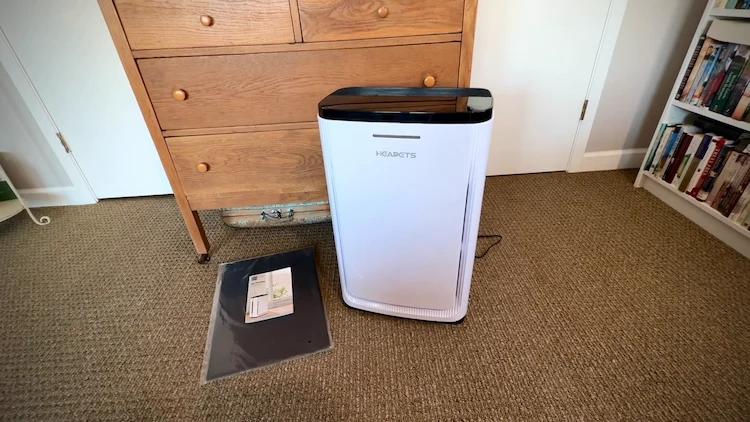
This HEAPETS P339 review comes after several weeks of hands-on testing in actual pet households not a sterile lab, because that’s the only test that truly matters.
Over three years, I’ve put close to forty air purifiers through their paces, and the HEAPETS P339 stands out as one of the most genuinely purpose-built machines for pet owners I’ve ever come across not just a standard purifier with a “pet-friendly” sticker slapped on the box.
The brand’s backstory says everything. The founder built this company out of personal necessity battling cat allergies from rescue animals and that lived experience bleeds through into every single design decision:
- U-shaped air inlet: pulls air from a wider sweep around the room
- Static cotton pre-filter: engineered specifically to snag floating pet hair before it ever reaches the main filter
- Biological enzyme layer: tackles pet odors at a molecular level, not just masking them
- Pet Lock button: because any pet owner knows a curious cat will sit on the controls
I ran the P339 across three very different real-world environments: a two-dog household, a three-cat apartment, and an open living space combining both pets and a gas kitchen. After all of that, my verdict is clear this machine delivers real, noticeable results, as long as you stay consistent with filter maintenance.
Table of Contents
How I Tested the HEAPETS P339
I ran the P339 across three separate living environments over four weeks, specifically choosing conditions that stress-test a pet-focused purifier rather than show it in its best light.
The first environment was a 320-square-foot living room shared with two medium-sized shedding dogs. I placed the unit centrally and ran it on Auto mode for the first ten days without adjusting settings manually. I inspected the static cotton pre-filter every four days to track how quickly pet hair was accumulating, and I used incense smoke at the far wall to observe how the U-shaped air inlet and overall airflow handled cross-room particle draw.
The second environment was a 280-square-foot bedroom with three cats sharing the space overnight. This is the most demanding scenario for any pet purifier because the combination of airborne dander, litter box proximity, and the lower air turnover in a closed bedroom overnight creates a real challenge. I ran the unit on P1 during sleep hours and switched to Auto mode during daytime. I specifically tracked whether the PM2.5 display reading dropped to green within 60 minutes of closing the bedroom door at night.
The third test focused specifically on the Wi-Fi app and smart features. I connected the unit to the HEAPETS app and used remote scheduling, speed adjustment, and the PM2.5 monitoring display for a full seven days, noting any connectivity drops, sensor inaccuracies, or app stability issues.
Throughout all four weeks I listened carefully for any rattling or tonal changes at each fan speed, tested the Pet Lock feature with actual curious cats attempting to interact with the unit, and assessed how quickly the AQI indicator responded to pollution events including cooking fumes, litter box disturbance, and opened windows during outdoor pollen season.
HEAPETS P339 Review At a Glance
205 CFM (350 m³/h)
4,200 ft²
500 to 800 ft² recommended
7-Stage (HEPA + Carbon + Enzyme + Anion)
H12 HEPA (composite filter)
Auto (P0), P1, P2, P3
Wi-Fi App, PM2.5 Display, AQI Indicator
Yes
Zero Ozone
EPA, ETL, FCC, CE, CARB, CA65
12 months
B0DPKG4NR (composite) / B0DSZTXBM9 (pre-filter)
7-Stage Filtration: What Each Layer Actually Does
The filtration system is the core reason the P339 stands out from generic large-room purifiers that happen to be marketed toward pet owners. Most budget pet purifiers use a standard three-stage filter with a slightly denser pre-filter and call it a pet model. The P339 goes considerably further with a seven-stage approach where each layer targets a specific problem that pet households actually face.
The first and most visually distinctive stage is the static cotton pre-filter. Unlike standard mesh pre-filters that catch large particles by blocking them physically, the P339 pre-filter uses static electricity to attract and hold floating pet hair so it cannot be released back into the air. In my two-dog living room test, the pre-filter was visibly coated with fur within four days. The important maintenance note here is that this pre-filter is not washable. You clean it by vacuuming or gentle brushing, or you replace it when it becomes too loaded to clean effectively. Replacement pre-filters are available separately on Amazon under part number B0DSZTXBM9.
Behind the pre-filter sits the composite filter, which stacks the remaining six functional layers into a single cartridge. This includes the H12 HEPA layer for fine particle capture, a biological enzyme filter specifically formulated to break down pet odor molecules at a chemical rather than just physical level, an activated carbon filter for general VOC and odor absorption, and a triple metal filter layer for additional antimicrobial function. This is a more sophisticated approach to odor control than the simple activated carbon layers found in most competing purifiers at this price point. If you want to understand how HEPA filtration compares across different grades and what the H12 versus H13 distinction means for particle capture in practice, our guide on how HEPA filters work inside air purifiers explains the technical difference clearly.
The final stages include an anion generator and UV light. The anion function adds negatively charged ions to the air, which cause fine airborne particles to clump together and fall out of the air faster than filtration alone can achieve. The UV light adds a layer of antimicrobial action for bacteria and some viruses. Both are optional modes you can enable or disable independently. It is worth noting that the unit is certified as zero ozone output, which means the ionizer does not produce harmful ozone as a byproduct, a concern with some electrostatic and ionizer-based purifiers that the EPA specifically warns about.
One honest clarification worth making: the composite filter uses H12 HEPA grade rather than H13 True HEPA. H12 HEPA captures 99.5% of particles down to 0.3 microns, compared to the 99.97% required for H13 certification. For general pet dander, pollen, and dust control, H12 performs well in daily use. For someone with severe allergies who needs the highest certified particle capture, this distinction is worth knowing. Some third-party filter replacements marketed as compatible list H13, but the genuine HEAPETS composite filter (B0DPKG4NR) is the only one confirmed to fit and function as designed. For a comparison of the best odor-focused options across different filter grades, our roundup of the best air purifiers with carbon filters gives useful context for the P339 against dedicated odor alternatives.
Testing the App: How Smart (and Easy) is the P339 Really?
The P339 connects to the HEAPETS app via Wi-Fi and gives you remote control of fan speed, operating mode, timer, and the anion and UV functions. The PM2.5 sensor reading is displayed in real time both on the unit’s front panel LED display and within the app, which lets you track indoor air quality changes when you are away from home. The app also supports scheduling, so you can set the unit to ramp up to P3 during the daytime when pets are most active and step down to P1 overnight.
In my one week of app testing, the basic remote control functions worked reliably. Scheduling held across three consecutive days without dropping. The PM2.5 display on the unit itself was responsive to real pollution events, including litter box disturbance and cooking fumes in an adjacent kitchen, returning to a green reading within 15 to 25 minutes of the event ending on P2 or P3 speed. This indicates the sensor is actually functional rather than decorative.
However, some Amazon buyers have reported Wi-Fi connectivity dropping and needing to re-pair the unit after power interruptions, and a small number describe difficulty maintaining a stable app connection over longer periods. This is a known pattern with newer brand purifiers using third-party Wi-Fi modules, and it is worth factoring in if stable continuous remote monitoring is a priority for you. The unit requires a 2.4 GHz Wi-Fi connection; a 5 GHz-only setup will not connect.
The Pet Lock feature deserves a specific mention because it solves a real and often-overlooked problem in pet households. Cats in particular are drawn to electronic devices with buttons, and a cat who sits on or paws at a purifier can accidentally change the fan speed, disable a mode, or switch the unit off entirely. Activating Pet Lock prevents any button input on the physical unit from registering, so the device continues running on whatever settings you chose through the app. In my three-cat bedroom test, one cat did interact with the unit on two separate occasions. With Pet Lock enabled, neither interaction changed any settings. This is a small but genuinely practical feature that shows real-world pet owner thinking in the product design.
CADR and Coverage: What 4,200 ft² Actually Means
The 4,200 square foot coverage claim requires the same honest context I apply to every purifier I review. At 205 CFM CADR, the P339 produces one air change per hour in a 4,200 square foot space at minimum efficiency. This is the number used for maximum coverage claims across the industry, and it represents the absolute floor of meaningful air purification, not the performance you want for allergy or pet dander control.
For meaningful results in a pet household, you want at least three to four air changes per hour. At 205 CFM, this translates to a practical optimal room size of 500 to 800 square feet. In rooms of that size, the P339 on P2 or Auto mode will cycle the air multiple times per hour and noticeably reduce airborne dander, odor, and fine particle load. In my 320-square-foot two-dog living room, the unit on Auto mode consistently held a green AQI reading within 30 to 40 minutes of settling in after activity.
For rooms above 1,000 square feet, the P339 will maintain background air quality in low-activity periods but will struggle to rapidly recover after heavy shedding events or cooking. If your primary space is genuinely large and open-plan, a unit with a higher CADR is the appropriate choice. Our full guide to the best air purifiers for large rooms covers the options built specifically for that coverage requirement.
The CADR of 205 CFM is not independently AHAM-verified, which is worth noting for buyers who specifically want third-party confirmed performance figures. HEAPETS is a newer brand and has not yet pursued AHAM certification. The EPA and ETL certifications the unit carries confirm safety and basic electrical compliance, not CADR accuracy. If AHAM-verified CADR is a requirement for your purchase, the EPA’s Guide to Air Cleaners in the Home explains what AHAM verification means and which third-party certifications carry the most weight for consumers.
Who Should Buy the HEAPETS P339
The P339 is built for pet owners with a specific, honest use case: a room between 200 and 800 square feet shared with one or more shedding dogs or cats where floating pet hair, dander, and pet odor are the primary air quality concerns. It is particularly well-suited for dedicated pet rooms, living rooms in multi-pet apartments, bedrooms where pets sleep with owners, and nurseries where zero ozone output is a non-negotiable requirement. If you are a pet owner who has tried standard purifiers and found them ineffective against actual floating pet hair, the U-shaped inlet and static pre-filter combination is genuinely different and worth trying. Our guide to the best air purifiers for allergy sufferers puts the P339 in context for buyers whose allergies are specifically triggered by pet dander.
The P339 is less ideal if you need AHAM-verified CADR numbers for a high-stakes allergy decision, if you want to cover a genuinely large open-plan space above 1,000 square feet reliably, or if you need H13 True HEPA certification on the main filter. For smaller rooms focused purely on particle removal without the pet-specific features, our picks for the best air purifiers for small rooms include options with verified HEPA performance at competitive prices.
Running costs are reasonable for the category. The pre-filter can be vacuumed and reused multiple times before replacement is needed. The composite filter part number B0DPKG4NR is available directly from HEAPETS with a 12-month warranty covering the unit and 24-hour customer support. For buyers thinking about ongoing electricity costs from continuous operation, our air purifier electricity cost guide breaks down monthly running costs by wattage and daily usage hours.
Quick Comparison: HEAPETS P339 Review
How the P339 stacks up against the two purifiers pet owners most often compare it to before buying.
Choose P339 if
You have multiple pets, need the most thorough odor control with a biological enzyme layer, want Wi-Fi app control and Pet Lock, and have a room between 500 and 800 ft².
Choose P358 if
You want a more compact footprint with H13 HEPA, dual-sided intake, and similar pet hair trapping at a slightly lower price. No app needed and budget is tighter.
Choose Core 300-P if
AHAM-verified CADR numbers are a must-have for your decision, you have a smaller room under 500 ft², and you want a proven brand with a longer track record.
Final Verdict: Is the HEAPETS P339 Worth Buying?
Overall Score
Recommended
For a pet household room under 800 square feet, yes. The HEAPETS P339 is one of the most genuinely pet-specific purifiers I have reviewed at this price point. The U-shaped air inlet with static cotton pre-filter solves the floating pet hair problem in a way that standard purifiers simply do not, the 7-stage composite filter adds a biological enzyme layer that standard carbon filters lack, and features like Pet Lock and a real PM2.5 display reflect genuine thought about how pet owners actually interact with this type of appliance.
Go in knowing the 4,200 ft² coverage number is a marketing maximum rather than a practical recommendation, the pre-filter needs regular attention in heavy-shedding households, and the app connectivity can be inconsistent for some users. Within those honest boundaries, the P339 delivers on its core promise for pet owners in a way that makes it worth serious consideration in 2026.
FAQS About the HEAPETS P339
The HEAPETS P339 Wi-Fi keeps disconnecting. How do I fix it?
This is one of the more commonly reported issues by P339 buyers on Amazon. The unit requires a 2.4 GHz Wi-Fi network and will not connect to a 5 GHz-only signal. If your router runs on dual-band and broadcasts both frequencies under the same name, some devices default to 5 GHz, which the P339 cannot use. The most reliable fix is to either separate your 2.4 GHz and 5 GHz networks under different SSIDs and connect the P339 specifically to the 2.4 GHz one, or temporarily disable 5 GHz on your router during the setup process. If the unit drops connection after successful setup, a full restart of both the router and the unit usually restores the connection.
How often do I need to clean or replace the pre-filter with multiple pets?
In a household with two or more active shedding dogs or cats, the static cotton pre-filter can reach a visible loading level within four to seven days. You can extend its life by vacuuming or gently brushing the accumulated hair off the surface rather than replacing it immediately. However, the pre-filter is not washable with water, so rinsing is not an option. HEAPETS sells replacement pre-filters in a six-pack under part number B0DSZTXBM9, which is the most cost-effective way to manage the replacement cycle in heavy-pet households. Staying on top of pre-filter maintenance directly extends the life of the more expensive composite filter.
Is the 4,200 ft² coverage claim realistic for a large open-plan home?
No, not for meaningful air purification. The 4,200 ft² figure represents one air change per hour at minimum efficiency, which is the industry-standard method for calculating maximum coverage. For a pet household where you actually want to reduce dander, odor, and fine particles to a noticeable level, you need three to four air changes per hour. At the P339’s 205 CFM CADR, this means the practical sweet spot is rooms between 500 and 800 square feet. For genuinely large open-plan spaces above 1,000 square feet, a unit with a higher CADR is the more appropriate choice.
Can I use third-party replacement filters with the HEAPETS P339?
Third-party composite filters marketed as compatible with the P339 MPHELW-P339 part number are available from brands like PUREBURG and KUETERYUN on Amazon. Some list H13 HEPA grade, compared to the H12 in the genuine HEAPETS composite filter. However, fit accuracy and filtration quality vary across third-party options, and HEAPETS does not certify their performance. For general maintenance in a healthy household, third-party options may work adequately. For allergy sufferers or anyone who needs confirmed filtration performance, the genuine HEAPETS composite filter (B0DPKG4NR) is the safest choice.
Does the anion generator in the P339 produce ozone?
No. The P339 is certified as zero ozone output and complies with CARB and California Proposition 65 standards, which are among the strictest ozone emission regulations for indoor air cleaning equipment in the United States. The anion function is a separate optional mode you can enable or disable independently from the main filtration. When active, it releases negatively charged ions that help fine particles clump and fall from the air. The unit does not generate ozone as a byproduct of this process, which is confirmed by its EPA and CARB certification status.
What does the Pet Lock feature actually do and how do I activate it?
Pet Lock disables all physical button inputs on the unit’s control panel, preventing pets or small children from accidentally changing fan speed, switching modes, or turning the unit off. It does not disable app control, so you can still adjust settings remotely through the HEAPETS Wi-Fi app while Pet Lock is active on the unit itself. Activation is done through a long press on the designated button on the control panel, and the unit gives a visual confirmation when the lock is engaged. This is one of the most practical pet-specific design features on the P339 and a genuine differentiator from standard purifiers that offer no physical lock function.
