If you own a Levoit air purifier or are thinking about getting one, you have probably seen the words “H13 True HEPA” printed on the box. But what does that label actually mean, and how does the filter inside your unit pull invisible particles out of the air you breathe every day? I have been testing air purifiers for years, and in this article I will explain exactly how Levoit HEPA filters work, what they capture, and where their real-world limits are so you can get the most out of your machine.
What Is a True HEPA Filter?
HEPA stands for High Efficiency Particulate Air. To qualify as True HEPA, a filter must capture at least 99.97% of airborne particles at the 0.3-micron size. Levoit uses H13 True HEPA filters across its core lineup, including the Core 300, Core 400S, and Core 600S. The H13 rating comes from the European EN 1822 standard and represents medical-grade filtration performance.
The 0.3-micron threshold is known as the Most Penetrating Particle Size (MPPS). Particles at exactly this size are the hardest to capture because they are too small for direct impaction but too large to move erratically on their own. Testing a filter at its worst-case size guarantees real-world performance for everything else. Particles larger or smaller than 0.3 microns are actually captured at an even higher efficiency rate, which surprises most people.
The 3-Stage Filtration System Inside Levoit Air Purifiers
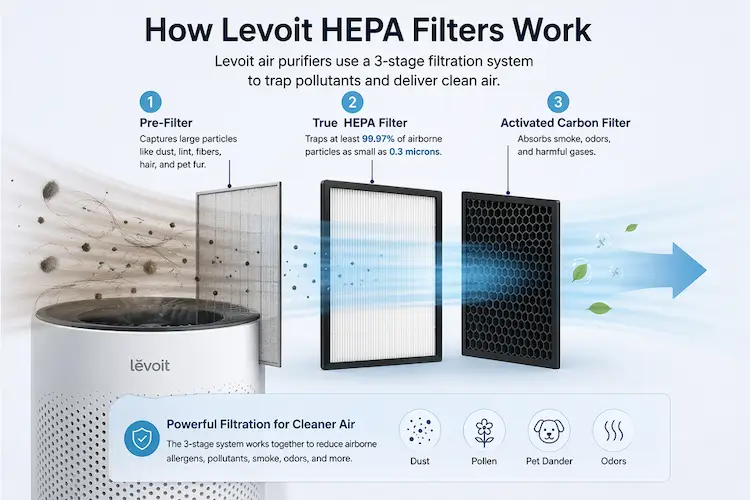
Levoit does not rely on the HEPA layer alone. Every unit in the core lineup runs air through three distinct stages, and each stage handles a completely different category of pollutant.
Stage 1: Pre-Filter. This outer mesh layer catches large visible particles like pet hair, lint, and dust clumps before they reach the more delicate HEPA media. Trapping these early extends the life of the main filter significantly. Most Levoit pre-filters can be gently vacuumed between full replacements.
Stage 2: H13 True HEPA Layer. This is the core filtration stage. It is responsible for capturing fine particles including pollen, smoke, pet dander, mold spores, and most airborne bacteria. The filter itself is made from a dense mat of randomly arranged glass fibers that work through multiple physical mechanisms rather than simple sieving.
Stage 3: Activated Carbon Layer. The final layer uses activated carbon to adsorb gases, odors, and volatile organic compounds (VOCs). This is the only stage that addresses chemical pollutants. Some Levoit models use a thin carbon coating while others like the Core 400S include a thicker pellet-based carbon bed for stronger odor and gas removal.
If you want to see how these filtration differences play out across actual models, our 2026 Levoit model comparison ranks every purifier by filtration performance, room size, and value.
The Four Mechanisms That Make HEPA Filtration Work
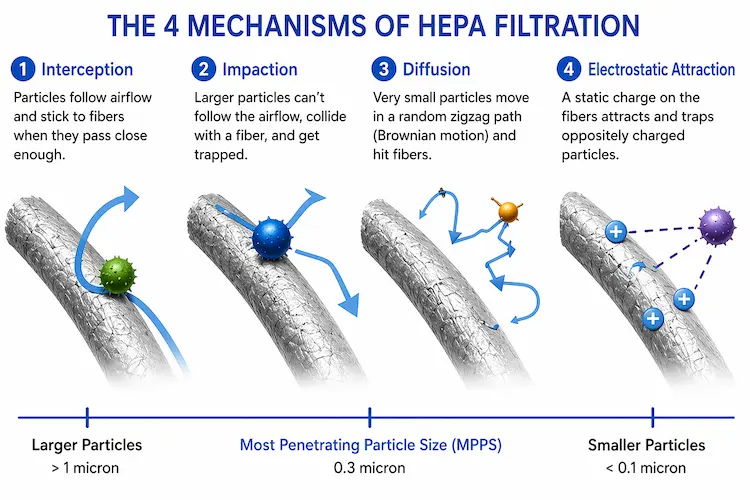
A HEPA filter does not work like a simple net that blocks particles bigger than its holes. The randomly arranged glass fibers inside use four distinct physical forces to capture particles of all sizes, including particles far smaller than the visible gaps between fibers.
Interception: Particles traveling in the airstream close to a fiber touch it and stick due to adhesion. This works best for medium-sized particles in the 0.5 to 1 micron range.
Impaction: Larger particles above 1 micron carry enough inertia that they cannot follow the curved airflow around a fiber. They fly straight, collide with the fiber, and get trapped.
Diffusion: Very small particles below 0.1 microns travel in a random zigzag pattern called Brownian motion rather than following the airstream. This erratic movement dramatically increases the chance of hitting a fiber. This is exactly why HEPA filters capture ultrafine particles so well despite those particles being smaller than the pores in the filter.
Electrostatic Attraction: Some Levoit HEPA filters carry a small static charge on their fibers. This charge pulls in oppositely charged particles and supplements the mechanical capture mechanisms above.
These four forces working in combination are why HEPA performance does not fall off sharply for very small particles. The MPPS at 0.3 microns sits in the gap where diffusion is just starting to take over from impaction, making it the single least-efficiently captured size. Everything else performs better by definition.
What Levoit’s H13 HEPA Filter Actually Captures
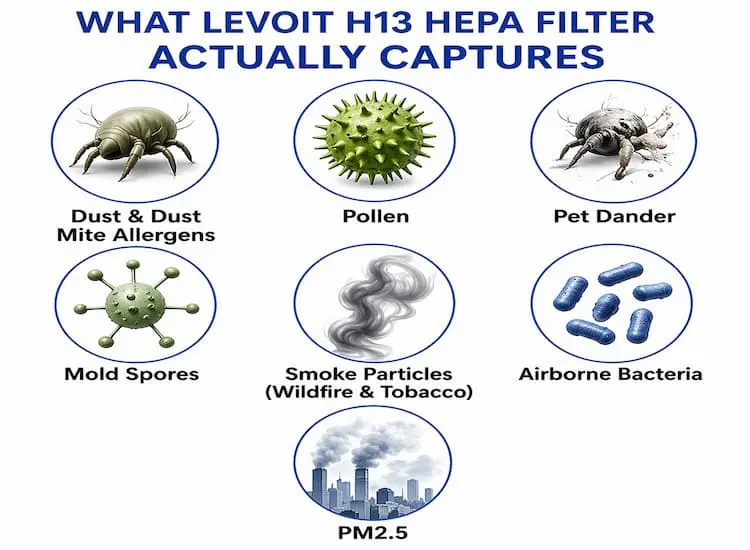
Based on published specifications and my own testing in real home environments, here is what the H13 HEPA layer in a Levoit unit reliably removes from the air:
- Dust and dust mite allergens (typically 1 to 10 microns)
- Pollen (10 to 100 microns, captured at very high efficiency)
- Pet dander (2.5 to 10 microns)
- Mold spores (2 to 20 microns)
- Wildfire and tobacco smoke particles (0.1 to 1 micron range)
- Most airborne bacteria (1 to 10 microns)
- Fine particulate matter classified as PM2.5
Levoit publishes CADR ratings for each model so you can match the unit to your room size accurately. The Core 300 carries a smoke CADR of 141 CFM, which covers rooms up to around 219 square feet. The Core 600S reaches a smoke CADR of 410 CFM and covers spaces up to 635 square feet. You can see how these numbers compare across brands in our full air purifier buying guide.
What Levoit HEPA Filters Cannot Remove
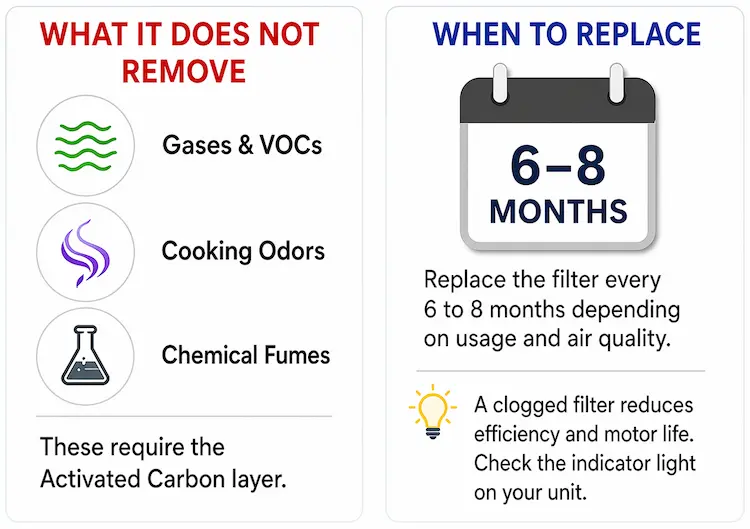
This is the point I stress most with readers because it creates real disappointment when expectations are wrong. The HEPA layer is a physical filter. It captures solid particles and liquid droplets. It cannot capture gases or molecular-level chemical compounds on its own.
If you are dealing with cooking smells, formaldehyde off-gassing from new furniture, cigarette odors, or VOCs from cleaning products, the H13 layer does nothing for those. That is the job of the activated carbon stage. Some Levoit models offer an optional ARC formula replacement filter with a higher-grade carbon bed for situations where chemical filtration is the main concern.
Viruses are worth addressing separately. A single virus particle measures between 0.02 and 0.3 microns, sitting at or below the MPPS. However, viruses in real indoor air rarely travel alone. They typically attach to respiratory droplets and aerosol particles that are much larger and easier to capture by impaction or interception. The EPA advises that HEPA air purifiers can help reduce airborne viral concentrations but should be used as one layer in a broader ventilation and hygiene strategy.
When to Replace Your Levoit HEPA Filter
evoit recommends replacing the combination filter every 6 to 8 months depending on usage intensity and local air quality. If you have pets, live near a highway, or run the unit on high speed for most of the day, plan for 6 months. If you use it lightly in a clean environment, 8 months is reasonable.
The filter indicator light on most Levoit models will notify you when it is time. Do not ignore this indicator for long. A clogged HEPA layer forces the motor to work harder, restricts airflow, and drops filtration efficiency below the H13 standard. Running a saturated filter is barely better than running no filter at all, and it shortens motor life in the process.
One thing to be clear about: the H13 HEPA filter in Levoit units is not washable. Wetting the glass fiber mat collapses its structure permanently and destroys its filtering ability. Only the outer pre-filter mesh can be lightly vacuumed. For more on how filter maintenance affects overall performance, see our comparison of HEPA vs carbon filters.
One practical thing to know: when your Levoit’s filter indicator light turns red, it doesn’t always mean the filter is ruined. Before replacing it, check our step-by-step red light reset guide.
FAQS About: Levoit Air Purifier HEPA Filter
Does Levoit use a real HEPA filter?
Yes. Levoit uses H13 True HEPA filters across its core product lineup. The H13 designation follows the European EN 1822 standard and certifies that the filter captures at least 99.97% of particles at the 0.3-micron MPPS size. This is the same filtration grade used in medical facilities and clean rooms.
Can a Levoit HEPA filter capture viruses?
The HEPA filter captures the airborne droplets and particles that viruses attach to, which helps reduce viral load in a room. Individual virus particles at the nanometer scale are partially captured through diffusion and electrostatic effects. The EPA recommends using HEPA air purifiers as part of a broader strategy that includes ventilation and hygiene, not as a standalone solution.
How long does a Levoit HEPA filter last?
Levoit recommends replacing the filter every 6 to 8 months. The exact timeline depends on how many hours per day the unit runs, your local air quality, and whether you have pets or smokers in the household.
Can I wash a Levoit HEPA filter?
No. The H13 True HEPA filter in Levoit units is not washable. Water destroys the glass fiber mat structure and permanently reduces filtration efficiency. Only the outer pre-filter mesh can be vacuumed gently. The main HEPA and carbon combination filter must be replaced on schedule.
Does the Levoit HEPA filter remove odors?
The HEPA layer alone does not remove odors. Odors are caused by gas molecules too small for physical filtration. Only the activated carbon layer in the 3-in-1 combination filter handles odors and VOCs. Because Levoit bundles both layers into a single replacement unit, one filter change addresses both particles and odors at the same time.