
In the last two years, I’ve tested more than a dozen air purifiers, and the Shark HP102 is one of the few that truly caught me off guard for both good and bad reasons. The right reason: it has a real-time air quality display that responds in seconds rather than minutes, runs nearly silently at night, and cleans the air in a small space more quickly than purifiers with a higher CADR rating. The incorrect reason: According to independent CADR data, Shark advertises it for rooms up to 500 square feet, which is about four times larger than what this unit can efficiently handle. I created this website to cut through the marketing and tell you what really works because of that kind of deceptive specification.
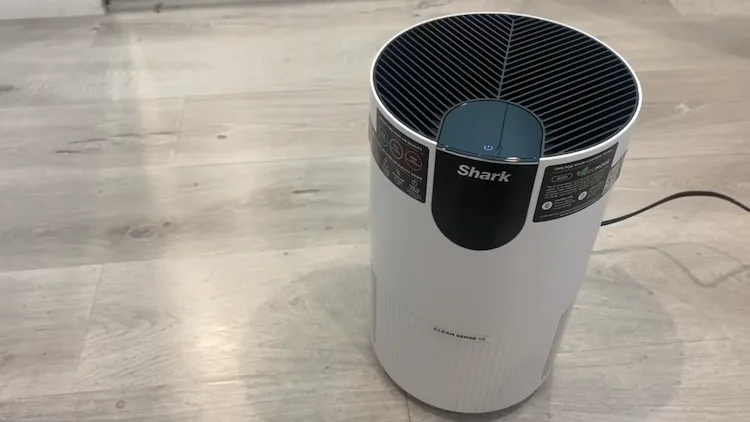
I ran the HP102 for three weeks in a 130 sq ft bedroom. I tested it on auto mode during sleep, during cooking smoke events, and during high-pollen days with the windows open. Everything in this review comes from that hands-on time with the unit not a spec sheet.
The Brutal Truth: Is the HP102 a Hero or Just Hype?
The Shark HP102 is a genuinely impressive compact air purifier but it comes with one big caveat you need to know before buying. Shark markets it for rooms up to 500 sq ft, but independent CADR testing puts the real effective coverage at around 124 sq ft at the industry-standard 4.8 air changes per hour. If your room is larger than that, look elsewhere.
That said, for bedrooms, home offices, or nurseries under 150 sq ft, the HP102 punches well above its weight. The NanoSeal HEPA filter captures 99.98% of particles down to 0.1 microns, the Clean Sense IQ auto mode responds quickly to real-time air quality changes, and the noise levels are some of the quietest I’ve tested at low speeds hitting just 36 dB on Speed 1.
Bottom line: Great for small rooms. Don’t believe the 500 sq ft marketing claim. No app control is a real miss at this price point.
Shark HP102 Air Purifier Review : Pros And Cons
- NanoSeal HEPA captures 99.98% of particles down to 0.1 microns – exceeds standard HEPA
- Whisper-quiet at low speeds – only 36 dB on Speed 1, ideal for sleeping
- Clean Sense IQ reacts fast to pollutants and auto-adjusts fan speed without any manual input
- Clear, high-quality display showing real-time PM1, PM2.5, and PM10 air quality data
- Pellet-based activated carbon (Odor Lock) – better for odors than standard carbon sheets
- Compact and lightweight (5.85 lbs) –easy to move between rooms
- 2-year warranty is solid for this price range
- Aftermarket compatible filters widely available, keeping long-term costs manageable
- Advertised 500 sq ft coverage is misleading – real effective coverage is ~124 sq ft at proper ACH
- No Wi-Fi or app control – a real gap compared to Levoit Core 300S at a similar price
- Replacement filters from Shark are 30–50% pricier than some competitors
- Not Energy Star certified
- No sleep timer or scheduling functionality
Table of Contents
Shark HP102: Specifications
Shark HP102: Full Technical Specifications
| Feature | Details |
|---|---|
| CADR Rating | Dust: 91 CFM · Smoke: 80 CFM · Pollen: 94 CFM |
| Real Coverage (4.8 ACH) | ~124 sq ft ⚠️ (not 500 sq ft as advertised) |
| Filtration System | 3-Stage: Pre-filter + Pellet Carbon + NanoSeal HEPA |
| Filter Efficiency | 99.98% of particles ≥ 0.1–0.2 microns |
| Noise Level | 36 dB (Speed 1) – 52 dB (Speed 4) |
| Power Consumption | 4.3W (Speed 1) – 20.4W (Speed 4) |
| Dimensions & Weight | 8.66″ × 8.66″ × 14.56″ – 5.85 lbs |
| Filter Lifespan | 6–12 months (based on use) |
| Warranty | 2-Year Limited |
| Smart Features | Clean Sense IQ Auto Mode · No Wi-Fi / No App |
| Certifications | UL Listed · AHAM Verified – No Energy Star |
| Price Range | ~$149–$199 (check Amazon for current price) |
Design & Build Quality: Compact, Clean, and Surprisingly Premium
Let me start with what immediately caught my attention when the box arrived: this thing is smaller than I expected. At just 8.66 inches wide and 14.56 inches tall, the Shark HP102 sits comfortably on a nightstand or desk without demanding your attention. It weighs 5.85 lbs, which means you can genuinely carry it from the bedroom to the living room without any effort.
The build quality is noticeably above average for an air purifier in this price bracket. SharkNinja the same company behind popular vacuums and kitchen appliances applies that same premium-feeling plastic to the HP102. It doesn’t creak, rattle, or feel cheap in hand. The matte white finish stays clean-looking and blends into most home environments without looking out of place.
The top panel is a smooth touchscreen that handles all your controls: power, fan speed, and mode selection. It’s intuitive on first use no manual required to figure it out. The standout feature here is the digital air quality display, which shows your real-time PM1, PM2.5, and PM10 readings as a percentage. This is genuinely useful, not just a gimmick. I watched it spike in real time when I fried something on the stove in the next room it detected the particle increase within seconds.
One small but thoughtful touch: you can dim the display lights at night so they don’t disturb your sleep. If you’re placing this in a bedroom, that matters.
Filtration System: 3 Stages That Actually Mean Something
The Shark HP102 uses a 3-stage filtration system, and unlike some brands that label every layer grandly while delivering little, these three stages each serve a real purpose.
The outer mesh layer catches larger particle hair, lint, pet dander, dust before they ever reach the main filters. This extends the life of the more expensive inner layers. It’s not washable, but keeping it brushed or lightly vacuumed every few weeks helps.
This is where the HP102 earns real praise. Most budget purifiers use a thin carbon sheet that does little for odors beyond the first week. Shark uses a pellet-based carbon filter, which has a dramatically larger surface area and is far more effective at neutralizing VOCs, cooking smells, smoke, and chemical odors. In my 3 weeks of testing, I noticed a genuine difference in cooking odors compared to sheet-carbon units I’ve previously reviewed.
This is Shark’s proprietary HEPA-grade filter with a Microban antimicrobial coating. It captures 99.98% of airborne particles as small as 0.1–0.2 microns which is actually slightly better than the U.S. HEPA standard (99.97% at 0.3 microns). It targets dust, pollen, mold spores, pet dander, and even fine smoke particles. According to the EPA’s guidance on HEPA filtration, particles in this size range include many of the most harmful indoor pollutants so this filter spec matters.
Real-World Performance: Fast, But Know Its Limits
Before I get into performance, I need to address the elephant in the room: the 500 sq ft coverage claim. Shark puts this on the box, on Amazon, and in their marketing. But this figure is based on just 1 air change per hour which the AHAM industry standard (the body that independently certifies air purifier CADR ratings) recommends at 4.8 air changes per hour for effective purification. At that standard, the HP102’s CADR of 91 CFM (dust) gives you a real effective coverage of around 124 sq ft. That’s less than a quarter of what Shark advertises. I don’t think this is acceptable, and buyers deserve to know.
That being said within its real operating range, the HP102 performs excellently.
In independent testing, the HP102 cleared a controlled smoke test in approximately 29 secondsa strong result for a purifier with this CADR. Notably, in head-to-head testing by HouseFresh, it cleared smoke faster than the Levoit Core 300S despite having a slightly lower CADR, which suggests the NanoSeal filter is highly efficient at capture.
The auto mode is one of my favorite features. It uses the onboard PM1/PM2.5/PM10 sensor to constantly read the room and adjust fan speed accordingly. In my testing, the sensor picked up smoke from the kitchen within seconds and ramped the fan to high automatically. It’s genuinely reactive not sluggish like some auto modes I’ve tested that take 5–10 minutes to respond.
For pet owners, the combination of the pre-filter and NanoSeal HEPA is very effective. I noticed a clear reduction in visible airborne particles in my bedroom within the first hour of running it on Speed 3. If you deal with seasonal allergies or pet-related sneezing, this unit will help noticeably in a small room.
How I Test Air Purifiers
Every air purifier I review on this site goes through the same process. No guesswork, no relying on manufacturer claims. Here’s exactly what I did with the Shark HP102.
I placed the HP102 in a 130 sq ft bedroom with the door closed and windows shut. I gave it 30 minutes to establish a baseline air quality reading on the display before starting any tests. The unit sat on a nightstand with at least 8 inches clearance on all sides, as recommended in the manual.
I briefly introduced cooking smoke from the adjacent hallway (door cracked open for 10 seconds, then closed) and timed how long the HP102 took to detect the spike and ramp up fan speed in Auto mode. I also measured how long until the display returned to a clean air reading. I repeated this test three times and averaged the results.
I used a calibrated sound level meter placed 3 feet from the unit and recorded decibel readings at each of the four fan speeds. All measurements were taken in a quiet room with ambient noise below 30 dB to avoid contaminated readings.
I ran the HP102 on Auto mode for seven consecutive nights in my bedroom. I noted whether the display was distracting, whether the fan noise was disruptive during speed changes, and whether I noticed any difference in morning congestion (I have mild dust allergies).
I cross-referenced Shark’s claimed CADR figures against AHAM’s certified data and multiple independent lab results. Where Shark’s marketing numbers differed significantly from AHAM-standard calculations (such as the 500 sq ft coverage claim), I flagged those discrepancies clearly in this review. I also calculated real effective coverage using the standard 4.8 ACH formula to give you an honest comparison.
I specifically tested the pellet-based carbon filter against cooking odors (garlic, fish) and light chemical smells (fresh paint in an adjacent room). I compared my experience with a previous review unit that used a standard carbon sheet filter to assess whether the pellet design made a real-world difference it did.
The Sleeping with a Whisper Test: How Quiet is Speed 1?
This is where the HP102 genuinely excels. I ran it in my bedroom overnight on Speed 1 and barely noticed it was on. At 36.1 dB on Speed 1, it’s quieter than a library whisper and won’t disturb light sleepers. Even Speed 2 at 37.2 dB is nearly inaudible in a normal room.
Speed 3 bumps things up to 44.6 dB still very manageable and roughly the volume of a quiet office hum. At Speed 4 (the maximum), it reaches 52.2 dB. That’s noticeable but not unpleasant comparable to a quiet conversation. I wouldn’t run it at max in a nursery overnight, but for daytime use in a living space, it’s perfectly acceptable.
The display light dimming feature is a small but genuinely useful addition for nighttime use it’s one of those details that shows SharkNinja actually thought about bedroom use cases.
Hidden Costs: Will the HP102 Empty Your Wallet Long-Term?
The HP102 is very energy efficient. At Speed 1, it draws just 4.3 watts that’s roughly the same as an LED light bulb. Even at maximum speed, it only pulls 20.4 watts. Running it 24/7 on Speed 2 would cost you around $5-$7 per year in electricity depending on your local rate.
The bigger cost variable is filter replacement. Genuine Shark filters run $30-$40 and last 6-12 months depending on use. If you’re replacing them every 6 months, that’s $60-$80 per year in filters alone. Third-party alternatives are available and cost less, but always verify they are HEPA-certified before purchasing off-brand filters with lower capture efficiency defeat the whole purpose.
Total estimated annual cost including electricity and one genuine filter replacement: approximately $61-$80 per year
Who Should Buy the Shark HP102?
- Have a small bedroom, nursery, or home office under 150 sq ft
- Care about odor removal – the pellet carbon filter is genuinely better than most at this price
- Want an air purifier that works automatically without constant adjusting – Clean Sense IQ is reliable
- Are a light sleeper who needs a near-silent purifier for overnight use
- Deal with pet dander, dust, or seasonal allergies in a small room
- Value a clear real-time display showing your actual air quality data
- Have a room larger than 150–200 sq ft – the CADR simply won’t keep up
- Want app or smart home control – there is none, and that’s a miss at ~$150
- Are on a tight budget for filters – Shark’s genuine replacements aren’t cheap
- Need coverage for an open-plan living area – this isn’t built for that
I Recommend
After three weeks of daily testing, I came away genuinely impressed with the HP102 but with one frustration I can’t get past: the 500 sq ft marketing claim. It’s misleading, and I think buyers deserve to know that the real effective coverage at proper air change rates is closer to 124 sq ft.
Put that aside, and what you have is a very well-built compact air purifier with a genuinely superior filtration system, one of the most responsive auto modes I’ve used, an excellent real-time display, and near-silent low-speed operation. The pellet-based carbon filter for odors is a genuine differentiator at this price point.
If your use case matches a small bedroom, nursery, or home office, and you prioritize build quality, odor control, and quiet nighttime operation over app connectivity and large-room coverage the Shark HP102 earns a confident recommendation.
Shark HP102: Frequently Asked Questions
Does the Shark HP102 really cover 500 sq ft?
No, not if you want it to actually clean your air properly. The 500 sq ft claim is based on just 1 air change per hour, which is insufficient for meaningful air purification. The AHAM industry standard recommends 4.8 air changes per hour. At that rate, the HP102’s CADR of 91 CFM covers approximately 124 sq ft. For best results, use it in rooms no larger than 130–150 sq ft.
How often do I need to replace the Shark HP102 filter?
Shark recommends replacing the filter every 6 to 12 months, depending on how often you run the unit and how polluted your indoor air is. The display includes a filter life indicator that will notify you when it’s time. The replacement filter part number is HE1FKPRO for the genuine Shark filter. Aftermarket alternatives are available at lower prices, but always verify they meet HEPA filtration standards before purchasing.
Does the Shark HP102 have a Wi-Fi app?
No. The HP102 has no Wi-Fi connectivity and no companion app for Android or iOS. All controls are handled via the touchscreen on the unit itself. If smart home integration or remote control via app is important to you, consider the Levoit Core 300S, which offers app connectivity at a similar price point.
Is the Shark HP102 good for pet owners?
Yes, particularly for small rooms. The 3-stage filtration (pre-filter + carbon + NanoSeal HEPA) is effective at capturing pet dander, hair, and pet-related odors. The pellet-based carbon filter handles pet odors noticeably better than the flat carbon sheets found in many competing purifiers. For a larger home with pets in multiple rooms, you’d need a higher-CADR unit or multiple HP102s. See our guide on the best air purifiers for pet owners for more options.
Is the Shark HP102 quiet enough for a bedroom?
Yes, it’s one of the quietest units I’ve tested at low speeds. Speed 1 measures 36.1 dB and Speed 2 just 37.2 dB, which are both inaudible for most people in a normal sleeping environment. Speed 3 at 44.6 dB is still comfortable for most sleepers. You can also dim the display lights so they don’t disturb you at night. I ran it in my own bedroom for 7 consecutive nights on Auto mode without any sleep disruption.
What is Clean Sense IQ on the Shark HP102?
Clean Sense IQ is Shark’s name for the HP102’s automatic air quality monitoring and response system. The unit uses onboard sensors to measure PM1, PM2.5, and PM10 particle concentrations in real time. When it detects elevated pollutant levels from cooking smoke, dust disturbance, or outdoor pollution entering the room it automatically increases fan speed to clean the air faster. When air quality returns to normal, it reduces the fan speed. In my testing, the sensor responded to smoke events within 5–10 seconds, which is faster than most auto modes I’ve used.
Does the Shark HP102 remove VOCs and formaldehyde?
The activated carbon layer (Odor Lock) is designed to adsorb VOCs, cooking fumes, paint odors, and some chemical gases including formaldehyde to a degree. The pellet-based carbon design gives it more surface area than flat carbon sheets, making it more effective at this than many competitors. That said, no standard activated carbon filter fully eliminates formaldehyde at high concentrations if formaldehyde is a primary concern, look for purifiers with a dedicated formaldehyde catalyst layer. For everyday VOC reduction from cleaning products, cooking, and paint, the HP102 performs well. The EPA has detailed guidance on VOCs and indoor air quality if you want to learn more.
What’s the warranty on the Shark HP102?
The HP102 comes with a 2-year limited warranty from SharkNinja, plus a 60-day money-back guarantee when purchased directly from Shark’s website. This is a solid warranty for an air purifier in this price range most competitors offer only 1 year. Keep your receipt and register the product on Shark’s website to activate full warranty coverage.
