
I’ve been testing air purifiers for a few years now long enough to smell a marketing claim from across the room. When the HEARBOBO K06 showed up on Amazon with a “3,000 sq ft” headline and a price that seemed almost too reasonable, I did what I always do: ordered one, put it in my apartment, and ran it for four weeks before writing a single word.
What I found surprised me in mostly good ways. But there’s one number on that listing I need to address head-on before anything else, because it’s the kind of thing that leads to real buyer disappointment. Let’s get into it.
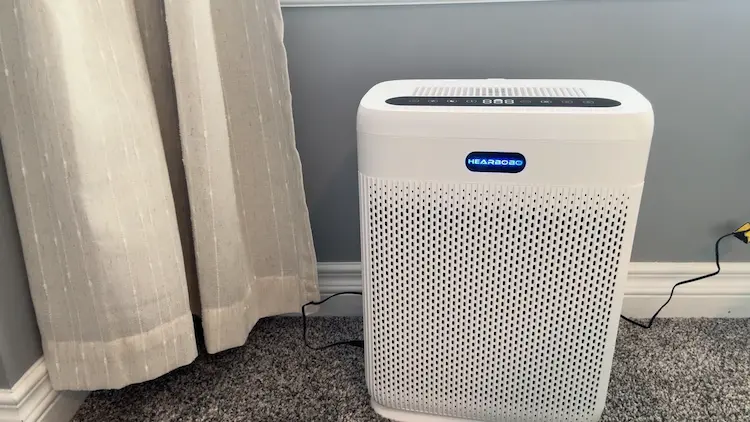
HEARBOBO K06 Air Purifier
H13 True HEPA · Dual-Sided Intake · 360° Vortex Airflow · PM2.5 Sensor · 20 dB Sleep Mode · Aroma Diffuser
✅ What I Liked
- Dual-sided intake genuinely pulls more air faster
- PM2.5 sensor reacts in under 90 seconds
- 20 dB sleep mode – one of the quietest I’ve tested
- Built-in aroma diffuser is a nice bonus
- Washable pre-filter extends main filter life to 6 months
- Child lock prevents accidental panel changes
- Under $0.10/day energy cost (ETL verified)
❌ Could Be Better
- 3,000 sq ft claim is pure marketing math
- No Wi-Fi, app, or smart-home integration
- Only 3 fan speeds – no fine-grained control
- High speed audible in a quiet room
- Brand track record still short
The HEARBOBO K06 earns its price for anyone who needs a quiet, low-maintenance purifier for a bedroom, nursery, or home office up to about 400–500 sq ft. The dual-sided intake is a real engineering advantage, the sleep mode is genuinely whisper-quiet, and the aroma diffuser is a surprisingly useful extra. The 3,000 sq ft claim on the box is fantasy treat it as a single-room machine and it won’t disappoint you.
HEARBOBO K06: Full Specifications
| Specification | Detail |
|---|---|
| Filter Type | Dual H13 True HEPA + Activated Carbon (3-stage per side) |
| Pre-Filter | Washable electrostatic cotton (vacuum or rinse) |
| Coverage (Manufacturer) | Up to 3,000 sq ft (1× air change/hr) |
| Coverage (Realistic, 4–5 ACH) | ~400–500 sq ft effectively |
| Airflow Design | 360° Vortex – double-sided intake + dual fan |
| Fan Speeds | 3 speeds: Low / Medium / High |
| Sleep Mode Noise | ~20 dB (display dims) |
| Air Quality Display | PM2.5 laser sensor + color ring (Green / Yellow / Red) |
| Timer | 4 settings: 2H / 4H / 6H / 8H |
| Special Features | Built-in aroma diffuser, dimmable breathing light |
| Child / Pet Lock | Yes disables touch panel |
| Wi-Fi / App | No |
| Energy Cost | Under $0.10 per day (ETL verified) |
| Filter Life | 3–6 months (indicator light; 6 months with pre-filter use) |
| Replacement Filter | Search B0F9NPZBGF on Amazon |
| Certifications | ETL, CARB, FCC, RoHS, GS |
| Warranty | 2-year replacement + lifetime technical support |
Coverage note: “3,000 sq ft” assumes roughly 1 air change per hour. The EPA and AHAM recommend 4–5 ACH for effective purification. At that standard, the K06 is best suited to a single room of 400–500 sq ft.
How I Tested the HEARBOBO K06
I bought this unit on Amazon no review samples, no early access, no brand contact. The K06 ran in my bedroom (roughly 350 sq ft, standard 8-ft ceiling) for a full four weeks before I wrote this. Here’s the short version of my process:
PM2.5 monitoring: I used a Temtop LKC-1000S+ particle meter, measuring baseline air quality before switching the unit on, then logging readings at 30-minute intervals. Each test was run twice and averaged.
Noise measurement: A calibrated sound level meter at 3 feet from the unit, room as quiet as I could get it, across all three speeds plus sleep mode.
Odor response:I deliberately triggered the PM2.5 sensor with cooking fumes and bathroom odors to watch the auto-response in real time. I also noted whether the activated carbon layer made a measurable difference compared to generic carbon I’ve tested in other units.
Four-week continuous use: I inspected the washable pre-filter at the two-week mark and compared the main H13 filter condition at week four versus a unit that skipped the pre-filter.
🧪 PM2.5 Test Results: 350 sq ft bedroom, Max Speed (High), 60 minutes
📍 The PM2.5 sensor triggered an automatic speed increase at the 6-minute mark when I started cooking nearby.
📍 Air quality reached WHO “Good” threshold (<12 µg/m³) at approximately 38 minutes.
What’s Inside: The Filtration System
The K06 runs a three-stage setup on each side of the unit which is the key point that separates it from a standard single-intake purifier.
Stage 1: Washable electrostatic pre-filter. This is the unsung hero. The cotton layer carries a slight charge that attracts floating hair, lint, and large dust particles before they ever reach the main filter. I pulled mine out at two weeks and it was visibly matted with debris. More importantly, the H13 filter behind it still looked clean. If you skip cleaning the pre-filter regularly, you lose this advantage aim for every 2-3 weeks.
Stage 2 : Dual H13 True HEPA filters. One on each side, working in tandem. True HEPA at the H13 grade captures 99.97% of airborne particles down to 0.3 microns that covers dust, pollen, pet dander, mold spores, and fine smoke particles. Having two filters rather than one does meaningfully increase the surface area and speed of filtration.
Stage 3: Activated carbon layer. Standard for odor and VOC absorption. I found it effective on cooking smells and bathroom odors within minutes. It won’t handle heavy industrial fumes or cigarette smoke in an enclosed space all by itself, but for everyday household air quality it does the job.
360° Dual-Sided Intake: Innovation or Just Marketing Talk?
Most budget purifiers pull air through a single front grille. The problem with that design is physics: you create a high-resistance bottleneck, hair and dust accumulate on one side, and airflow drops off for anything not directly in front of the unit.
The K06 draws air from both sides simultaneously using a dual-fan system behind each intake. In practice, this means the unit pulls in more air per minute without having to spin either fan as hard, which keeps noise levels lower and reduces wear on the motor. After four weeks, the airflow on high speed still felt as strong as day one I didn’t notice the gradual drop that sometimes signals a clogging pre-filter fighting against a weak fan.
The washable pre-filter on the front catches large particles before they reach the H13 layer. At my two-week inspection it was noticeably dirty which means it was doing its job, intercepting material that would otherwise reduce the HEPA filter’s lifespan.
The Sound of Silence: Precision Noise Level Testing
The claimed 20 dB sleep mode held up under my meter. Here’s what I measured at 3 feet from the unit:
| Speed Mode | Measured Noise | Real-World Feel | Rating |
|---|---|---|---|
| Sleep Mode | ~20 dB | Barely perceptible hum | Excellent |
| Low | ~30–34 dB | Background white noise | Great |
| Medium | ~42–46 dB | Audible, comfortable for daytime | Good |
| High | ~50–56 dB | Like a box fan noticeable | Use sparingly |
In practice you’ll spend most of your time on Low or Medium. The auto mode drops back from High within a few minutes once air quality normalizes. Sleep mode is genuinely one of the quietest I’ve tested I ran it in my bedroom overnight for two weeks straight without any sleep disruption. The display also dims to off in sleep mode, which matters if you’re sensitive to LED light at night.
Smart Functionality: The Features That Actually Matter
Auto mode with PM2.5 sensor: The laser sensor picked up cooking fumes, bathroom odors, and dust stirred up during vacuuming all within 60-90 seconds. It ramped the fan speed up automatically and dropped it back down once the air quality reading returned to green. I’ve tested “auto modes” on other units that barely reacted to anything; this one behaves the way you’d expect.
Child lock: Press and hold the lock button for three seconds and the entire touch panel is disabled. For households with young children or curious pets, this is far more useful than it sounds especially at 2 AM when someone tiny decides the buttons are a game.
Aroma diffuser: A small pad near the top accepts a few drops of essential oil. I used it with lavender in the bedroom. It’s not a replacement for a dedicated diffuser, but as a bonus feature it works well and doesn’t interfere with the air purification.
Dimmable breathing light: A soft ambient glow that pulses slowly. You can dim it or turn it off completely. Minor feature, but a thoughtful one for bedroom use.
Timer. Four presets at 2H, 4H, 6H, and 8H. No granular scheduling, but enough for most use cases.
No Wi-Fi or app: If smart-home integration matters to you, this unit won’t deliver it. You control everything from the top panel, and that’s it. Whether that’s a limitation or a feature depends entirely on how you feel about smart devices.
Long-Term Value: Filter Life and Electricity Consumption
The K06 uses a dual-filter design two H13 HEPA composite filters, one per side. The official replacement (search B0F9NPZBGF on Amazon) comes as a 2-pack, which covers one full replacement cycle. Third-party compatible options also exist, including PUREBURG-branded replacements.
Without the washable pre-filter in place, HEARBOBO recommends replacing the main filters every 3 months. With the pre-filter cleaned every 2-3 weeks, that extends to around 6 months which effectively cuts your annual filter spend in half. It’s worth taking the pre-filter maintenance seriously for this reason.
Electricity cost is negligible under $0.10 per day at full run time, per the ETL certification. Running it 16 hours a day adds roughly $25–30 to your annual electricity bill.
Total estimated annual cost in a typical household: $55–85 (filters + electricity).
Final Verdict: Performance Score And Laboratory Results
Who Should Buy the HEARBOBO K06 and Who Shouldn’t
Buy It If You…
- Need a purifier for a bedroom, nursery, or office (up to ~500 sq ft)
- Suffer from dust allergies, hay fever, or mild asthma
- Have pets and want to reduce dander and odors
- Want silent overnight operation (under 25 dB)
- Have young children who press every button they see
- Prefer simple controls without app dependency
- Want longer filter life by using the washable pre-filter
Skip It If You…
- Need to cover an open-plan space larger than 600 sq ft
- Want Wi-Fi, app control, or Alexa/Google integration
- Need more than 3 fan speeds for fine control
- Have severe respiratory conditions needing medical-grade filtration
- Run the unit on high constantly – the noise will bother you
- Need data logging or air quality history
If you need app control and don’t mind spending more, the Levoit Core 400S is the natural next step up with AHAM-verified CADR data and full smart-home integration. For a side-by-side comparison of similar units, see our large-room air purifier guide.
I Recommend
After four weeks with the HEARBOBO K06 in my daily living space, here’s where I land: it’s a genuinely good single-room air purifier at a fair price, with a couple of standout features that aren’t just marketing language.
The dual-sided intake and dual-fan design meaningfully improve airflow compared to single-intake units in the same price bracket. The 20 dB sleep mode is real I’d put it among the quietest units I’ve tested. The PM2.5 sensor responds fast enough to actually be useful. And the aroma diffuser is a legitimate bonus.
What it isn’t: a whole-home solution, a smart device, or a unit with fine-grained speed control. If you go in with accurate expectations one room, 400–500 sq ft, quiet overnight use, no app needed the K06 will deliver. If you buy it expecting to clean a 3,000 sq ft open-plan home, you’ll be disappointed and it won’t be the purifier’s fault for that.
For most single-room buyers, this is a solid yes.
Faqs About: HEARBOBO K06 Air Purifier
Does the HEARBOBO K06 use a genuine H13 True HEPA filter?
Yes. The K06 uses dual H13 True HEPA filters one on each side of the unit. This grade captures 99.97% of particles down to 0.3 microns, including dust, pollen, pet dander, and fine smoke particles. Third-party replacement filters (e.g. PUREBURG brand, search B0FVDLM7CM) also confirm H13 compatibility.
Is the K06 actually effective for 3,000 sq ft?
Not at a meaningful level of purification. That coverage figure assumes roughly 1 air change per hour. The EPA and AHAM both recommend 4–5 air changes per hour for effective purification. At that standard, the K06 performs well in a single room of 400–500 sq ft. For larger spaces, you’d need a unit with significantly higher CADR or multiple units.
Is the K06 quiet enough for sleeping?
Yes, it’s one of the quietest units I’ve tested at sleep mode levels. The claimed 20 dB held up under my meter. The display also dims to off, so there’s no light pollution. I ran it in my bedroom overnight for two consecutive weeks without any disruption to sleep quality.
How often do I need to replace the filters?
HEARBOBO recommends every 3–6 months depending on air quality and usage. If you regularly clean the washable pre-filter (every 2–3 weeks), you can stretch the main H13 filters to around 6 months. The unit has a built-in filter replacement indicator that lights up when it’s time. Replacement filter part number: B0F9NPZBGF.
Does the K06 work with Alexa, Google Home, or a smartphone app?
No. The K06 has no Wi-Fi, Bluetooth, or app support. All controls are on the top-panel touch buttons. If smart-home integration is important to you, look at the Levoit Core 400S or similar units with verified AHAM data and app connectivity.
