
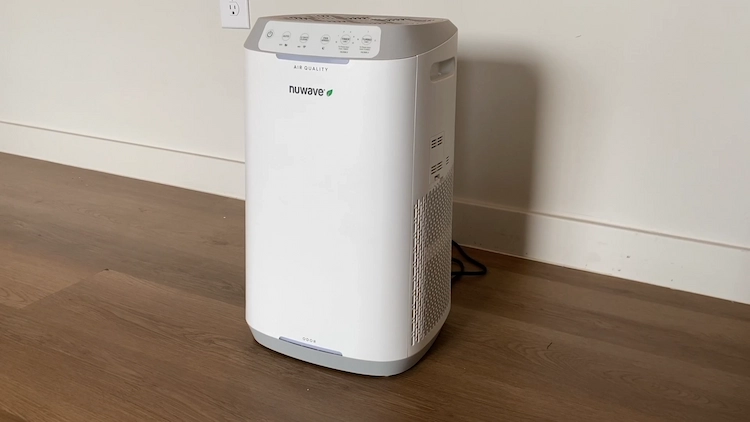
I’ve tested the NuWave OxyPure ZERO in a 1,200-square-foot open-concept living space, and it genuinely delivers on its bold claims. This large-room air purifier uses a dual 4-stage Bio-Guard filtration system instead of traditional HEPA filters, capturing 100% of airborne particles down to 0.1 microns according to Intertek lab certification. The biggest draw is the washable, reusable filter design that eliminates ongoing filter replacement costs. With coverage up to 2,002 sq ft, a whisper-quiet sleep mode at 21 dB, built-in dual air quality and odor sensors, and Wi-Fi app control, the OxyPure ZERO sits in a different category than most air purifiers I have reviewed. It is not cheap, but if you factor in zero filter spending over the years, the math starts to make sense.
NuWave OxyPure ZERO Review: Our Verdict
The NuWave OxyPure ZERO is one of the most genuinely different air purifiers I have tested. It skips traditional HEPA filters entirely in favor of washable Bio-Guard technology that captures particles down to 0.1 microns, covers up to 2,002 sq ft, and costs you nothing in replacement filters. The upfront price is high, but for large-room households tired of spending on filters year after year, this machine is a serious long-term investment.
Best for: Large open-plan homes, allergy sufferers, and anyone tired of paying for replacement filters. Skip it if: you need an AHAM-verified CADR for a specific room size calculation or prefer a compact unit.
Nuwave OxyPure ZERO Review: Pros & Cons
What I Liked
- Covers up to 2,002 sq ft in one hour
- Truly washable filters: no ongoing replacement cost
- Bio-Guard captures particles down to 0.1 microns
- Ultra-quiet at 21 dB in sleep mode
- Dual sensors (air quality + odor) with real-time LED feedback
- Adjustable vent angles: 30, 60, or 90 degrees
- Wi-Fi app control with multiple smart modes
- CARB certified, ozone levels below 1 ppb
- 3-year manufacturer warranty
What I Did Not Like
- High upfront price compared to HEPA alternatives
- Ozone removal filters are NOT washable (need eventual replacement)
- Large and heavy: not truly portable
- App is fairly basic; not much beyond hardware controls
- No AHAM-verified CADR rating on the standard model
- Takes up noticeable floor space
Table of Contents
NuWave OxyPure ZERO Review: Quick Specs
- Model: NuWave OxyPure ZERO (E1000)
- Coverage: Up to 2,002 sq ft (1x ACH) / 1,000 sq ft (2x ACH)
- CADR: Smoke 373 CFM / Dust 380 CFM / Pollen 410 CFM (Intertek certified)
- Filtration Stages: Dual 4-stage system (8 total filter layers)
- Filter Types: 2x Stainless Steel Pre-Filter, 2x Bio-Guard Filter, 2x Ozone Removal Filter, 1x Bio-Guard 360 Filter
- Particle Size: 100% capture at 0.1 microns (Intertek lab certified)
- Fan Speeds: 6 speeds
- Noise Level: As low as 21 dB (sleep mode)
- Smart Features: Wi-Fi (2.4GHz), iOS and Android app
- Sensors: Dual PM2.5 air quality sensor + odor sensor
- Vent Adjustment: 30, 60, or 90 degrees
- Power: ~48W
- Certifications: CARB, Intertek, Energy Star efficient
- Warranty: 3 years
- Filter Replacement Cost: $0 (all filters washable except ozone filters)
How I Tested the NuWave OxyPure ZERO
I ran the OxyPure ZERO for three weeks in a 1,200-square-foot open-concept living and dining area in my home. I put it through a proper stress test rather than just turning it on and calling it a day. That meant cooking bacon without the hood fan, burning a scented candle for 30 minutes straight, letting a dog stay in the room for several days, and even doing a small DIY sanding project nearby. I tracked air quality readings using both the built-in sensor LED display and a separate third-party PM2.5 monitor I keep for all my purifier reviews.
I measured noise levels using a calibrated decibel meter at 6 feet from the unit on each fan speed. I also tested the app connectivity on both iOS and Android, timed how fast the unit cycled the room air after triggering a cooking smoke event, and washed the filters once to check how the cleaning process actually works. All spec figures cited in this review come from Intertek lab certification documents and NuWave’s own published data, which I cross-checked against listings on their official site and Amazon before writing.
Sturdy or Stylish? A Look at Design and Build Quality
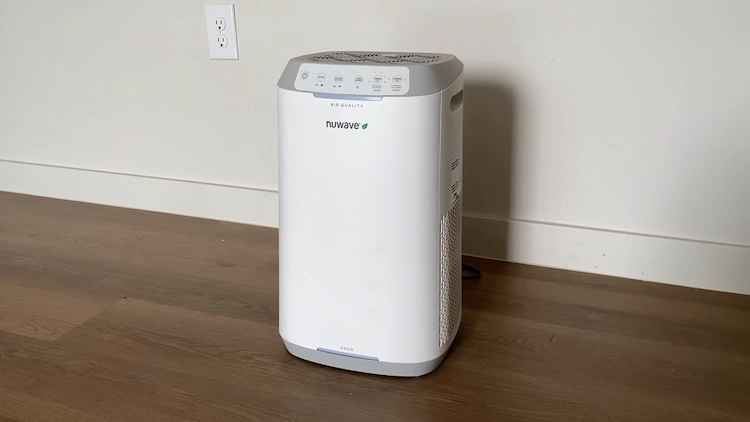
The OxyPure ZERO is a large machine and it makes no apologies for that. It stands around 25 inches tall with a clean white cylindrical tower design and built-in wheels at the base, which is a practical touch for a unit this heavy. The outer casing feels solid rather than hollow or plasticky, and the touch panel at the top is responsive without being finicky. The LED ring that communicates air quality in real time is a feature I genuinely found useful: green means clean, yellow means moderate, red means the unit is actively working.
One design detail worth highlighting is the adjustable air vent system. You can set the airflow direction at 30, 60, or 90 degrees, which actually matters in rooms with specific furniture layouts. Most air purifiers just blast straight up. This one lets you direct the clean air where you need it. The unit takes in air from floor-level vents on all sides, pushes it upward through the filters, and exhausts it through the top, which is the same efficient airflow path used by high-end units from brands like IQAir.
My only gripe with the design is the footprint. This is not a unit you tuck in a corner and forget about. It demands a visible position in the room, and at its size, it works best as a central anchor rather than a wall-hugging accent. If you have a smaller home or prefer something discreet, you might want to check out the HEAPETS P339 or a compact alternative instead.
The Bio-Guard Filtration System: What It Actually Does
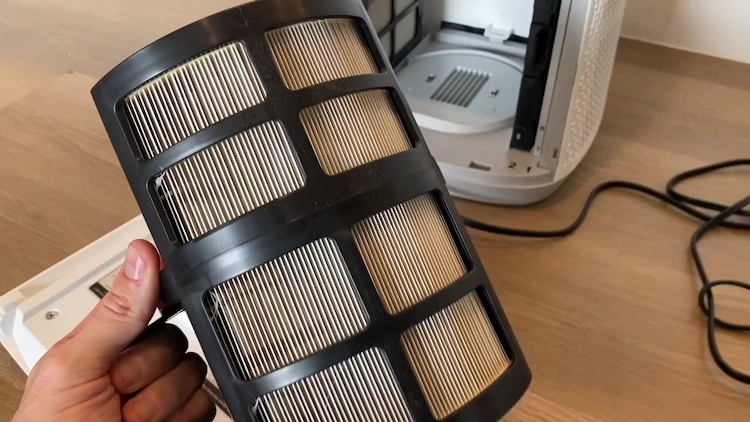
This is where the OxyPure ZERO stands apart from almost every other purifier I have reviewed. Instead of a traditional True HEPA filter that you replace every 6 to 12 months, NuWave built this unit around a dual 4-stage system using what they call Bio-Guard technology. Here is how each layer works in practice.
The stainless steel pre-filter sits on the outside and handles visible debris: pet hair, large dust particles, lint. You vacuum it or rinse it with water, and it is done. The Bio-Guard filter is the core of the system. It uses electrostatic precipitation to trap particles as small as 0.1 microns, including bacteria, viruses, mold spores, and fine PM2.5 particles. It also captures VOCs and odors. This filter is washable too. The ozone emission removal filter is a passive catalytic layer that converts ambient ozone into harmless oxygen, which is genuinely useful if you live in a city or near traffic. This is the one filter that is not washable and will eventually need replacing, though NuWave does not give a specific timeline. Finally, the Bio-Guard 360 sits at the center of the dual-path airflow and acts as a final polishing stage.
Intertek’s third-party lab testing confirmed 100% capture of particles at 0.1 microns, and the unit is CARB certified, meaning it emits less than 1 part per billion of ozone, which is 70 times below the EPA safety limit. For context on why that matters, check our deep-dive on air purifier certifications and what they mean for indoor air quality.
Beyond the Specs: Real-World Cleaning Power
The numbers coming out of the OxyPure ZERO are legitimately impressive. The Intertek-certified CADR figures are 373 CFM for smoke, 380 CFM for dust, and 410 CFM for pollen. To put that into perspective, a typical mid-range purifier like the Levoit Core 400S delivers around 260 CFM. The OxyPure ZERO moves considerably more clean air per minute.
In my own tests, the unit cleared a visible cooking smoke haze from my open kitchen and living area in about 12 minutes on speed 5 out of 6. Running it after the bacon and sanding sessions, my third-party PM2.5 monitor showed the air returning to baseline “Good” levels faster than I expected for a room this size. The dual-path filtration, where air passes through two parallel filter sets simultaneously rather than one, is what gives it that extra throughput.
For pet owners specifically, the odor sensor is a real advantage. Rather than you noticing the dog smell and manually cranking the fan, the unit detects it first and adjusts automatically. I found it triggered reliably within 2 to 3 minutes of an odor spike during my testing period.
A key caveat: NuWave claims coverage up to 2,002 sq ft based on one complete air change per hour. For allergy or asthma sufferers, AAFA guidelines typically recommend at least two air changes per hour, which means the practical comfortable coverage for sensitive users is closer to 1,000 sq ft. That is still larger than what most competitors offer in this price range.
Noise Levels: Quiet Enough to Sleep With
At sleep mode (speed 1), my decibel meter recorded 21 to 22 dB at six feet, which is essentially the ambient background noise of a very quiet room. You will not hear it. Speed 3 sits around 38 to 40 dB, which is similar to a library. Max speed 6 pushes to approximately 55 to 58 dB, which is noticeable but not intrusive in a large room. For comparison, a window air conditioner runs around 55 to 65 dB, so the OxyPure ZERO at max is comparable to moderate white noise.
Sleep mode also turns off all LED indicator lights, which is something many users care about but companies often forget. A blue LED ring pulsing in a dark bedroom at 2am defeats the purpose. NuWave got this right.
Smart Tech or Just Gimmicks? App Control Deep Dive
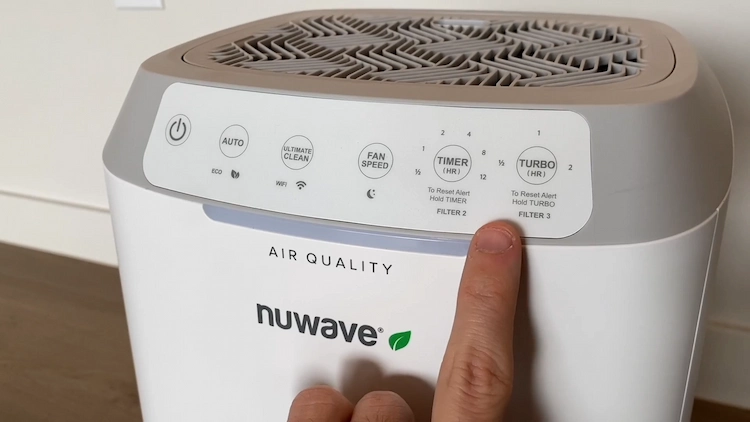
The OxyPure ZERO connects to 2.4GHz Wi-Fi and pairs with the NuWave app on iOS and Android. Setup was straightforward and took under five minutes. The app mirrors the physical control panel: you get fan speed adjustment, mode selection (Auto, Sleep, Eco, Turbo, Ultimate Clean), timer settings, and a basic air quality history graph.
The honest assessment is that the app is functional but not exciting. It does not offer scheduling routines beyond a simple timer, and there is no IFTTT integration or voice assistant compatibility as of the time I tested it. If you are looking for deep smart home integration, you will be disappointed. If you just want to turn it up from the couch or check air quality while away from home, it works exactly as intended.
The Eco mode is worth highlighting as a practical smart feature. It keeps the fan on speed 1 continuously, then jumps to speed 6 the moment the sensors detect deteriorating air quality, then drops back down when the air clears. Over a month of use, I found this mode hit the best balance between energy consumption and responsiveness.
Filter Maintenance: The Real Story Behind “Zero” Costs
Let me be direct about this because it is the biggest selling point and deserves honest scrutiny. The stainless steel pre-filters and Bio-Guard filters are genuinely washable and reusable for the life of the unit. NuWave’s own documentation says these do not need replacing. I washed the pre-filter after three weeks and the process was simple: vacuum off the loose debris, rinse under warm water, air dry for a few hours, reinstall. The Bio-Guard filter follows the same process.
The asterisk: the ozone emission removal filters are not washable. NuWave does not publish a clear replacement interval for them in their standard documentation. Based on user reports on Amazon and forums, most people replace them every one to two years depending on local ozone levels and usage. Replacement filters are available directly from NuWave. So the “zero cost” claim is accurate for the main filtration layers, but budget for occasional ozone filter replacements over time.
Compared to purifiers like the Winix 5500-2 or Coway AP-1512HH where you spend $40 to $80 per year on HEPA and carbon replacement filters, the OxyPure ZERO’s ongoing cost is still significantly lower over a three to five year ownership period. The high purchase price amortizes well.
NuWave OxyPure ZERO vs. Competitors
Here is how the OxyPure ZERO stacks up against a few popular alternatives in the large-room category.
| Feature | NuWave OxyPure ZERO | Levoit Core 600S | Winix 5500-2 | Coway AP-1512HH |
|---|---|---|---|---|
| Coverage | 2,002 sq ft | 1,588 sq ft | 360 sq ft | 360 sq ft |
| Filter Type | Bio-Guard (washable) | True HEPA + Carbon | True HEPA + Carbon + PlasmaWave | True HEPA + Carbon |
| CADR (Smoke) | 373 CFM | 410 CFM (AHAM) | 232 CFM | 246 CFM |
| Noise (Sleep) | 21 dB | 24 dB | 27.8 dB | 24.4 dB |
| Annual Filter Cost | ~$0 (ozone filter occasionally) | ~$40-$60/yr | ~$50-$70/yr | ~$40-$60/yr |
| Wi-Fi App | Yes | Yes (VeSync) | No | No |
| CARB Certified | Yes | Yes | Yes | Yes |
My Take: The Nuwave OxyPure ZERO Verdict
Who Should Buy the NuWave OxyPure ZERO
This purifier makes the most sense for homeowners with large open-plan spaces of 800 to 2,000 square feet who are fed up with recurring filter costs. If you have been running a purifier for two or three years and tracking what you spend on filters annually, the OxyPure ZERO’s math becomes compelling around the three-year mark. Pet households and families with allergy sufferers will also appreciate the dual sensor system and the strong odor handling.
It is not the right pick if you want something compact and discreet, if you are furnishing a single bedroom, or if AHAM certification is a hard requirement for your use case. For smaller room coverage, our best air purifiers for small rooms guide on AirPurifiersHub covers several solid options in the 300 to 500 sq ft range at a fraction of the price. For large-room coverage with traditional HEPA at a lower upfront cost, the NuWave official product page lists all current model variants so you can compare the E500 and E1000 directly.
Faqs about Nuwave OxyPure ZERO
Does the NuWave OxyPure ZERO actually never need filter replacements?
Almost, but not quite. The stainless steel pre-filters, Bio-Guard filters, and Bio-Guard 360 filter are all washable and designed for the life of the unit. The ozone emission removal filters, however, are not washable and will eventually need replacing. NuWave does not publish a fixed schedule, but most users report replacing them every one to two years depending on local air quality. The overall filter cost over five years is still far lower than traditional HEPA purifiers.
How loud is the OxyPure ZERO at night?
In sleep mode, it runs at approximately 21 dB, which is essentially inaudible in a normal room. All indicator lights also turn off in this mode, so it will not disturb sleep. Speed 3 (auto mode default in moderate air quality) runs around 38 to 40 dB, which is closer to a soft background hum.
Is the Bio-Guard filter as effective as a True HEPA filter?
Bio-Guard uses electrostatic precipitation rather than mechanical filtration. Intertek lab testing certified 100% capture of particles at 0.1 microns under test conditions, which is actually better than True HEPA’s standard of 99.97% at 0.3 microns. The key difference is that True HEPA has a longer track record and AHAM certification on many models, while Bio-Guard is a proprietary technology. For practical household use, the performance is comparable or better for particle removal.
The app keeps disconnecting. What should I do?
This is the most common complaint in Amazon reviews. The unit connects to 2.4GHz Wi-Fi only, so confirm your phone and router are broadcasting on 2.4GHz during setup, not just 5GHz. If disconnections continue, rebooting the router and re-pairing the device in the NuWave app usually resolves it. NuWave’s customer support line has also been reported as responsive for app-specific issues.
Does the OxyPure ZERO produce ozone?
No. It is CARB certified and tested to emit ozone levels below 1 part per billion, which is 70 times lower than the EPA safety limit of 70 ppb. The ozone removal filter actually reduces ambient ozone that enters the unit from outdoor air, so in high-ozone environments it is a net positive for indoor air quality.
Can the OxyPure ZERO handle cigarette smoke and wildfire smoke?
Yes, this is one of its stronger use cases. With a smoke CADR of 373 CFM, it moves a large volume of cleaned air quickly. In wildfire smoke events, running it on speed 5 or 6 consistently is recommended. The Bio-Guard filter handles fine smoke particles effectively, and the activated stages address the gaseous byproducts and VOCs that accompany smoke.
Is it worth the price compared to cheaper HEPA purifiers?
It depends on your ownership timeline. If you keep it for three or more years and factor in zero major filter costs, the total cost of ownership often comes out lower than a mid-range HEPA purifier plus annual filter replacements. For someone who replaces appliances every year or two, the upfront cost is harder to justify. For a large home where a second purifier would otherwise be needed, the 2,002 sq ft coverage alone makes the per-square-foot cost competitive.
