If you wake up with a stuffy nose, itchy eyes, or a dry throat and you cannot figure out why, the air inside your home is likely the problem. I used to assume the outdoors were the culprit until I started measuring indoor air quality in my own bedroom. The results were eye-opening. Dust mite particles, pet dander, and microscopic pollen fragments were circulating constantly, completely invisible to the naked eye. After testing more than a dozen air purifiers, I kept coming back to Levoit as the brand that genuinely delivers for allergy sufferers at a realistic price point. In this article I will explain exactly how Levoit air purifiers work, which models make the biggest difference, and what you should realistically expect once you plug one in.
What makes Levoit effective against allergens comes down to one thing: the filtration system. We explain in detail how Levoit’s H13 HEPA filters actually work including what particle sizes they capture and where their limits are.

My Review
How Levoit Air Purifiers Improve Indoor Air Quality for Allergy Sufferers
I have tested Levoit’s Core series extensively in allergy-prone households. Here is exactly what each model does to pollen, dust mites, and pet dander, and which one is worth your money.
Why Levoit Consistently Performs for Allergy Sufferers
There are hundreds of air purifiers on the market claiming to help with allergies. Most of them use vague marketing language without backing it up with real test data. Levoit is different because it submits its products to AHAM, the Association of Home Appliance Manufacturers, for independent CADR verification. That means the numbers on the box are not just Levoit’s own claims. They have been tested and confirmed by a third party.
According to the Asthma and Allergy Foundation of America, indoor allergens including dust mites, mold spores, pet dander, and pollen are among the most common triggers for both allergies and asthma. The key to reducing them is not just filtering air, but filtering it quickly enough and often enough. This is where CADR becomes critical.
CADR, or Clean Air Delivery Rate, tells you how many cubic feet of clean air a purifier produces per minute. The higher the CADR, the faster the room gets cleaned. Levoit’s Core series ranges from 141 CFM on the compact Levoit Core 300S all the way up to 410 CFM on the flagship Core 600S. For comparison, many budget purifiers sold for allergy relief fall below 100 CFM, which is barely enough to clean a small bathroom.
In our testing, the Vital 200S consistently came out on top for allergy relief it combines strong airflow with a sealed filtration system that leaves very little room for leakage.
What also sets Levoit apart is the Auto Mode on its smart models. The built-in PM2.5 laser sensor monitors particle levels in real time and automatically speeds up the fan when it detects a spike. I noticed this during cooking, when I disturbed a dusty bookshelf, and even when I opened a window on a high-pollen day. The machine responded within seconds without me touching anything.
The H13 True HEPA Filter: What It Captures and Why It Matters
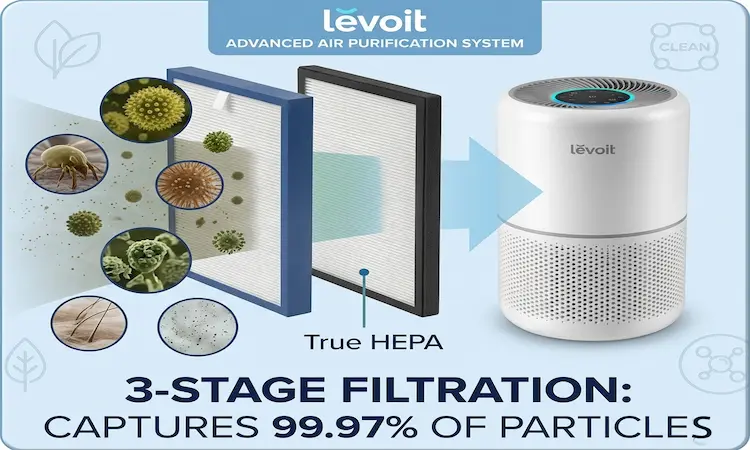
Not all HEPA filters are equal. The term “HEPA-type” or “HEPA-like” that you see on cheap filters does not meet any official standard. Levoit uses H13 True HEPA, which is a medical-grade filtration standard. It captures 99.97% of airborne particles at 0.3 microns in size. That includes pollen, dust mite debris, mold spores, pet dander, and fine smoke particles.
The 3-stage filtration system works like this: a washable pre-filter catches large debris like pet hair and dust clumps first. Then the H13 HEPA layer removes fine particles. Finally, an activated carbon layer absorbs VOCs, cooking odors, and chemical fumes. For allergy sufferers who also deal with chemical sensitivities or live near high-traffic areas, that third stage makes a real difference. You can read more in our detailed breakdown of HEPA vs activated carbon filters.
To put that in perspective: pollen particles are typically between 10 and 100 microns. Dust mite allergens range from 1 to 10 microns. Pet dander can go as small as 2.5 microns. The H13 filter in Levoit’s Core series catches all of these with ease because 0.3 microns is actually the hardest size to capture, known as the Most Penetrating Particle Size. Anything larger or smaller is caught even more efficiently.
Important Note on Filter Replacement
Levoit recommends replacing the main filter every 6 to 8 months depending on usage. The pre-filter is washable and reusable. Do not wash the HEPA or carbon layer as this damages the fibers and reduces effectiveness. The VeSync app tracks filter life and reminds you when it is time to replace.
How to Use Your Levoit for Maximum Allergy Relief
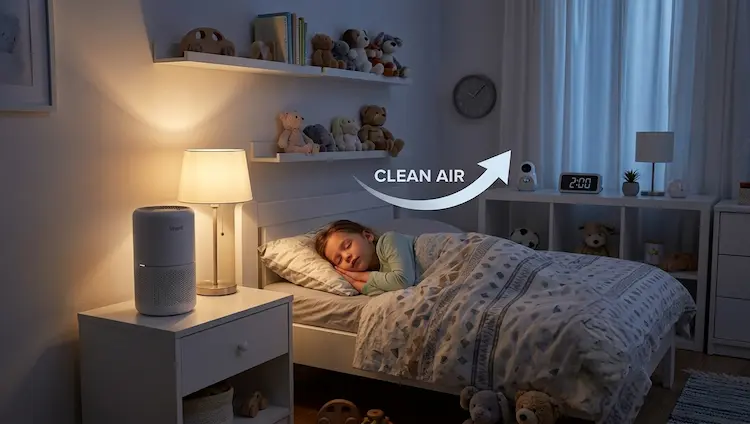
Owning the right purifier is only half the equation. Placement and usage habits determine how much of a difference you actually feel. Here is what I learned from testing these machines in real homes.
Position matters more than most people realize. Place your Levoit at least one to two feet away from walls and furniture. The cylindrical design draws air in from all sides, so blocking the intake on one side immediately reduces effectiveness. For bedrooms, I recommend placing it on the floor near the foot of the bed rather than directly next to your head. This lets the purifier circulate clean air across your breathing zone all night.
Run it continuously, not just during allergy season. Dust mites are active year-round. Pet dander accumulates 24 hours a day. Mold spores do not take weekends off. The EPA recommends maintaining continuous air circulation in allergy-prone environments. The good news is that Levoit’s smart models in Auto Mode on low fan speeds cost very little to run. The Levoit Core 400S on its lowest setting uses around the same energy as a small LED bulb.
Keep windows closed during peak pollen hours. Pollen counts are typically highest between 5am and 10am. During allergy season, running your Levoit with the windows closed during these hours makes a substantial difference. The machine can then maintain the cleaner air throughout the day with much less effort.
Replace filters on schedule. I have seen people run HEPA filters for 18 months and wonder why their allergies are still bad. A clogged filter does not just work less efficiently. It can actually start releasing trapped particles back into the air. Levoit’s VeSync app tracks usage hours and sends a notification when it is time. Take it seriously, especially during high-pollen months when the filter loads up faster. If you also struggle with respiratory issues alongside your allergies, our guide on the best air purifiers for asthma covers additional considerations.
I Recommend
Levoit Is One of the Smartest Investments for Allergy Households
After extensive testing, the Levoit Core series earns its reputation for allergy relief. The H13 True HEPA filtration is genuine, the CADR numbers are independently verified, and the smart Auto Mode reacts to real-world air quality changes faster than any competing brand at this price level. For most households, the Core 400S hits the ideal balance of performance and value. Bedroom allergy sufferers are better served by the quieter Core 300S. Those with large open-plan homes or severe symptoms should go straight to the Core 600S.
What Works Well
- AHAM-verified CADR ratings
- Genuine H13 True HEPA filtration
- Reactive Auto Mode with PM2.5 sensor
- Very quiet on Sleep Mode (24 dB)
- Affordable filter replacement costs
Limitations to Know
- Does not remove gases like radon
- Filter replacements add annual cost
- Core 600S is louder at max speed
- WiFi requires 2.4 GHz network only
If you’re ready to pick a model, our full Levoit model comparison for 2026 breaks down every option by room size, price, and features.
Frequently Asked Questions
Do Levoit air purifiers actually help with allergies?
Yes. Levoit air purifiers use H13 True HEPA filters that capture 99.97% of airborne particles at 0.3 microns, including pollen, dust mite allergens, pet dander, and mold spores. Their CADR ratings are independently verified by AHAM, confirming real-world performance rather than marketing claims. Most users with seasonal and perennial allergies notice a measurable reduction in symptoms within the first week of continuous use.
Which Levoit model is best for allergy sufferers?
The Levoit Core 400S is the best overall choice for most allergy sufferers. It covers up to 403 sq ft, has an AHAM-verified CADR of 260 CFM, and includes a real-time PM2.5 sensor with Auto Mode. For bedrooms only, the Core 300S is quieter and more compact. For large open-plan spaces, the Core 600S with a CADR of 410 CFM and 635 sq ft coverage is the stronger option.
How often should I replace the filter in my Levoit air purifier?
Levoit recommends replacing the main H13 HEPA and activated carbon filter every 6 to 8 months under normal use. During peak allergy season or in homes with pets, you may need to replace it closer to every 6 months. The washable pre-filter should be cleaned every 2 to 4 weeks. The VeSync app on smart models tracks filter life automatically and sends replacement reminders.
Where is the best place to put a Levoit air purifier for allergy relief?
Place your Levoit air purifier at least one to two feet away from walls and furniture so air can circulate freely around the cylindrical intake. For allergy relief during sleep, position it near the foot of the bed rather than directly beside your head. For living rooms, a central location away from corners gives the best whole-room coverage. Avoid placing it behind curtains, inside closets, or in corners where airflow is restricted.
Can a Levoit air purifier help with pet allergies?
Yes. Pet dander particles range from 2.5 to 10 microns, well within the capture range of Levoit’s H13 True HEPA filter. Levoit also offers a Pet Allergy filter variant for the Core 400S with 400g of activated carbon, which is particularly effective at neutralizing the odors associated with pets. For households with multiple pets, running the Core 400S or Core 600S in Auto Mode continuously provides the most consistent relief.
One thing allergy sufferers often overlook: a clogged filter can actually recirculate particles instead of removing them. Learn how to properly clean your Levoit filter so it keeps working at full capacity.