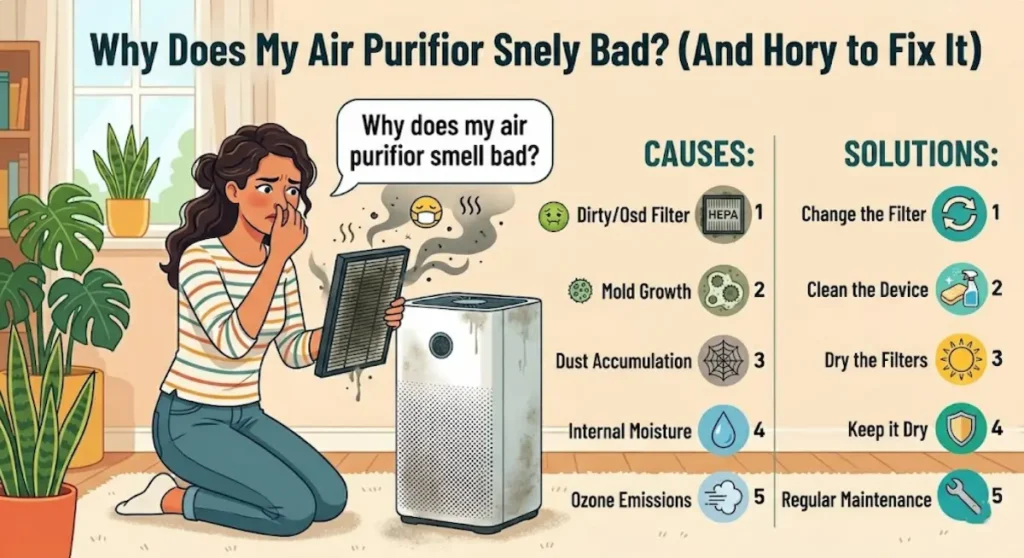
I remember the first time I noticed an unusual smell coming from one of my air purifiers. My immediate reaction was, “This is supposed to clean the air so why does it smell worse after I turned it on?” If you’re reading this, chances are you’ve experienced that same moment of confusion.
The good news is that a bad smell coming from an air purifier almost never means it’s permanently broken. In most cases, the cause is one of a few easily fixable issues. Having tested and lived with dozens of air purifiers over the years, I’ve encountered every variation of this problem. In this guide, I’ll explain exactly what causes those odors and, more importantly, how to eliminate them for good.
📋 In This Article
- Quick Answer: The Most Common Cause
- What Type of Smell Are You Noticing?
- Cause #1: Dirty or Saturated Filters
- Cause #2: Mold or Bacteria Inside the Unit
- Cause #3: New Unit / New Filter Off-Gassing
- Cause #4: Ozone Smell (Ionizer Units)
- Cause #5: Burning or Electrical Smell
- Cause #6: Poor Ventilation
- Step-by-Step Fix Guide
- How to Prevent Odors Long-Term
- FAQ
Quick Answer: The Most Common Cause
If your air purifier smells bad, the most likely culprit is a dirty, saturated, or overdue filter. Over time, HEPA and activated carbon filters trap so many particles dust, pet dander, mold spores, volatile organic compounds (VOCs) that they can start releasing those captured contaminants back into the air as an unpleasant odor. Check when you last replaced your filters. If it’s been longer than the manufacturer recommends, that’s almost certainly the problem.
That said, there are several other causes worth knowing. Let’s go through each one.
What Type of Smell Are You Noticing?
Not all air purifier odors are created equal. The type of smell is actually your best diagnostic clue. Here’s a quick breakdown before we dive into each cause:
| Smell Type | Most Likely Cause | Urgency |
|---|---|---|
| Musty / Wet Dog | Mold or bacteria in filters / unit | High fix soon |
| Sour / Stale | Saturated HEPA or carbon filter | Medium replace filter |
| Plastic / Sweet | New unit or new filter off-gassing | Low usually normal |
| Sharp / Metallic / Ozone | Ionizer or UV-C generating ozone | Medium reduce exposure |
| Burning / Electrical | Overheating motor or blocked airflow | High turn off immediately |
| Dusty / Stale Air | Clogged filter reducing airflow | Medium replace filter |
Found your smell in the table? Let’s dig deeper into each cause and the fix that goes with it.
Cause #1: Dirty or Saturated Filters (The #1 Culprit)
This is by far the most common reason I see people complain about a smelly air purifier. Filters don’t last forever and when they fill up, they don’t just stop working quietly. They start emitting the very particles they trapped.
Here’s what’s happening on a microscopic level: your HEPA filter is a dense mat of fibers that captures particles by interception, impaction, and diffusion. Your activated carbon filter absorbs odor molecules and VOCs into its porous surface. Both have a finite capacity. Once that capacity is reached whether it takes 3 months or 12 depends on your environment they become a source of odor rather than a solution.
⏱️ General Filter Replacement Benchmarks
- True HEPA filters: Every 6–12 months under normal use; sooner with pets, heavy dust, or smoke
- Activated carbon filters: Every 3-6 months these saturate faster under continuous odor and VOC loads
- Washable pre-filters: Rinse every 2-4 weeks; replace non-washable ones every 3 months
Signs your filters are past due:
- Visible grey or brown discoloration on the filter surface
- Noticeably reduced airflow from the outlet
- The filter indicator light is on (if your model has one)
- You haven’t replaced filters in over 6 months
- Sour, stale, or dusty odor coming from the unit
The fix: Replace the filter. Don’t try to wash a True HEPA filter water damages the fiber structure and destroys its filtration efficiency. Only pre-filters labeled “washable” should be rinsed. When in doubt, check our full guide on how to clean HEPA filters or refer to your manual.
Cause #2: Mold or Bacteria Growing Inside the Unit
This is the one that concerns me most when I hear people describe a “wet dog,” musty, or mildewy smell from their air purifier. Those odors are a classic signature of mold and bacteria, and they tend to show up in two situations: humid environments, and units that haven’t been cleaned in a long time.
When moist air passes through your purifier repeatedly, moisture can accumulate on the filter media, fan blades, and internal housing surfaces. Mold spores which your purifier is actively trapping from the air can then germinate in that moisture and start colonizing the inside of your unit. Once mold takes hold, every time the fan runs, it pushes spores and their musty VOCs right back into your room.
Where to look:
- The filter itself (look for black, green, or grey spots)
- The interior housing walls and fan blades (pull the front panel off)
- Air intake and outlet grilles (visible buildup is a red flag)
The fix:
- Unplug the unit completely before doing anything.
- Remove and inspect all filters. If there’s visible mold, replace them don’t try to clean a moldy HEPA filter.
- Wipe down the interior housing, fan blades, and grilles with a lightly dampened cloth. A small amount of diluted white vinegar works well on hard plastic surfaces.
- Allow the unit to air out completely at least a few hours before reassembling and plugging back in.
- Consider running a dehumidifier in the same room if humidity levels are persistently high (above 50–55% RH). If allergy symptoms persist alongside mold odor, our guide to the best air purifiers for allergies covers models with sealed filtration that better prevent internal mold buildup.
Cause #3: New Unit or New Filter Off-Gassing (Plastic Smell)
Got a brand new air purifier and it smells like plastic or has a faintly sweet chemical odor? Don’t panic this is almost always normal, and it’s one of the questions I get most often from first-time air purifier buyers.
New plastic components, resins, and manufacturing residues release volatile organic compounds (VOCs) when they first heat up during operation. This is called off-gassing. Similarly, a new activated carbon filter can emit a faint sweet-ish smell during its first few hours of use as the carbon settles. Philips, for example, explicitly acknowledges in their product documentation that a plastic smell during initial use is expected and will fully disappear within a few days of normal operation.
How long does it last? In my experience, the plastic smell from a new unit typically dissipates within 24-72 hours of continuous use. A new carbon filter’s initial odor usually clears within a few hours.
The fix:
- Run the air purifier on its highest fan setting in a well-ventilated room for the first few days
- Open a window nearby to help the off-gassing escape faster
- If the plastic smell is very strong and persists beyond one week, check that no internal components are making contact with the fan or heating elements
Cause #4: Ozone Smell from Ionizer or UV-C Technology
If your air purifier uses an ionizer, plasma wave, or certain UV-C technologies, and you’re noticing a sharp, metallic, or “electric storm” smell that’s ozone. This is one of the less obvious causes of air purifier odor, and it’s worth understanding in some detail.
Ozone (O₃) is produced as a byproduct when electrical discharges (like those in ionizers) interact with oxygen molecules in the air. At low concentrations, it has that distinctive clean-storm smell. At higher concentrations, it becomes an irritant and can actually worsen air quality rather than improve it.
The EPA has flagged ozone-generating air cleaners as a concern for indoor air quality. Ozone can react with other indoor pollutants to create secondary pollutants, and at sufficient levels it can irritate the respiratory tract.
The fix:
- Check whether your unit has an ionizer setting many models allow you to disable it independently from the main fan. Turn it off and see if the smell disappears.
- If your purifier is primarily ozone-based rather than filter-based, consider replacing it with a True HEPA + activated carbon model, which produces no ozone.
- Always ensure adequate ventilation when running any ionizer-equipped unit.
Cause #5: Burning or Electrical Smell
This one requires immediate action. A burning smell whether it smells like hot plastic, singed rubber, or an electrical fire should not be ignored.
The most common causes are:
- Severely clogged filter restricting airflow: The motor works harder, generates excess heat, and the surrounding plastic or rubber components can start to overheat.
- Overheating motor: Especially in older units or those run continuously at maximum speed for extended periods.
- Foreign object in the unit: Debris, a piece of a torn filter, or a small object sucked into the intake can create friction on the fan blades.
- Electrical fault: In rare cases, an internal wiring or component failure.
If you smell burning: Turn the unit off and unplug it immediately. Do not continue running it. Inspect the filter if it’s heavily clogged, replace it. If the burning smell returns after a filter replacement and a thorough inspection, contact the manufacturer or stop using the unit.
Cause #6: Poor Room Ventilation
This is a cause that often gets overlooked. Your air purifier doesn’t operate in isolation it works with the air in your room. If the room itself is poorly ventilated, the carbon filter can become saturated with odor particles much faster than the manufacturer’s schedule anticipates.
In tightly sealed rooms with persistent odor sources cooking smells, pet activity, cigarette smoke, cleaning products he activated carbon filter gets hit with a higher continuous load and reaches its adsorption capacity sooner. The result is a unit that starts to smell like the odors it absorbed, rather than clean air. If you’re dealing specifically with smoke odors, our roundup of the best air purifiers for smoke highlights models with oversized carbon filters designed for exactly this high-load scenario.
The fix:
- Replace the carbon filter more frequently than the standard schedule if your room has heavy, persistent odor sources
- Open windows periodically to introduce fresh air and reduce the pollutant load your purifier has to handle
- Make sure the air purifier’s intake and outlet vents are not blocked maintain at least 12 inches of clearance on all sides for proper airflow
Step-by-Step Fix Guide: What to Do Based on Your Smell
Here’s a practical troubleshooting sequence I’d walk any reader through if they called me with this issue:
Step 1: Identify the smell type
Refer back to the smell table above. Your nose is your first diagnostic tool.
Step 2: Unplug and open the unit
Always unplug before touching any internal component. Remove the front panel and take out all filters.
Step 3: Inspect the filters
Hold them up to a light source. Heavy discoloration, visible particulate buildup, dark spots, or any signs of mold mean it’s time to replace not clean the HEPA and carbon filters.
Step 4: Clean the interior
Use a dry microfiber cloth or a low-suction vacuum attachment to remove dust from the fan blades, interior housing walls, and air grilles. For sticky or moldy buildup, a cloth lightly dampened with diluted white vinegar is effective on hard plastic surfaces. Let everything dry completely before reassembling.
Step 5: Replace filters and reassemble
Install fresh filters, making sure they’re seated correctly with no gaps around the edges. Even a small gap allows unfiltered air to bypass the filter entirely. Not sure which replacement filter to buy? See our guide to top-rated home air purifiers for OEM replacement filter sources.
Step 6: Run the unit in a ventilated space
After reassembly, run on a medium-high setting for a few hours with a nearby window cracked. This helps any residual odors from new filters or the cleaning process to clear out.
Step 7: If the smell persists
If you’ve replaced all filters, thoroughly cleaned the unit, and the bad smell is still there particularly if it’s a burning or persistent electrical odor contact the manufacturer. Most reputable brands offer at least a 1-year warranty, and a genuine fault may qualify for a replacement.
How to Prevent Air Purifier Odors Long-Term
Prevention is dramatically easier than remediation. Here’s the maintenance routine I follow with my own units:
- Set a filter replacement reminder: Mark your calendar when you install fresh filters. For carbon filters, set a reminder for 3 months; for HEPA filters, 6-12 months depending on your environment.
- Clean pre-filters every 2-4 weeks: Most pre-filters are washable. A quick rinse and air dry (never put them back in damp) extends the life of your HEPA and keeps airflow optimal. Our step-by-step HEPA cleaning guide covers this in detail.
- Wipe down the exterior grilles monthly: Dust accumulates on the intake grilles and can get pushed back into the unit during operation.
- Keep the unit away from moisture sources: Don’t place air purifiers next to humidifiers, in bathrooms, or directly on the floor in rooms prone to dampness.
- Don’t block the vents: Restricted airflow leads to overheating and accelerated filter loading. Running costs also increase see our air purifier electricity cost guide to understand how blocked vents affect your bill.
- Buy OEM or verified replacement filters: Counterfeit or low-quality replacement filters can themselves introduce odors and don’t perform to spec. Always buy from the manufacturer or a reputable retailer.
Frequently Asked Questions
Is it dangerous if my air purifier smells bad?
In most cases, no a dirty or saturated filter is unpleasant but not dangerous. The exceptions are a burning or electrical smell (turn off immediately potential fire hazard) and a persistent ozone smell (can irritate the respiratory system over time, especially for asthma sufferers). A musty smell from mold is worth addressing promptly, as it means your purifier is redistributing mold spores rather than capturing them.
My air purifier smells like feet / gym socks. What is that?
That sour, locker-room smell is almost always bacterial growth either on the filter or inside the housing. Bacteria that accumulate on saturated filters can produce sulfur-containing compounds that smell distinctly unpleasant. Replace the filters and clean the unit’s interior as described above.
Can I use baking soda or vinegar to clean my HEPA filter?
No. HEPA filters should not be washed with any liquid. Water whether plain or mixed with cleaning agents destroys the electrostatic charge and physical structure of HEPA fibers, permanently reducing their filtration efficiency. Only vacuum gently with a brush attachment if absolutely necessary, and always follow your manufacturer’s guidance. When a HEPA filter smells, the right answer is replacement.
Why does my air purifier smell like chemicals?
A chemical smell can come from two directions: (1) your purifier is new or has a new carbon filter and is off-gassing this is temporary and will resolve in a few days; or (2) the carbon filter has become saturated with VOCs from your indoor air and has reached its adsorption limit, meaning it can no longer hold additional molecules. In the latter case, replacing the carbon filter is the solution.
How do I know if my air purifier has an ozone problem?
The smell is distinctive sharp, clean, somewhat metallic, like the air after a lightning storm. If you notice this and your unit has an ionizer, plasma, or “air sterilizer” function, that component is the source. Try disabling it in your settings. If the smell disappears, that confirms the diagnosis. Stick to units with True HEPA + activated carbon filtration if you’d rather avoid ozone entirely.
Conclusion
An air purifier that smells bad is almost always telling you something useful: the filter needs replacing, the unit needs cleaning, or there’s a setting that needs adjusting. In years of testing and writing about air purifiers, I’ve never encountered a persistent odor problem that couldn’t be resolved with a filter swap, a proper cleaning, or in the case of new units a little patience while the off-gassing cleared.
The key is not to ignore it. A smelly air purifier is operating below its potential at best, and actively redistributing captured contaminants at worst. Regular maintenance on a real schedule not just when the smell reminds you is the difference between an air purifier that earns its place in your home and one that becomes a source of frustration.
If you’ve gone through all the steps above and still can’t identify the cause, feel free to leave a comment with the brand, model, and a description of the smell. I’m happy to help you troubleshoot.