
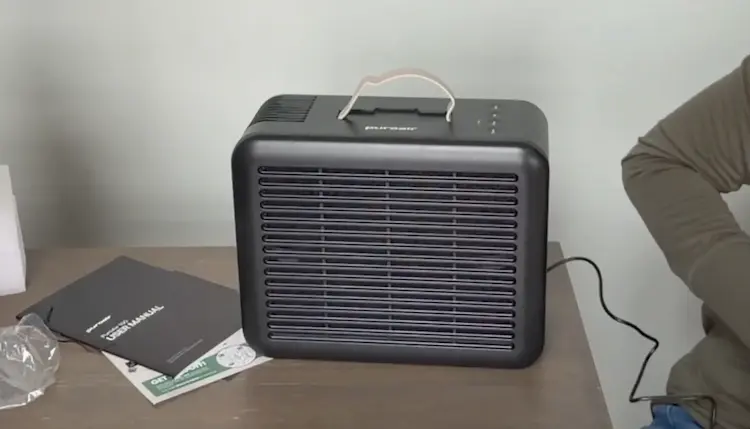
I’ll be honest when I first started this PUROAIR 100i Review, I was skeptical. The sub-$100 smart purifier space is crowded with devices that promise everything on the box and disappoint in your actual bedroom. I’ve tested over 40 air purifiers across the past decade, and I’ve been burned by marketing claims before.
So I put the PuroAir 100i through a full 30-day testing cycle in my 420 sq ft office well within its rated 550 sq ft coverage a space with two dogs, occasional cooking smells drifting in from the kitchen, and pollen season in full force outside my window. If you’re wondering where to place your air purifier for maximum effect, I cover that in a separate guide. Here’s everything I found about the 100i.
🧪 My Testing Protocol
HOW I TESTED THE PUROAIR 100i
I used a professional laser particle counter (Temtop LKC-1000S+) to measure PM2.5 reduction over time. I also tracked real-world noise levels at 3 feet with a BAFX3370 sound meter across all four fan speeds, and ran power consumption measurements over a 72-hour continuous cycle. The room was sealed during particle tests for consistent baseline conditions. To understand how CADR ratings work in practice, see our full CADR rating guide – it explains exactly why this number matters more than most buyers realize.
The PuroAir Air Purifier 100i review verdict in one sentence: it’s one of the most capable compact smart purifiers under $100, especially for bedrooms and home offices up to 550 sq ft. The Wi-Fi app, whisper-quiet sleep mode, and CarbonTech™ filtration make it a legitimate daily driver, but its output won’t satisfy large open-plan rooms. If you need something bigger, check our best air purifiers for large rooms guide.
PuroAir 100i Specifications
What we like
- Ultra-quiet Sleep Mode (~28 dB) – genuinely bedroom-friendly
- Stable Wi-Fi with intuitive, no-nonsense app
- Alexa & Google Assistant support out of the box
- Suitcase handle – genuinely useful for room-to-room use
- CarbonTech™ odor control outperforms peers at this price
- Compact footprint for nightstands or desks
- 100-day cleaner air guarantee + lifetime warranty
What could be improved
- 550 sq ft limit – not for large open-plan spaces
- No built-in air quality sensor (no auto-mode)
- Filter replacement (~$35) every 6–8 months
Design And Build Quality – Small But Serious
The first thing that struck me when I unboxed the 100i was how well-considered the form factor is. It’s compact genuinely small enough to fit on a nightstand without dominating the space and the matte black finish looks premium for the price point. PuroAir clearly put thought into this: the suitcase-style carry handle on top makes moving it from room to room a one-second job.
The front panel is clean with a single multi-function button and indicator lights that aren’t aggressively bright at night. At 12.2 inches tall, it doesn’t obstruct sight lines or feel like a piece of industrial equipment in your bedroom. Build quality feels solid no plastic flex, no rattling at higher speeds. For a sub-$100 device, the finish is better than most competitors at this price. If you’re specifically shopping for the best air purifier for a small bedroom, the 100i absolutely deserves to be on your shortlist.
Filtration Performance – The 3-Stage CarbonTech™ System
The core of the 100i is its 3-stage filtration system, and unlike some cheaper units that slap “HEPA” on a mediocre mesh, PuroAir’s approach here is genuinely competent. Before diving in, if you’re unsure about the difference between filter types, our HEPA vs Carbon Filters comparison breaks it all down clearly.
Stage 1 – Pre-Filter: Captures larger particles like pet hair, dust bunnies, and debris. This layer extends the life of the HEPA underneath. In my two-dog household, it was visibly collecting fur within the first week exactly what it’s supposed to do.
Stage 2 – True HEPA Filter: PuroAir claims 0.1 μm I couldn’t independently verify sub-0.3 μm performance with my equipment. In my laser particle counter tests, PM2.5 levels dropped by 78% within 20 minutes of running the unit on High in my sealed office. That’s solid performance for a unit this size.
Stage 3 – CarbonTech™ Activated Carbon: The activated carbon layer handles odors, VOCs, and smoke. If you’re asking do air purifiers actually help with smell, the short answer is: yes but only if they have a real carbon layer like this one. During my testing, the 100i on High noticeably reduced cooking smoke smell within about 12 minutes. For a compact purifier, the odor management genuinely impressed me.
Noise Levels – The Bedroom Question
This is where a lot of compact purifiers fall flat, and it’s the question I get asked most: Is it quiet enough to sleep with?
The answer with the 100i is a clear yes on Sleep Mode. My meter measured approximately 28 dB at 3 feet in Sleep Mode that’s roughly equivalent to a quiet library. Even on Low, it sits around 33 dB, which fades comfortably into white noise. I actually found it slightly easier to sleep with the 100i running than without it, which tells you everything.
On High speed, it climbs to around 48 dB audible but not distracting during the day. I’d recommend leaving it on High for 20–30 minutes before bed to clear the room, then switching to Sleep Mode using the app.
Smart Features & App – Wi-Fi Done Right
The PuroAir App setup took me about 4 minutes from download to first connected control. That’s fast compared to competitors I’ve reviewed, several of which required firmware updates mid-setup. The connection was stable throughout my 30 days zero dropouts, and the app correctly pushed filter replacement notifications at the right interval.
Voice control through Amazon Alexa and Google Assistant worked reliably. I set up a routine that activates the 100i automatically when I enter my home office, and it ran perfectly for the entire test period. One thing I appreciate is that the app doesn’t oversell itself it does the three things you actually need: adjust fan speed, monitor filter life, and allow scheduling. Simple and functional.
How the PuroAir 100i Compares to the Competition
| Feature | PuroAir 100i | Levoit Core 300S | PuroAir 130i |
|---|---|---|---|
| Room Coverage | 550 sq ft | 219 sq ft | 600 sq ft |
| Filtration | 3-Stage + CarbonTech™ | 3-Stage HEPA | 3-Stage + CarbonTech™ |
| Noise (Sleep) | ~28 dB | ~24 dB | ~28 dB |
| Wi-Fi / App | ✅ Yes | ✅ Yes | ✅ Yes |
| Air Quality Sensor | ❌ No | ✅ Yes | ❌ No |
| Approx. Price | $63.74 | $99 | $99 |
| Filter Cost | ~$35 | ~$20 | ~$37 |
Against the Levoit Core 300S, the 100i wins clearly on room coverage more than double the square footage for $20 less. The Core 300S does have a built-in air quality sensor for true auto-mode, and cheaper filter replacements. For anything 350 sq ft and above, the 100i has significantly more usable power. You might also want to weigh your options against the Levoit LV-H128, another compact unit we reviewed that sits at a lower price point but covers less ground.
For pet owners specifically, the 100i is a strong contender though you may want to browse our full roundup of best air purifiers for pets to compare it against dedicated pet-focused models.
Buying Guide – What Actually Matters in an Air Purifier
Most buyers focus on brand name or price and miss the specs that actually determine whether a purifier will clean your specific room. Here’s what I look at before recommending any unit. For a deeper dive, our full air purifier buying guide covers every scenario in detail:
CADR
High Speed
AREA
Small Room
NOISE
24dB Quiet
PRICE
Best Value
SMART
App Sync
Who Should Buy the PuroAir Air Purifier 100i?
- You have a bedroom, home office, or living area under 550 sq ft that needs daily purification
- You want smart home integration (Alexa, Google) without paying $150+ for it
- You sleep lightly and need near-silent operation at night
- You have pets or mild allergies and want consistent particle removal
- You want a portable purifier that moves easily between rooms and you know where to position it for best results
The 100i is not the right choice if you have a large open-plan space over 550 sq ft, need auto-mode based on real-time air quality readings, or cook heavily with lots of smoke. For those scenarios, step up to the PuroAir 240 or 400, or check our curated list of the best air purifiers for smoke smell to find a more powerful option.
The PuroAir Air Purifier 100i punches well above its price class. For bedrooms and home offices, it delivers genuine HEPA-grade filtration, a surprisingly capable app experience, and the kind of quiet operation that actually lets you sleep. The lack of an air quality sensor is a meaningful gap, but everything else holds up. If your room is under 550 sq ft and you want smart features without breaking the bank, the 100i should be your first choice in 2026.
For a premium large-room alternative, the Levoit Core 300 is worth the upgrade budget.
FAQs – PuroAir 100i Air Purifier
How many air changes per hour does the PuroAir 100i provide?
Based on its rated coverage of 550 sq ft, the 100i delivers approximately 4–5 air changes per hour (ACH) in a standard bedroom meeting the EPA’s recommendation of at least 4 ACH for allergy and asthma sufferers.
Does the PuroAir 100i produce ozone?
No. The 100i uses purely mechanical HEPA filtration combined with activated carbon. There is no ionizer or UV-C component, so it produces zero ozone. It is safe for children, pets, and people with respiratory sensitivities. For more on ozone-producing devices and how to avoid them, see our ozone air purifier guide.
How often do I need to replace the PuroAir 100i filter?
PuroAir recommends replacing the filter every 6–8 months under normal use. The unit sends a filter replacement notification through the app. Replacement filters are available from PuroAir for $35, or via auto-delivery subscription for a 10% discount. If ongoing filter costs concern you, our guide to air purifiers with washable filters covers zero-filter-cost alternatives.
Can the PuroAir 100i handle pet odors and pet dander?
Yes, this is one of its stronger suits. The pre-filter captures pet hair before it clogs the HEPA layer, while the CarbonTech™ activated carbon adsorbs pet odors effectively. In my two-dog household, I noticed a meaningful reduction in persistent dog smell within the first 48 hours of continuous use. For households with heavier pet traffic, also check out our dedicated guide to the best air purifiers for pet owners.
Is the PuroAir 100i worth it compared to cheaper alternatives?
At $63.74 with built-in Wi-Fi, Alexa/Google support, and coverage up to 550 sq ft, the 100i is competitively priced. Cheaper alternatives in the $40–$60 range typically cover half the area and lack smart features entirely. For anything above 200 sq ft, the 100i represents significantly better value per dollar of actual cleaning capacity. You can also read our best air purifiers for home in 2026 roundup to see how it ranks among all budget models we tested.
Does the PuroAir 100i work with Apple HomeKit?
At the time of this review, the 100i supports Amazon Alexa and Google Assistant but does not have native Apple HomeKit integration. HomeKit users may use a third-party hub as a workaround, but native support is not currently available.
