
If you’ve ever stood in a store staring at a wall of air purifiers, wondering what all those numbers actually mean, you’re not alone. This guide was written for U.S. homeowners and renters who want straight answers – no jargon, no fluff. We’ll walk you through Clean Air Delivery Rate (CADR): what it is, how it gets measured, and why it matters when you’re trying to breathe cleaner air at home. You’ll learn how to match a CADR rating to your actual room size, what the separate scores for smoke, dust, and pollen really tell you, and whether AHAM certification should factor into your decision. We’ll also show you how CADR fits alongside other air quality terms you’ll come across – like HEPA, ACH, and PM2.5 – so nothing catches you off guard. By the end, you’ll have enough to make a confident, informed choice and actually get the most out of whichever purifier you bring home.
| Room Type | Room Size (Sq. Ft.) | Required Smoke CADR (CFM) | Recommended Unit Example |
| Small Bedroom | 100 sq. ft. | 67+ CADR | Levoit Core Mini |
| Standard Bedroom | 150 sq. ft. | 100+ CADR | Levoit LV-H128 |
| Large Bedroom | 225 sq. ft. | 150+ CADR | Morento MR2566 |
| Living Room | 360 sq. ft. | 240+ CADR | Winix 5510-2 |
| Open Plan Area | 500 sq. ft. | 334+ CADR | Levoit Vital 200S |
Table of Contents
Key Takeaways
- CADR rating measures how quickly an air purifier removes smoke, dust, and pollen.
- Knowing what is clean air delivery rate (cadr) makes comparing air purifiers easier.
- Air purifier CADR should be matched to room size for effective results.
- AHAM CADR certification and CADR measurement details reveal testing limits and strengths.
- Combine CADR with ACH, proper placement, and regular filter changes for best performance.
So, What Exactly Is CADR and Why Should You Care?
The clean air delivery rate shows how fast an air cleaner can remove particles from a room. It helps you compare air cleaners fairly. This rate combines filter efficiency and airflow to show how fast it cleans in cubic feet per minute (CFM).
Here are some tips to help you choose and place an air cleaner.
Definition of CADR and how it’s used
CADR is a score in CFM that shows how fast an air purifier removes particles. It reports three numbers for smoke, dust, and pollen. These numbers show how well it removes small, mid-size, and larger particles in lab tests.
A higher CADR means faster removal of particles. People use this to find the right air purifier for their room size. It’s not for medical benefits or full protection from viruses.
These standards are verified by the Association of Home Appliance Manufacturers (AHAM), ensuring a fair comparison between different brands. While a higher CADR means faster air cleaning, it’s essential to match the CADR to your specific room size for optimal results. Note that CADR focuses on particle removal and is not a measure of medical protection against viruses
Why CADR matters for homeowners and renters
Homeowners and renters need a way to choose an air cleaner that really works. CADR helps compare air cleaners for different spaces.
During wildfire smoke or pollen season, CADR helps estimate cleaning time. Choosing the right CADR can save money and improve air quality where it matters most.
Common misconceptions about CADR
Some think a high CADR means complete protection or gas removal. But CADR only measures particulate removal. It doesn’t measure gases or volatile organic compounds unless the device has special treatments.
A high CADR in lab tests may not match real-life results. It depends on correct sizing, placement, and maintenance. Real effectiveness also depends on these factors.
| Topic | What CADR Shows | Limitations |
|---|---|---|
| Smoke CADR | Removes smallest particles; useful for wildfire smoke and some combustion aerosols | Does not indicate virus removal or gas capture |
| Dust CADR | Targets mid-size particles common with household dust and pet dander | May drop if filters clog or airflow is obstructed |
| Pollen CADR | Reflects removal of larger allergen particles during allergy season | Won’t cover odors or VOCs without activated carbon or equivalent |
| Home selection | Helps match unit to room size for faster cleaning | Room layout, open floor plans, and HVAC interaction alter performance |
Does a Higher CADR Actually Mean Cleaner Air?
Understanding CADR ratings helps you choose the right air purifier. CADR shows how much clean air a unit can move per minute for different particles. Here’s a quick guide to help you compare and avoid overpaying.
What CADR numbers mean for smoke, dust, and pollen
CADR ratings give three values: for smoke, dust, and pollen. Each number shows how well the purifier captures different-sized particles. Smoke particles are the smallest, dust is medium, and pollen is the largest.
Smaller particles are harder to catch, so smoke CADR is usually lower. Pollen CADR is higher because pollen is bigger. For example, a higher smoke CADR means faster cleaning of tiny particles.
Comparing CADR to other performance metrics
CADR combines filter efficiency and airflow into one number. ACH, on the other hand, measures air changes per hour. It’s important for ventilation and keeping infections away.
MERV rates are for HVAC filters and show how well they filter different sizes of particles. But MERV doesn’t directly relate to CADR because HVAC systems and fan power affect overall performance.
HEPA filters are known for catching 99.97% of particles at 0.3 µm. When comparing HEPA to CADR, remember that a purifier with a HEPA filter but low airflow might have a lower CADR. This means it cleans slower.
Look at CADR, ACH, and MERV/HEPA ratings together for a complete picture. This helps you understand the balance between ventilation and purification speed.
Real-world effectiveness vs. lab CADR values
CADR tests are done in labs. But real rooms have furniture, people, and other factors that affect how well an air purifier works. These factors make real-world performance lower than lab results.
Where you place the air purifier matters. Obstacles, closed doors, and dirty filters all reduce its effectiveness. Choose a purifier with a bit more power than you need for your room.
Use a particle monitor to check the air purifier’s real-world performance. This gives you a practical idea of whether the CADR rating means cleaner air in your space.
| Metric | What it measures | When to prioritize |
|---|---|---|
| CADR rating | Clean air delivery in CFM for smoke, dust, pollen | Choosing a purifier for fast whole-room cleaning |
| ACH | Air changes per hour for a room | Ventilation planning and infection control |
| MERV | Filter media efficiency across particle sizes | Selecting HVAC filters for central systems |
| HEPA | Filter efficiency standard (99.97% at 0.3 µm) | High filtration need for allergens or smoke |
| Real-world factors | Placement, room layout, occupancy, maintenance | Final purifier effectiveness in daily use |
How Do They Even Test and Measure CADR?
Understanding CADR measurement is key to comparing air purifiers. Labs use strict protocols to ensure accurate results. Here’s a quick guide on how CADR is measured and what you should know.

Overview of how CADR is measured in laboratories:
Testing starts in a sealed chamber of known size. Technicians add a pollutant aerosol, like smoke or pollen, to set a baseline. The air purifier runs at a set fan speed while particle decay is tracked.
Labs then test without the purifier to measure natural decay. The CADR value is the difference in decay rates, adjusted for cubic feet per minute (CFM). The Association of Home Appliance Manufacturers (AHAM) sets the standards for many brands.
Key testing protocols and conditions that affect results:
- Chamber size and shape are standardized for fair comparisons.
- Pollutant type and particle size are controlled to match specific categories.
- Tests use the manufacturer’s recommended fan settings. Multi-speed units report CADR for a specific speed only.
- Environmental conditions like temperature and humidity are kept steady to limit variables.
- Filters are new and clean for the test, so real-world performance may differ.
Limitations of CADR measurements:
CADR measures particles of specific sizes but not gases, odors, or ultrafine particles. Real rooms leak air and have furniture, which can affect performance. Long-term filter loading reduces flow and CADR. Different labs may have small variations, even with AHAM certification.
| Test Element | Controlled Condition | Impact on Reported CADR |
|---|---|---|
| Chamber volume | Specified, repeatable size | Ensures decay rates scale correctly to CFM |
| Pollutant type | Smoke, dust, pollen particles | Provides separate CADR scores per pollutant |
| Fan speed | Manufacturer-recommended setting | CADR tied to the tested speed; other speeds vary |
| Filter condition | New, unused filters | Shows peak performance; long-term decline not measured |
| Environmental controls | Stable temperature and humidity | Reduces test variability for fair comparisons |
What the AHAM Certification Label Is Really Telling You
Manufacturers and shoppers use a common standard to compare air cleaners. AHAM has a voluntary program that checks CADR numbers through tests. This helps answer the question: what is AHAM CADR and why is it important when shopping?
The AHAM CADR certification shows a unit’s smoke, dust, and pollen removal rates were tested the same way. Brands like Honeywell and Blueair send their models to AHAM. This way, their CADR claims can be trusted.
When you read labels, look for CADR values and the recommended room size. The AHAM CADR label shows three CADR numbers: for smoke, dust, and pollen. It also lists the model ID and room-size guidance based on air changes per hour.
Check the small print on labels for the fan speed used during testing. A high CADR at maximum speed might not match your home use. Make sure the tested fan speed matches how you plan to use the purifier.
Air purifier CADR certification lets you compare different models easily. Retailers and guides often use AHAM-verified numbers to rank units. This is based on real particulate removal, not just marketing claims.
For homes with allergies, asthma, or concerns about wildfire smoke, AHAM CADR certification is helpful. It helps choose a device that effectively reduces particles in typical living spaces.
How to Pick the Right Air Purifier for Your Room Size
Choosing the right air purifier CADR starts with clear measurements and realistic expectations. Match unit performance to your space for reliable results. Below you will find simple rules, a conversion formula, and practical examples to help with room size CADR match and air purifier sizing.
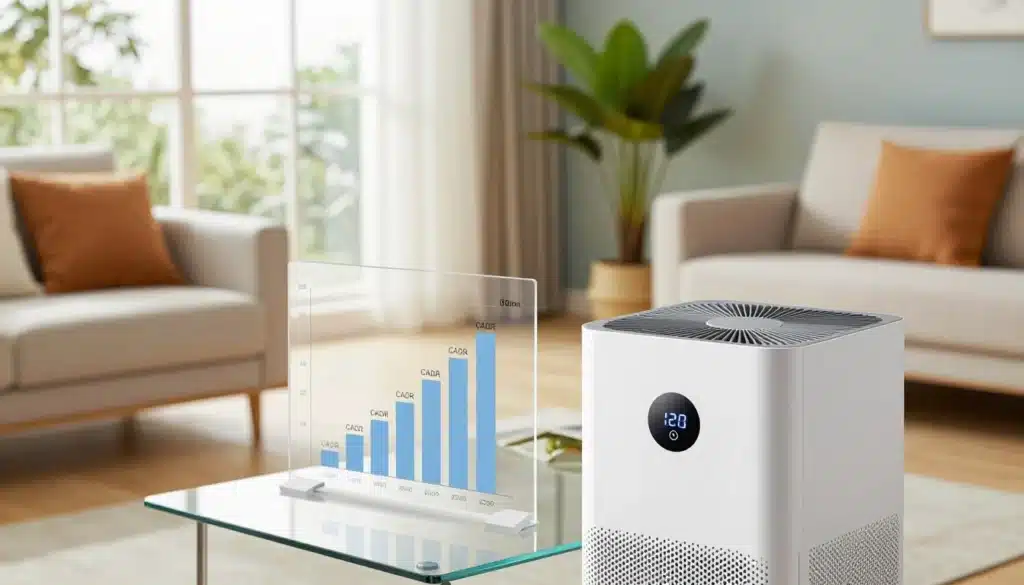
Calculating the right CADR for your room
First, find room volume by multiplying length × width × height. Then, plug that volume into the basic relationship for required CADR (CFM):
Required CADR (CFM) ≈ Room volume (cubic feet) × Desired ACH / 60.
A common rule-of-thumb used by AHAM and many manufacturers for smoke is: CADR (for smoke) ≈ Room area (sq ft) × 1.5. This roughly gives 2 ACH in an 8-foot ceiling room.
Round up the calculated CADR to allow for furniture, doors, and real-world inefficiencies. Picking a slightly higher air purifier CADR provides useful margin when airflow is restricted.
Using CADR with ACH to size a unit
Pick an ACH target based on needs. For general air cleaning aim for 2–5 ACH. For wildfire smoke or higher infection risk aim for 4–6+ ACH. These targets guide air purifier sizing.
Convert CADR to ACH with this formula:
ACH = (CADR × 60) / Room volume.
Choose a unit that meets your target ACH at a fan speed you will tolerate. Noise and speed trade-offs can cut effective CADR if you run the purifier on lower settings.
Practical examples for bedrooms, living rooms, and open floor plans
Bedroom example: 12′ × 12′ × 8′ = 1,152 cu ft. For 4 ACH: CADR ≈ (1,152 × 4) / 60 ≈ 77 CFM. Recommend selecting a unit with at least 100 CFM smoke CADR.
Living room example: 20′ × 15′ × 8′ = 2,400 cu ft. For 4 ACH: CADR ≈ (2,400 × 4) / 60 ≈ 160 CFM. Recommend about 200 CFM for margin and real-room losses.
Open floor plan: Calculate the combined volume for all connected zones. If the scene has multiple activity areas, consider multiple smaller units rather than one large one to prevent dead zones.
| Space | Dimensions | Volume (cu ft) | Target ACH | Calculated CADR (CFM) | Recommended air purifier CADR |
|---|---|---|---|---|---|
| Small bedroom | 10’×10’×8′ | 800 | 4 | (800×4)/60 = 53 | 75–100 CFM (smoke) |
| Standard bedroom | 12’×12’×8′ | 1,152 | 4 | (1,152×4)/60 = 77 | 100 CFM (smoke) |
| Living room | 20’×15’×8′ | 2,400 | 4 | (2,400×4)/60 = 160 | 200 CFM (smoke) |
| Large open plan | 30’×20’×9′ | 5,400 | 4 | (5,400×4)/60 = 360 | Two units: 180 CFM each or one 400+ CFM |
Smoke, Dust, or Pollen – Does CADR Treat Them All the Same?
Different particles act differently. CADR smoke dust pollen numbers show how well air purifiers handle three sizes of particles. This helps you find the right air purifier for smoke, allergies, or dust.
Why specific CADR values matter
Smoke particles are small and stay in the air longer. An air purifier’s CADR for smoke shows its effectiveness against wildfire smoke or indoor smoke. Dust and pollen are larger, so their CADR values tell you how well an air purifier cleans your home.
Practical tips for wildfire smoke, allergies, and pets
For smoky air, run your air purifier more and choose models with high CADR for smoke and true HEPA filters. Close doors and windows to keep out pollutants and increase ACH during smoky days.
For allergies, pick air purifiers with strong CADR for allergies and true HEPA filters. Use a pre-filter for pet hair and big debris to keep the HEPA filter working well and last longer.
For pet owners, focus on pet dander CADR. Use a good vacuum and an air purifier with strong CADR for dust and pollen, plus electrostatic or true HEPA filters. This combo cuts down on pet dander and fur in the air.
Choosing filters and features to boost real-world CADR
True HEPA filters remove the most particles. Pre-filters catch big particles, helping the HEPA filter last longer. Activated carbon helps with smells but doesn’t affect CADR for particles.
Look for air purifiers with adjustable fan speeds, turbo modes, and filter life indicators. Washable pre-filters save money and keep air flowing. Make sure to check the cost and availability of replacement filters, as low-quality or clogged filters can lower performance.
| Issue | Recommended CADR focus | Filter type | Usage tip |
|---|---|---|---|
| Wildfire smoke | High air purifier CADR for smoke | True HEPA + sealed housing | Run at higher fan speeds and seal room |
| Seasonal pollen | High CADR for allergies | True HEPA + pre-filter | Place near windows or bedroom; change pre-filter often |
| House dust | Balanced CADR smoke dust pollen | HEPA + washable pre-filter | Vacuum regularly to reduce load |
| Pet dander | High pet dander CADR and dust CADR | True HEPA + electrostatic option | Groom pets and clean floors to lower airborne dander |
| Mixed pollutants | Strong particulate CADR + carbon for odors | HEPA + activated carbon | Choose combined filter stacks and monitor AQI |
CADR Is Not the Whole Story – Here’s What Else Matters
Getting the most from an air purifier is more than just looking at the CADR number. Real rooms, furniture, and habits affect how well it cleans the air. By taking practical steps on placement and upkeep, you can turn a rated air purifier into a real air cleaner.
Placement, maintenance, and filter replacement tips
Place the purifier near the pollution source when possible. For kitchens, fireplaces, or a smoking area, position the unit so it can pull contaminated air directly. In living spaces aim for a central spot with several inches of clearance from walls and furniture to avoid blocked intakes.
Check pre-filters monthly and follow manufacturer schedules for HEPA or carbon replacement. Using genuine filters from brands like Dyson, Honeywell, or Coway ensures fit and rated performance. Clean external grilles and vacuum washable pre-filters; clogged filters lower airflow and reduce the air purifier performance metric.
How airflow, room layout, and obstacles affect CADR results
Furniture, open doors, and HVAC vents create complex air patterns. These patterns can form dead zones where cleaned air fails to reach. Irregular rooms and high ceilings change circulation and lower real-world CADR compared with lab conditions.
Use ceiling fans or small box fans to improve mixing and distribution of treated air. Run purifiers continuously at a moderate fan speed to maintain steady pollutant control. Avoid placing units in corners or behind couches where airflow becomes restricted.
When to combine multiple units or use supplemental ventilation
Large rooms and open floor plans often benefit from two or more smaller units placed in different zones rather than a single oversized purifier. Strategically distributed units reduce transport time and cut down on dead zones, so combined results can exceed a lone unit’s rating when you combine units CADR in practice.
For prolonged smoke events or infection control, pair portable purifiers with improved building ventilation. Upgrading HVAC filters to MERV 13 and increasing fresh-air mechanical ventilation helps lower indoor concentrations. Aim for higher combined ACH—about 4–6 or more—by using purifiers plus supplemental ventilation and sealing leaks.
| Action | Why it helps | Simple tip |
|---|---|---|
| Central placement with clearance | Maximizes intake and exhaust flow for better coverage | Keep at least 6–12 inches from walls and furniture |
| Regular air purifier maintenance | Prevents pressure drop and maintains rated performance | Check pre-filters monthly; replace HEPA per indicator |
| Use fans for mixing | Reduces dead zones and speeds pollutant removal | Direct a ceiling or box fan gently toward purifier |
| Combine units CADR across zones | Improves coverage in large or irregular spaces | Place units where people spend time, not in corners |
| Supplemental ventilation | Brings filtered fresh air and lowers overall load | Upgrade HVAC filters to MERV 13 and add mechanical fresh air |
| Continuous moderate operation | Maintains steady-state pollutant control | Run units 24/7 at a middle fan speed for balance |
The Bottom Line: Should CADR Be Your Deciding Factor?
Knowing about clean air delivery rate (CADR) helps you compare air cleaners. CADR is a standard measure that shows how well an air purifier works. It tells you how fast it can remove smoke, dust, and pollen in lab tests.
Use the CADR rating to find the right size air purifier for your room. But remember, it’s based on controlled conditions, not real-world situations.
When picking an air purifier CADR, look for AHAM-certified numbers. Also, check the HEPA or MERV filter and the ACH level you need. Calculate the CADR or ACH your space needs, then choose a model a bit higher.
This way, you can account for furniture, doors, and air leaks. Running units based on local air quality, like EPA AirNow alerts, makes them more effective during high-risk events like wildfires.
Maintenance is key: replace filters regularly, place units wisely, and sometimes use more than one. This boosts performance beyond what lab tests show. CADR is just one factor to consider when choosing an air purifier for your home or rented space.
With this knowledge, you can pick the right CADR for your room size. Keep your devices in good shape and use them when needed. This way, you can keep your indoor air clean during allergy season, wildfires, or just everyday life.
FAQS
What is Clean Air Delivery Rate (CADR)?
CADR is a measure of how well an air purifier cleans the air. It’s measured in cubic feet per minute (CFM). It shows how fast it can remove smoke, dust, and pollen from a room.
Why are there three CADR numbers (smoke, dust, pollen)?
Each CADR number is for a different size of particle. Smoke is the smallest, dust is mid-size, and pollen is the largest. This helps you know which pollutants a unit can handle best.
How does CADR relate to HEPA, MERV, and ACH?
CADR measures how well a purifier cleans a whole room. HEPA filters remove 99.97% of particles at 0.3 µm. MERV rates HVAC filters, and ACH shows air exchange. Together, they help you understand a purifier’s effectiveness.
How is CADR measured and who sets the testing standards?
CADR is measured in a sealed test chamber. A known pollutant is introduced, and the purifier’s effectiveness is tested. The Association of Home Appliance Manufacturers (AHAM) sets the standards.
Does a high CADR guarantee the same performance in my home?
Not always. CADR is tested in ideal conditions. Real-world factors like room layout and fan noise can affect performance. Choose a CADR slightly higher than needed and follow best practices for placement and maintenance.
How do I pick the right CADR for my room size?
Calculate your room’s volume and desired air changes per hour (ACH). For a simple rule, multiply floor area by 1.5 for smoke CADR. Round up for furniture and other losses. For example, a 12’×12′ room needs a unit with at least 100 CFM smoke CADR.
What ACH should I aim for in different situations?
Aim for 2–5 ACH for general cleaning. For wildfire smoke or high pollution, aim for 4–6+ ACH. Balance fan speed with noise tolerance. Use multiple purifiers or add ventilation for large spaces.
What should I look for on an AHAM CADR label?
Look for CADR numbers for smoke, dust, and pollen, and a recommended room size. Check the fan speed and ceiling height assumptions. AHAM verification means the values were tested to a standard protocol.
Can CADR measure gases, VOCs, or odors?
No. CADR only measures particulate removal. For gases and VOCs, look for units with activated carbon or chemisorption. Check VOC removal testing where available.
How do placement and maintenance affect CADR performance?
Placement and upkeep are key. Place the purifier centrally or near pollutant sources. Keep intakes and exhausts clear and run units continuously. Replace filters as needed to maintain performance.
Should I use one large unit or multiple smaller units in an open floor plan?
Multiple units may be better for large or irregular spaces. They reduce transport time and dead zones. Combine portable purifiers with HVAC upgrades for best results.
Are there tips for households dealing with wildfire smoke, allergies, or pet dander?
For wildfire smoke, choose high smoke CADR and true HEPA. Run at higher fan speeds and seal the room. For allergies and pollen, use high pollen CADR and HEPA plus pre-filters. Regular grooming and monitoring air quality help set targets.
How can I validate an air purifier’s real-world performance?
Use a particle counter to check before and after running the purifier. Test different placements and fan speeds. Watch for filter life indicators and airflow. AHAM certification and reviews add confidence.
