
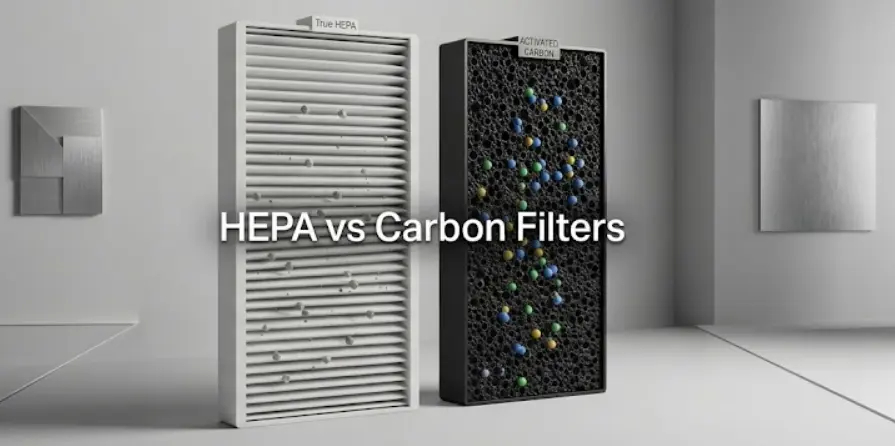
When it comes to indoor air quality, picking between HEPA and activated carbon filters is key. This guide compares these two air purifier filter technologies. It helps you choose the right one for allergies, odors, or chemicals in your home or office.
HEPA filters catch pollen, dust mites, pet dander, and smoke. Activated carbon focuses on odors, VOCs, and gases. Often, using both together is the best choice.
This article uses advice from the U.S. Environmental Protection Agency and the American Lung Association. It also looks at how each technology works, its uses, health effects, costs, and maintenance. You will get tips for bedrooms, kitchens, basements, and offices.
Whether you have allergies, pets, live in the city, or have a busy kitchen, this comparison is for you. It aims to give you practical, evidence-based advice – not a single solution for everyone.
Quick Comparison: HEPA vs. Carbon
| Feature | True HEPA (H13/H14) | Activated Carbon |
| Best For | Dust, Pollen, Pet Dander, Mold | Cooking Odors, Smoke, VOCs, Chemicals |
| Mechanism | Mechanical Filtration (Interception) | Chemical Adsorption (Pores) |
| Particle Size | Down to 0.1 Microns | Molecular Level (Gases) |
| Lifespan | 6–12 Months | 3–6 Months |
Table of Contents
- Quick Comparison: HEPA vs. Carbon
- Understanding HEPA and Activated Carbon Filters
- What is a HEPA Filter and How It Works
- What is an Activated Carbon Filter and How It Works
- Which One Do You Actually Need?
- Effectiveness for Allergies and Health
- Choosing by Room Type & Lifestyle
- Cost, Lifespan, and Maintenance
- Expert Verdict And Key Takeaways
- Air Purifier Filters FAQS: HEPA vs. Carbon
Understanding HEPA and Activated Carbon Filters
Choosing the right air cleaner starts with the basics. Whether for a bedroom or a clinic, knowing how these filters operate is essential for long-term air health.
What is a HEPA Filter and How It Works
A HEPA (High-Efficiency Particulate Air) filter is designed to trap microscopic physical particles. It captures at least 99.97% of particles 0.3 microns and larger using three mechanisms: Interception, Impaction, and Diffusion.
- Strengths: Excellent for pollen, dust mites, pet dander, and smoke particles.
- Expert Tip: Watch out for “HEPA-type” labels; they do not meet the strict H13 medical-grade standards.
In our hands-on tests, we found that Shark Air Purifier HP152 Review consistently highlight the efficiency of their H13 True HEPA filters in capturing fine dust.
Activated carbon is charcoal treated to open millions of tiny pores. It works through Adsorption (where gas molecules stick to the surface) rather than absorption.
-
- Strengths: Highly effective against cooking smells, pet odors, and VOCs like formaldehyde or benzene.
- Expert Tip: Effectiveness depends on the “Carbon Bed” thickness. Pellets work better than thin sheets.
For those living in areas prone to pollution, combining carbon with HEPA is essential, as noted in our guide on the best air purifiers for wildfire smoke.
| Feature | HEPA | Activated Carbon |
|---|---|---|
| Primary function | Particle removal (≥0.3 μm, mechanical capture) | Gas and odor adsorption (VOCs, smoke odor) |
| Typical targets | Pollen, dust mites, pet dander, smoke particles, some bacteria | Cooking odors, formaldehyde, benzene, solvents, pet smells |
| Limitations | Does not remove gases or most VOCs | Does not reliably remove fine particles alone |
| Best locations | Bedrooms, clinics, classrooms, living rooms | Kitchens, garages, salons, labs, apartments with VOC sources |
| Typical pairing | Often paired with carbon for broader coverage | Paired with HEPA to form combined air purifier filters |
| Notes on claims | Watch for “HEPA-type” labels; check standards or MERV for HVAC | Effectiveness varies by carbon bed size and treatment |
Which One Do You Actually Need?
Deciding between them depends on your specific “Air Problem.” At Air Purifiers Hub, we recommend assessing your environment first.
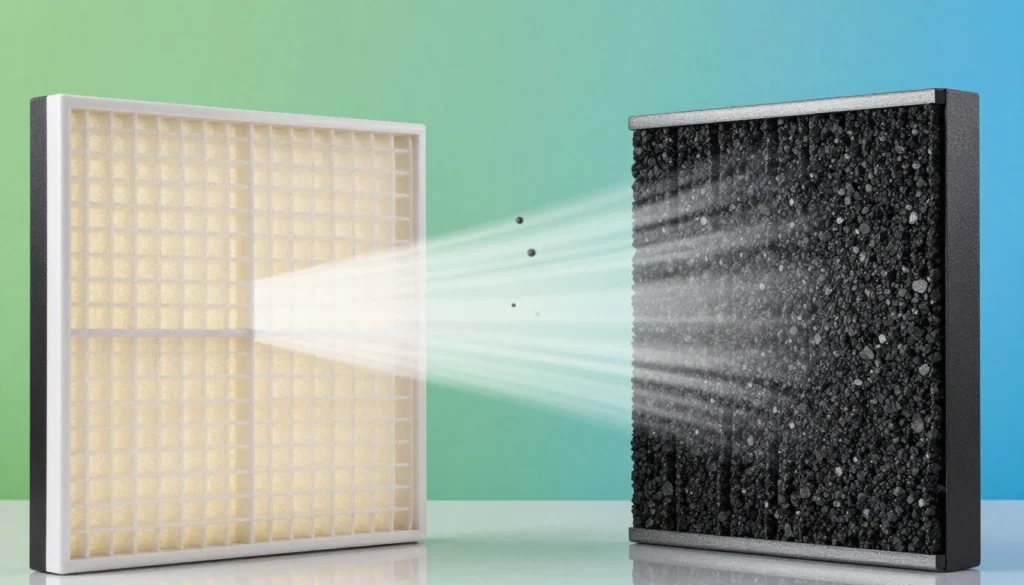
- Choose HEPA if: You suffer from asthma, allergies, or live in a dusty area.
- Choose Activated Carbon if: You have persistent odors, new furniture, or chemical vapors.
- The Hybrid Solution: For 90% of homes, a Combined System (HEPA + Carbon) is the best choice.
Effectiveness for Allergies and Respiratory Health
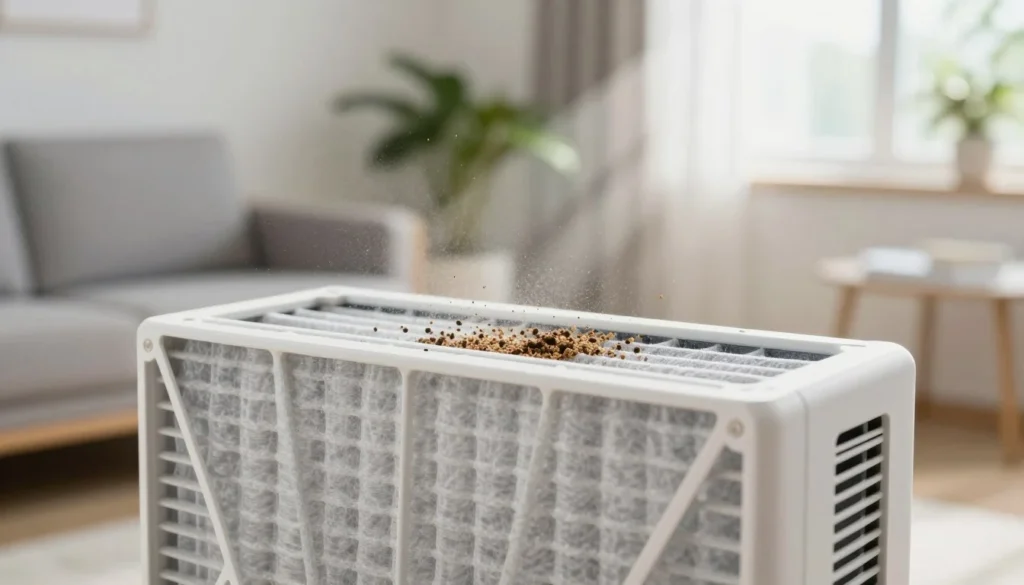
HEPA filtration significantly lowers indoor PM2.5 levels. Activated carbon targets the chemical triggers that cause headaches and throat irritation.
Choosing by Room Type & Lifestyle
Bedroom: Use True HEPA for silent, allergen-free sleep. Kitchen: Use heavy Activated Carbon for cooking fumes. Pet Owners: A combination of HEPA and a washable prefilter is essential.
Cost, Lifespan, and Maintenance
Upfront costs for HEPA units are affordable, but replacement filters range from $20 to $100. Always use a washable prefilter to extend the life of your expensive filters.
Expert Verdict And Key Takeaways
- HEPA is for Particles (Dust/Pollen).
- Activated Carbon is for Gases (Odors/Chemicals).
- The Secret: Most effective purifiers use a “Sandwich” approach: Prefilter -> HEPA -> Carbon.
Air Purifier Filters FAQS: HEPA vs. Carbon
Can a HEPA filter remove odors from my home?
No. Standard HEPA filters are designed to capture physical particles like dust, pollen, and pet dander. To eliminate smells from cooking, smoke, or pets, you need an activated carbon filter, which chemically traps gas molecules.
Do I need both HEPA and carbon filters in one unit?
Ideally, yes. Most high-performance air purifiers combine both. The HEPA filter cleans the “visible” air pollutants (dust), while the carbon layer cleans the “invisible” pollutants (VOCs and odors) for total air purification.
Which filter is better for allergies and asthma?
HEPA is the better choice. If you suffer from seasonal allergies or asthma triggered by dust mites or mold spores, a True HEPA filter capturing 99.97% of particles is the most critical component you need.
How often should I replace an activated carbon filter vs. a HEPA?
Carbon filters often saturate faster, typically lasting 3–6 months because they absorb gases. True HEPA filters generally last longer, between 6–12 months, depending on the air quality in your home.
Does a carbon filter help with wildfire smoke?
Yes, but only partially. Wildfire smoke contains both ash particles (captured by HEPA) and toxic gases/VOCs (captured by carbon). For wildfire protection, a dual-filter system is strongly recommended.
Is a “HEPA-type” filter as good as a “True HEPA” filter?
No. “HEPA-type” is a marketing term and does not meet the strict 99.97% efficiency standard. For medical-grade air cleaning, always look for the True HEPA or H13 HEPA certification.
Can I wash my activated carbon filter to reuse it?
Never. Washing a carbon filter destroys its porous structure and renders it useless. Once the carbon pores are full of gas molecules, the filter must be replaced to remain effective.
