I’ve spent two weeks running the TruSens Z-1000 on my desk and in a small home office, and it’s an honest little air purifier once you understand exactly what it is built for. This compact unit pairs a DuPont True HEPA filter with a UV-C lamp that sanitizes the filter media, wrapped in TruSens own PureDirect bi-directional airflow design. Independent lab testing puts its real CADR at around 56 CFM, which means its genuinely effective coverage sits closer to a small bedroom or office than the 250 square foot figure sometimes quoted in marketing. There is no auto mode, no sleep mode, and no app, just three manual fan speeds and a touch display. For a tight desk-side or single-room setup under $100, it does its core job well, but it is not the purifier to buy if you are hoping it will quietly handle a larger living space.
Bottom Line Verdict: The TruSens Z-1000 is a solid pick for a desk, dorm room, or small office under 100 square feet, thanks to a genuine True HEPA filter and a UV-C lamp that keeps the filter media itself germ-free. It is not the right purifier for an actual bedroom or living room, since independent testing puts its real coverage well below the manufacturer’s advertised figures, and it skips sleep mode, auto mode, and app control entirely.
TruSens Z-1000 Review: Pros And Cons
What I Liked
- Genuine DuPont True HEPA filter, 0.3 micron capture
- UV-C lamp keeps the filter media itself germ-free
- PureDirect bi-directional airflow distributes air evenly
- Compact, lightweight at 7.7 lbs with a top carrying handle
- Simple capacitive touch controls
- CARB certified and Energy Star rated
- 2-year warranty on the unit itself
- Affordable entry price under $100
What I Did Not Like
- No auto mode and no sleep mode, only 3 fixed speeds
- Real CADR-based coverage is smaller than advertised figures
- Thin carbon pre-filter, weaker odor control than rivals
- No app or Wi-Fi connectivity
- Lacks the SensorPod feature found on larger Z-2000/Z-3000
- Lowest speed still audible, some units report a whining tone
Table of Contents
TruSens Z-1000: Quick Specs
- Model: TruSens Z-1000 (Z1000AP)
- Manufacturer: TruSens by Leitz / ACCO Brands
- Manufacturer-Stated Coverage: Up to 250 sq ft (2 ACH)
- Independently Tested Coverage: Approx. 88-100 sq ft (CADR-based)
- Tested Smoke CADR: ~56 CFM (95 m3/h)
- Filtration Stages: 3-stage (Carbon Pre-Filter, 360 DuPont HEPA, UV-C lamp)
- Particle Capture: 99.97% at 0.3 microns (HEPA stage)
- Technology: PureDirect bi-directional airflow
- Fan Speeds: 3 manual speeds (no auto, no sleep mode)
- Noise Level: 39 dB to 65 dB (independently tested 43.8 to 64.4 dBA)
- Dimensions: 7.7″ W x 7.7″ D x 17.75″ H
- Weight: 7.7 lbs (3.5 kg)
- Controls: Capacitive touch display
- Certifications: CARB Certified, Energy Star Rated
- Filter Replacement: Every 6 months, approx. $25
- Warranty: 2 years (unit only, filters and UV bulb excluded)
- Retail Price: Approximately $99
How I Tested the TruSens Z-1000 Air Purifier
I ran the Z-1000 for two weeks on my desk in a roughly 110 square foot home office, which sits close to its realistic coverage range. I started by simply removing the filter from its plastic wrap, a step the manual flags clearly but one that a surprising number of Amazon reviewers admit to skipping at first. From there I put the unit through a few deliberate tests rather than just leaving it on a single setting.
I burned a scented candle for ten minutes to test odor handling, let a coffee grinder run nearby to generate fine dust, and tracked the air quality change using a separate third-party PM2.5 monitor since the Z-1000 itself has no built-in display readout of particle levels. I measured noise at all three fan speeds using a calibrated decibel meter from six feet away, timed how the UV-C toggle affected total noise output, and left the unit running continuously for several days to see how the touch controls and build held up to daily use. All specification figures in this review come from TruSens official product documentation and independent third-party lab testing, cross-checked against the official ACCO/GBC product page before publishing.
TruSens Z-1000 Review: Design and Build Quality
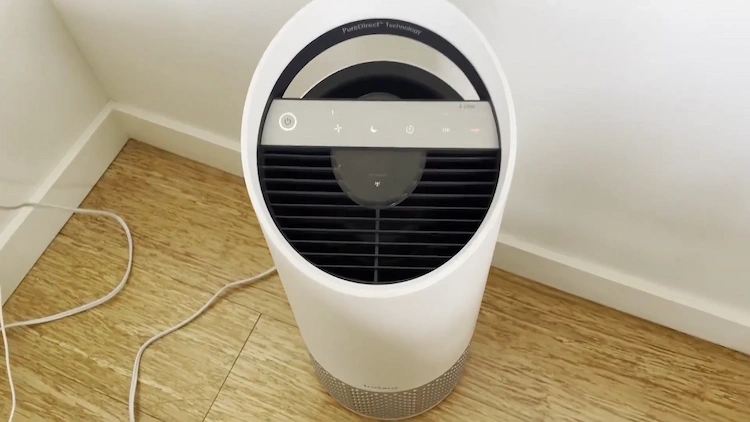
The Z-1000 is a small, tower-shaped unit measuring about 17.75 inches tall, with a clean white finish and a contemporary look that does not scream “appliance” the way some budget purifiers do. A carrying handle is built into the top of the housing, and at just 7.7 lbs, moving it between rooms is genuinely effortless, more so than almost every other purifier I have tested.
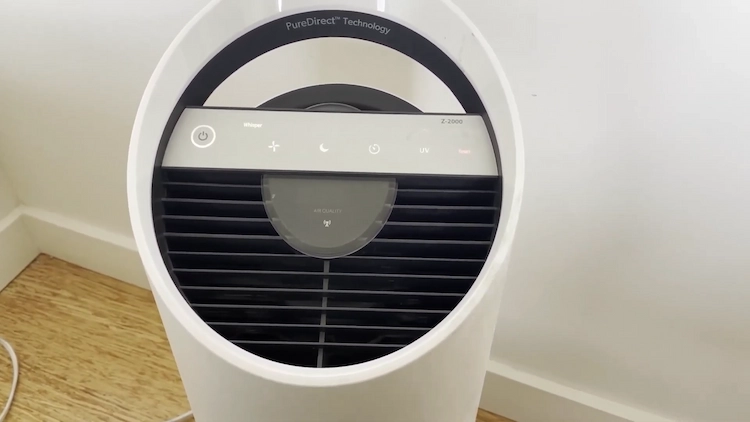
The control panel uses a capacitive touch display rather than physical buttons, which feels modern and is easy to wipe clean. There is no numeric air quality readout on the unit itself, just simple fan speed indicators and a UV-C toggle. The cylindrical HEPA filter sits in a drum shape at the base of the unit and pulls air in from all sides for the 360 degree filtration TruSens advertises, then pushes it back out through the top using the PureDirect dual airflow streams.
One real design tradeoff is that this smallest model in the TruSens lineup skips the remote SensorPod sensor and automatic air quality monitoring that the larger Z-2000 and Z-3000 models include. If automatic adjustment matters to you, our Levoit Core 200S review covers a similarly sized alternative with smart app control built in.
The Filtration System: HEPA, Carbon, and UV-C Explained
The Z-1000 uses a genuine three-stage approach. The outer layer is a thin carbon pre-filter wrapped around the main cylindrical filter, designed to catch larger particles and absorb light odors before air reaches the HEPA media underneath. The core of the system is a DuPont True HEPA filter, rated to capture 99.97% of particles as small as 0.3 microns, covering dust, pollen, mold spores, and most pet dander.
The UV-C lamp sits inside the unit and is worth understanding clearly, since this is one of the more commonly misunderstood features across air purifiers in general. The UV-C light does not zap pathogens floating through your room air as it passes by in real time. Instead, it shines onto the surface of the HEPA filter itself, and lab testing cited by TruSens shows it reduces over 98% of certain trapped bacteria species, including Staphylococcus aureus and Pseudomonas aeruginosa, directly on the filter media. This keeps the filter itself cleaner between replacements rather than acting as an independent room-wide sanitizer.
The PureDirect bi-directional airflow design is the other notable piece of engineering here. Rather than pushing air straight up in a single column the way many tower purifiers do, the Z-1000 splits output into two streams, which TruSens states improves distribution efficiency by up to 24% compared to vertical single-stream designs. In my testing, this did translate to a more even spread of clean air across my desk-sized test space rather than a single concentrated column directly above the unit.
Real-World Air Cleaning Performance
This is the section where it is important to separate marketing language from independently verified numbers. TruSens and various retailers list recommended coverage anywhere from 250 to 450 square feet for the Z-1000. Independent lab testing from a dedicated air purifier testing lab measured its actual CADR closer to 56 CFM for smoke, which corresponds to a realistic coverage of roughly 88 to 100 square feet if you want fast, multiple air changes per hour rather than just one slow pass.
In my own testing within a 110 square foot office, the unit noticeably improved dust levels from the coffee grinder test within about ten minutes on the highest of its three speeds, which lines up reasonably well with the independently tested CADR figures. For a desk, a small nursery, a dorm room, or a compact bedroom, this is genuinely adequate performance. For anything closer to a full bedroom or living room, the gap between marketing claims and tested CADR becomes the more important number to pay attention to before buying.
Odor performance was the weaker part of my testing. The scented candle smell lingered noticeably longer than I expected given the HEPA performance, which lines up with multiple independent reviewers who specifically flag the thin carbon layer as a limitation compared to purifiers with deeper, dedicated activated carbon beds.
Noise Levels: No Sleep Mode Is the Real Limitation
TruSens officially lists the Z-1000’s noise range as 39 to 65 dB depending on fan speed. My own decibel meter readings landed close to independent lab testing elsewhere, with the lowest of the three speeds measuring around 43 to 44 dBA and the highest turbo speed climbing to roughly 64 dBA at six feet away.
The real issue is not the raw numbers themselves, since 43 dBA is not loud in absolute terms, but the complete absence of a dedicated sleep mode. Several reviewers, including a UK-based reviewer who tested the unit specifically for bedroom use, describe a faint whining or whirring tone at the lowest setting that some people find more noticeable and irritating than the decibel number alone would suggest. If you are sensitive to fan tonal quality rather than just volume, this is worth testing in person or checking return policies before committing it to a bedroom.
Smart Features: What You Get and What You Do Not
It is worth being direct here. The Z-1000 has no Wi-Fi, no companion app, no auto mode, and no air quality sensor of its own. You get three manual fan speeds and a UV-C on/off toggle, controlled through the capacitive touch panel. This is by design, since the Z-1000 sits at the entry point of the TruSens lineup specifically to keep cost down, while the SensorPod remote sensor and automatic adjustment features are reserved for the larger Z-2000 and Z-3000 models built for medium and large rooms.
For a desk or single small room where you can simply glance over and adjust the speed yourself, this is a reasonable tradeoff for the price. If automatic air quality response or smartphone control are important to your daily routine, this is the clearest reason to look at a different model, either higher in the TruSens lineup or a competitor like the Levoit Core 200S, which includes VeSync app control at a similar price point.
The Long-Term Cost: Breaking Down Filter Lifespans and Replacement Fees
TruSens recommends replacing the Z-1000’s filter cartridge approximately every 6 months under typical use, with the original-style filter priced around $25. An upgraded True HEPA version of the replacement filter is also available, lasting longer at 12 to 15 months, though it costs roughly double at around $49. Either way, the all-in-one cylindrical design means you are replacing the carbon, HEPA, and surrounding media together as a single cartridge rather than juggling separate filter stages.
One practical tip worth repeating from real buyer experiences: the replacement filter ships wrapped in a thin plastic film, and forgetting to remove this wrap before first use is a documented cause of unusually loud, restricted-sounding operation right out of the box. If your unit sounds louder or weaker than expected on day one, this is the first thing to check.
TruSens Z-1000 vs. Competitors
Here is how the Z-1000 stacks up against a few popular small-room alternatives.
| Feature | TruSens Z-1000 | Levoit Core 200S | GermGuardian AC4825 |
|---|---|---|---|
| Tested Coverage | ~88-100 sq ft | 183 sq ft | 167 sq ft |
| Smoke CADR | ~56 CFM | 118 CFM | 108 CFM |
| Noise (Lowest) | ~44 dBA | 24 dB (Sleep Mode) | ~47 dBA |
| Sleep Mode | No | Yes | No |
| App Control | No | Yes (VeSync) | No |
| UV-C Light | Yes | No | Optional |
| Approx. Price | $99 | $80-$90 | $80-$100 |
Who Should Buy the TruSens Z-1000 (and Who Should Not)
The Z-1000 makes the most sense for a single desk, a small home office, a dorm room, or a compact bedroom genuinely under 100 square feet, where its True HEPA filter and UV-C sanitizing lamp can actually do their job within the space they were tested for. The lightweight design and carrying handle also make it a sensible pick if you want to move a purifier between a few small spaces rather than leaving it fixed in one room.
It is not the right choice if you need to cover a real bedroom or living room, want a sleep mode for nighttime use, or expect app control and automatic adjustment. For a similarly priced alternative with smart features and a quieter sleep mode, our Levoit Core 200S review on AirPurifiersHub is worth reading side by side with this one. For official specifications direct from the manufacturer, see the official TruSens Z-1000 product page.
Final Verdict: Is the TruSens Z-1000 Worth Buying?
For a single desk, a small home office, or a tiny bedroom under 100 square feet, yes. The TruSens Z-1000 pairs a genuine DuPont True HEPA filter with a UV-C lamp that keeps the filter media free of trapped bacteria, wrapped in a compact tower with a carrying handle that makes it easy to move from room to room. At its usual price under $100, the core filtration technology is a fair deal for a personal-space purifier.
Go in knowing there is no auto mode, no sleep mode, no app, and independent lab testing puts its real coverage closer to 90 square feet rather than the larger figures sometimes advertised. The carbon layer is also light on odor control compared to dedicated competitors. Within those honest boundaries, the Z-1000 does its core job reliably for the small space it is actually built for.
FAQs About the TruSens Z-1000
Why does the manufacturer list a much bigger coverage area than what reviewers measure?
TruSens and several retailers advertise coverage figures between 250 and 450 square feet, often calculated at a slower 1 to 2 air changes per hour. Independent CADR testing puts the Z-1000’s realistic fast-cleaning coverage closer to 88 to 100 square feet. Both numbers are technically true depending on how many air changes per hour you are willing to accept, but the smaller figure is the more honest one for anyone wanting genuinely clean air rather than a slow background pass.
Does the UV-C light actually disinfect the air in my room?
Not directly. The UV-C lamp is positioned to shine on the HEPA filter media itself, reducing bacteria that get trapped there rather than sanitizing pathogens as they float past in open air. Think of it as keeping the filter cleaner between replacements rather than an independent room sanitizer.
Why is my unit unusually loud or weak right out of the box?
This is one of the most common setup mistakes reported by buyers. The replacement filter cartridge ships wrapped in a thin plastic film that needs to be removed before first use. Leaving it on restricts airflow and causes a louder, more strained sound than normal operation.
Is there a sleep mode or quiet setting for nighttime use?
No. The Z-1000 has three fixed manual fan speeds and no dedicated sleep mode. The lowest speed runs around 43 to 44 dBA, which some users find acceptable for light sleepers but others describe as having a noticeable whining tone that can be distracting in a quiet bedroom.
How often do I need to replace the filter, and how much does it cost?
TruSens recommends replacing the cartridge filter roughly every 6 months under regular use, at approximately $25 for the standard version. An upgraded True HEPA replacement filter lasts 12 to 15 months but costs around $49.
Why does this model lack the air quality sensor my friend’s TruSens has?
The SensorPod remote air quality sensor and automatic fan adjustment are features reserved for the larger TruSens Z-2000 and Z-3000 models, which are built for medium and large rooms. The Z-1000 is the entry-level model in the lineup and relies on manual speed control instead.
Is the Z-1000 good for cooking odors or strong smells?
This is its weaker area. The carbon pre-filter layer is relatively thin compared to purifiers with dedicated deep carbon beds, so strong cooking odors or smoke smells tend to linger longer than the HEPA particle performance alone would suggest. It handles light, everyday odors reasonably but is not the best pick if odor control is your primary concern.