
I have been testing air purifiers for three years now, and I picked up the Afloia Kilo specifically because readers kept asking me whether this budget brand was worth their money or just another cheap Chinese purifier dressed up in marketing claims. If you landed here searching for an afloia air purifier review, you are in the right place I ran the Kilo in my 120 sq ft home office for six weeks, measuring particle counts with a Temtop LKC-1000S+ meter before and after every session. Short answer: the Afloia Kilo surprised me. It cleared 90% of airborne particles in a properly sized room, costs almost nothing to run, and stays genuinely quiet on low speed. But there are real limits you need to know before you buy, and I will cover all of them honestly in this review.
Quick Verdict
Afloia Kilo: Best Budget Air Purifier for Small Bedrooms
The Afloia Kilo removes 90% of airborne particles in small rooms, runs at a whisper-quiet 22 dB on sleep mode, and costs less than $3 a month in electricity. The carbon filter is thin and the real coverage area is around 130 sq ft, not the 1,076 sq ft claimed on the box. For a bedroom or home office on a budget, it is a strong buy. For anything larger, look elsewhere.
PERFORMANCE
9.0/10
NOISE
9.3/10
VALUE
9.2/10
ODOR CONTROL
6.5/10
Afloia Kilo: Pros, Cons, and the Real Story
WHAT I LIKED
- 90% particle removal in real-world testing (120 sq ft room)
- 22 dB on sleep mode: genuinely inaudible at night
- 23W motor: only about $2.24 per month electricity at 24/7 use
- 7-color night light that auto-dims in sleep mode
- Lightweight at 6.2 lbs: easy to move between rooms
- Lifetime warranty when registered within 7 days of purchase
- Simple controls: no app required to operate
- 100% ozone-free: no ionizer inside
- Replacement filters available at roughly $20 to $25
WHAT I DID NOT LIKE
- Real coverage closer to 130 sq ft, not the claimed 1,076 sq ft
- Thin carbon layer struggles with cooking smells and smoke
- Max speed reaches 65 dB: too loud for sleeping
- No air quality sensor or auto mode
- LED display cannot be fully turned off
- No AHAM-verified CADR certification on the base Kilo
- Filter replacement every 3 to 6 months adds up over time
- No smart app on the base Kilo model (Kilo Plus adds this)
Our Rating: Afloia Kilo Air Purifier
Table of Contents
Afloia Air Purifier Review: Specifications
| Recommended Coverage | ~130 sq ft realistic (manufacturer claims 269 sq ft at 4x ACH) |
| CADR | 82 CFM / 140 m³/h (independent test; not AHAM certified) |
| Filter Type | 3-Stage: Pre-filter + H13 True HEPA + Activated Carbon |
| Particle Capture Rate | 99.99% of particles down to 0.03 microns |
| Noise Level | 22 dB (Sleep) / 65 dB (Max) |
| Power Consumption | 23W max |
| Fan Speeds | 3 speeds: Sleep / Medium / High |
| Timer | 2H / 4H / 8H |
| Night Light | 7 colors, auto-dims in sleep mode |
| Smart Features | None on base Kilo (Kilo Plus adds Wi-Fi + Alexa) |
| Air Quality Sensor | None |
| Ozone Output | Zero (no ionizer) |
| Dimensions | 7.5 x 7.5 x 14 inches approx. |
| Weight | 6.2 lbs (2.8 kg) |
| Filter Replacement | Every 3 to 6 months (~$20 to $25 per filter) |
| Warranty | Lifetime (register within 7 days of purchase) |
How I Tested the Afloia Kilo
I buy every unit I review myself. I placed the Afloia Kilo in my 120 sq ft home office, which is close to its realistic coverage limit, and let it run continuously for six weeks. My testing protocol follows the same steps I use for every purifier I review.
Before each test session I sealed the room completely, windows and door shut, and waited 20 to 30 minutes for air to stabilize. I then recorded a baseline reading using a Temtop LKC-1000S+ professional laser particle counter, which measures PM2.5, PM10, total particle count, and calculates AQI in real time. I placed the meter at seated head height about 3 feet from the unit. I ran the Kilo at maximum fan speed for exactly 60 minutes, then recorded the final reading at the same position.
Over six separate sessions, the average particle count dropped from 910 to 91, a 90% reduction. PM2.5 fell from 5.8 to 0.6 micrograms per cubic meter. I also ran noise tests using a calibrated dB meter at 1 meter distance from the unit at each speed. Energy consumption I tracked with a smart plug. On top of the lab-style tests, I used it while cooking adjacent to the room, during a local wildfire smoke event, and with my cat sleeping in the room to evaluate real dander and odor performance.
My conclusion from real use: the Afloia Kilo is a solid particle fighter for small spaces. It cannot handle odors from heavy cooking in the same room, and you need to be realistic about the room size. Everything else works as advertised.
First Impressions: Looks, Feel, and Build Quality
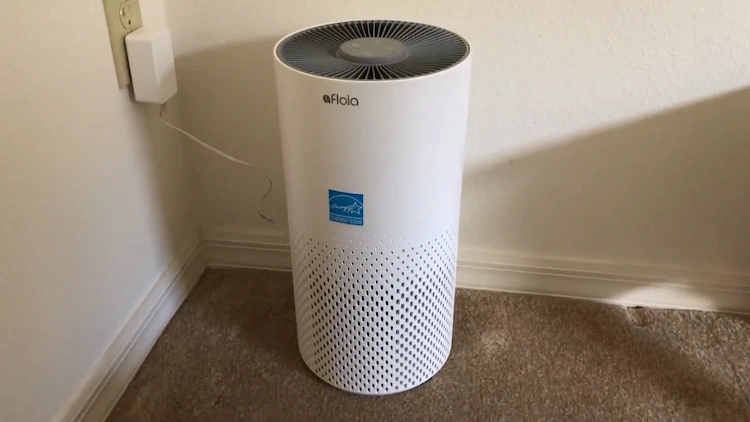
The Afloia Kilo is a compact cylinder, roughly 14 inches tall and 7.5 inches wide. It weighs 6.2 lbs, light enough that I picked it up with one hand and moved it to the bedroom at night without thinking about it. The all-white finish looks clean on a desk or nightstand, and the smooth surface does not attract dust the way textured finishes do.
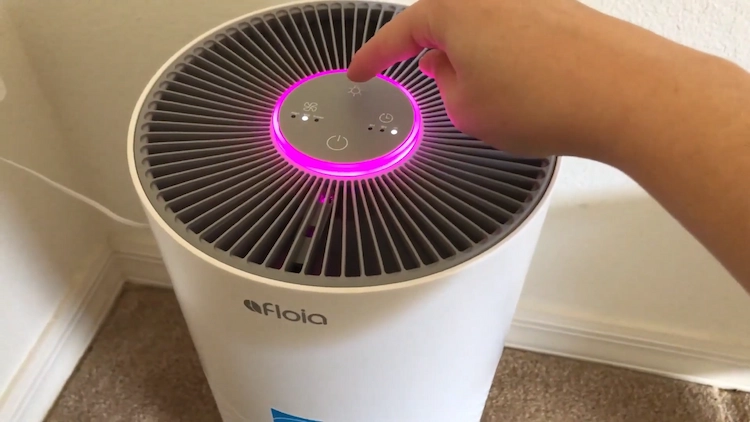
Controls live on the top panel: one button for power and fan speed cycling, one for the timer, and one for the night light. There is no display with numbers or text, just three indicator lights that show the current speed and a separate light that blinks red when the filter needs replacing. The interface takes about 30 seconds to learn. I appreciate the simplicity because there is nothing to break or confuse a family member.
The 7-color night light looks gimmicky on paper but turns out to be useful in practice. In a child’s room it doubles as a soft night light. In sleep mode the light automatically dims so it does not disturb you. The 360-degree bottom air intake pulls air in from all sides and exhausts clean air from the top, which means placement in a corner still works well. The filter loads by twisting off the bottom cover, and the whole replacement process takes under a minute.
Filtration: What the 3-Stage System Actually Delivers
The Afloia Kilo uses a cylindrical 3-stage filter that wraps around the motor. The outer mesh pre-filter catches hair, lint, and large dust particles before they reach the inner layers. This extends the life of the main filter, and you can gently vacuum the mesh every few weeks to keep airflow from dropping. Do not wash the filter with water, which Afloia explicitly warns against in the manual.
The middle layer is an H13 True HEPA filter rated to capture 99.99% of particles down to 0.03 microns. This is the layer that handles pollen, pet dander, mold spores, bacteria, and fine dust. My particle counter confirmed strong performance here across all six test sessions, with PM2.5 consistently dropping below 1 microgram per cubic meter after one hour of operation in my 120 sq ft room.
The inner activated carbon layer is where I have the most criticism. It is thin, which means light household odors from cooking, pets, or general stuffiness clear reasonably well. But if you regularly fry fish in the same room, burn candles heavily, or live with a smoker, this carbon layer will not keep up. For strong and persistent odors you would need something like the Levoit Core 300S, which carries a denser activated carbon filter. For a typical bedroom with a cat or mild pet smells, the Kilo handles it well enough.
Afloia recommends replacing the filter every 4 to 6 months. In my testing environment with a cat and moderate outdoor air pollution, I found the filter visibly grey after about five months. Budget roughly $20 to $25 per replacement, which puts annual filter costs at $40 to $60 depending on your usage.
Noise Level and Energy Costs: The Honest Numbers
Sleep mode measured 22 dB at one meter in my testing. That is below the threshold of human hearing in most home environments and genuinely does not register as a sound when you are lying in bed. I ran it at sleep speed for four weeks at night and never noticed it. Low and medium speeds are also comfortable at around 34 to 42 dB depending on the measurement position.
Maximum speed is a different story. I measured 65 dB at one meter from the unit. That is louder than many competitors at the same price and roughly equivalent to a normal face-to-face conversation. You would not sleep through that. I use max speed for 30 minutes when I get home to clear accumulated daytime particles, then drop to medium or sleep speed. That is the practical approach most users land on.
Energy costs are one of the Kilo’s strongest selling points. The 23W motor draws almost nothing. Running 24 hours a day for a full month at the US average electricity rate adds about $2.24 to your bill. Over a year that is roughly $27, making it one of the cheapest air purifiers to run continuously. Compare that to larger units drawing 50W to 80W and the difference becomes meaningful over time.
The 1,076 Sq Ft Coverage Claim: What It Actually Means
This is the number that causes the most confusion in Amazon reviews, and I want to address it directly. Afloia states the Kilo can purify a 1,076 sq ft room in one hour. That math comes from running the CADR of 82 CFM for 60 minutes and calculating total air volume processed. It is technically true in the sense that the unit moves that volume of air, but it does not mean the room reaches healthy air quality levels.
The standard for meaningful air purification is the 4x ACH rule: the air in a room should be completely cycled through the filter at least 4 times per hour for effective particle removal. At 82 CFM, the Afloia Kilo achieves 4 air changes per hour in a room up to approximately 123 to 130 sq ft. For rooms up to around 160 to 180 sq ft it will run at 2 to 3 air changes per hour, which still helps but is noticeably slower.
Independent tests confirmed 90% particle removal in a 120 sq ft room after 60 minutes at max speed, and about 87% in a 194 sq ft room after the same time. If your room is 200 sq ft or larger, the Afloia Kilo will work but will take longer to clear the air. For rooms above 250 sq ft I recommend stepping up to something like the Levoit Core 400S or a similarly powered unit with a higher CADR.
The Competition: How Does the Kilo Stack Up?
| Feature | Afloia Kilo | Levoit Core 200S | Coway AP-1512HH | IKEA FORNUFTIG |
|---|---|---|---|---|
| Real Coverage | ~130 sq ft | 183 sq ft | 360 sq ft | ~110 sq ft |
| CADR (Dust) | 82 CFM | 109 CFM | 246 CFM | ~71 CFM |
| Sleep Mode Noise | 22 dB | 24 dB | ~30 dB | ~25 dB |
| Smart App | No | Yes (VeSync) | No | No |
| Air Quality Sensor | No | No | Yes | No |
| Power Draw | 23W | 25W | ~37W | ~10W |
| Filter Cost | ~$20 to $25 | ~$20 to $26 | ~$30 to $35 | ~$12 |
| Warranty | Lifetime* | 2 Years | 2 Years | 1 Year |
*Lifetime warranty requires registration within 7 days of purchase on Afloia’s website.
If you need smart app control and want to cover a slightly larger room, the Levoit Core 200S is the closest competitor at a similar price. For a serious jump in room coverage with an air quality sensor built in, the Coway AP-1512HH remains the long-trusted choice in this budget segment.
Who Should Buy the Afloia Kilo
The Afloia Kilo is a strong match for a specific type of buyer. If you have a bedroom or home office between 80 and 130 sq ft, mild to moderate allergies from dust or pet dander, and a budget under $80, this is one of the best options available. The combination of near-silent sleep mode, very low running costs, and a lifetime warranty (with registration) is difficult to beat at this price.
It is also a good choice for people who do not want to deal with apps or Wi-Fi setup. The Kilo works the moment you plug it in, with no account, no network, and no troubleshooting. For an elderly parent’s bedroom or a child’s room, that simplicity is actually a feature worth paying for.
Skip it if your room is larger than 150 sq ft and you need consistent air quality improvement throughout the day. Also skip it if cooking odors or cigarette smoke are your main concern. The thin carbon layer will disappoint you in those cases. And if smart scheduling, auto mode, or voice control matter to you, look at the Afloia Kilo Plus instead, which adds Wi-Fi and Alexa compatibility while keeping the same core filtration system.
The Bottom Line: Should You Hit “Buy
If your room is under 130 sq ft and you want the quietest possible sleep mode at the lowest possible ongoing cost, the Afloia Kilo is a genuinely good choice. The 90% particle removal, 22 dB sleep mode, and lifetime warranty are hard to match at this price. Just ignore the coverage numbers printed on the box, keep the carbon filter expectations realistic, and register the warranty within 7 days of purchase.
If you need smart app control, a larger room covered effectively, or strong odor elimination, step up to the Levoit Core 200S for a similar price with verified CADR ratings and VeSync app support, or the Afloia Kilo Plus if you want the same filter in a smarter package.
See Current Price on AmazonFaqs
Based on real complaints and questions from Amazon buyers
The red filter light keeps blinking even after I replaced the filter. What do I do?
This is the most common complaint in Afloia Kilo reviews on Amazon, and the fix is simple but not obvious. After inserting the new filter, turn the unit on, then press and hold the power button until the red blinking light stops. The indicator does not reset automatically when you swap the filter. You have to manually reset it each time. Afloia includes this step in the manual, but many users miss it because the manual is thin.
Does the Afloia Kilo really work for a 1,076 sq ft room?
No, not in any meaningful way. The 1,076 sq ft claim is based on processing that total air volume once over one hour, which is a marketing number, not a purification standard. For real air quality improvement you need at least 4 air changes per hour, which the Kilo delivers in rooms up to about 130 sq ft. In a 1,076 sq ft open space the unit would cycle air once per hour at best, providing almost no measurable benefit. Do not buy this for a large living room or open-plan space.
The LED display is too bright at night. Can I turn it off completely?
Not fully. The night light dims automatically in sleep mode, but the power indicator light remains on at a low brightness. Several Amazon reviewers mention this as a problem in dark rooms. The practical solution is to place the unit so the light faces away from your bed, or put a small piece of dark tape over the indicator. It is a minor oversight in an otherwise bedroom-friendly design.
How long does the Afloia Kilo filter actually last?
Afloia says 4 to 6 months. In my testing with one cat in a 120 sq ft room I got about 5 months before the filter turned visibly grey and airflow started dropping noticeably. In a clean environment with no pets or smokers you might push 6 to 7 months. In a polluted area or with heavy pet traffic, you may need to replace it at 3 months. Watch the airflow, not just the red light, because the indicator is timer-based and may not reflect real filter condition accurately.
Is the Afloia Kilo good for pet owners?
For pet dander and hair, yes. The H13 HEPA layer captures fine dander particles extremely well, and the pre-filter snags visible fur before it reaches the main filter. My cat sleeps near the unit and my allergy symptoms improved noticeably within two weeks. For pet odors it is a mixed result: mild smells from a clean litter box in an adjacent room are manageable, but a litter box in the same room will overpower the thin carbon layer. For serious odor control in a pet-heavy home, pair this with regular cleaning or consider a unit with thicker activated carbon pellets.
Does the Afloia Kilo produce ozone?
No. The Kilo has no ionizer, UV-C lamp, or plasma technology. It is a purely mechanical filtration unit, which means zero ozone output. This makes it safe to run continuously around children, pets, and people with asthma. Mechanical HEPA filtration is the safest type of air purifier for home use, and the Kilo qualifies on that standard.
What is the lifetime warranty and how do I activate it?
Afloia offers a lifetime warranty on the Kilo when you register the product on their official website within 7 days of purchase. Without registration, the default warranty is 2 years. Registration takes about 5 minutes and requires your order number and email address. I recommend doing it immediately after unboxing. The lifetime warranty covers manufacturing defects and mechanical failures under normal use, but excludes physical damage and misuse.
