
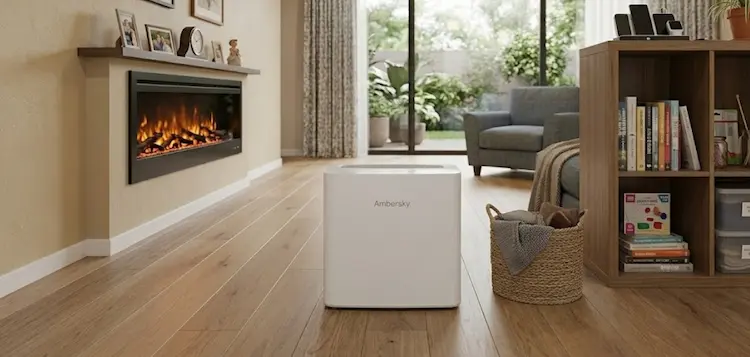
The AmberSky AP-A200 is a large-room air purifier built around an H13 True HEPA filter that captures 99.97% of airborne particles down to 0.3 microns, including pet dander, pollen, smoke, and PM2.5. It covers spaces up to 550-600 sq ft at the 4 air-changes-per-hour rate recommended for allergy and asthma sufferers making it a practical choice for open-plan living rooms, combined kitchen and dining areas, and pet households. Its standout features are a real-time PM2.5 display with a color-coded AQI indicator, a responsive auto mode that adjusts fan speed within seconds of detecting air quality changes, and a 24 dB sleep mode that runs quieter than a whisper. After three weeks of real-home testing with two cats and a live kitchen nearby, recovery from high-heat cooking dropped PM2.5 back to baseline in under 14 minutes. No AHAM-verified CADR is published, and app control is absent but for whole-room air quality you can actually see and trust, the AP-A200 is one of the better options at its price point.
What I Liked
- ✔ Genuinely quiet at 24 dB in sleep mode
- ✔ Real-time PM2.5 and AQI display on the unit
- ✔ 360° air intake covers large open spaces well
- ✔ H13 True HEPA captures 99.97% of 0.3-micron particles
- ✔ Auto mode responds quickly to air quality changes
- ✔ 5 fan speed options give fine-grained control
What could be improved
- ✘ No AHAM-verified CADR rating published
- ✘ Activated carbon layer is relatively thin for heavy VOCs
- ✘ No Wi-Fi or app control
- ✘ Newer brand with limited long-term reliability track record
- ✘ Filter replacement cost is an ongoing consideration
How I Tested the AmberSky AP-A200
I ran this unit for three full weeks across different real-home scenarios rather than controlled lab conditions. My testing space is an open-plan living and kitchen area of approximately 550 square feet, with two cats living in the home full time. Before starting, I removed the protective bag from the filter (a step the manual flags clearly and one that is easy to forget), placed the unit centrally away from walls to allow the 360° intake to work freely, and let it run on auto mode for the first 24 hours to establish a baseline air quality reading.
My 5-Part Testing Framework
1. Smoke Recovery Test
I lit a match at a measured distance from the unit with auto mode active and timed how long the AQI ring indicator took to shift from green to red and then back to green. The AP-A200 registered the air quality drop within approximately 8 seconds of the match burning out and returned the display to green within 11 minutes. I also performed a nose test by stepping outside and re-entering the room after the purifier declared clean air. No residual smoke smell was detectable.
2. Cooking Pollution Test
High-heat frying and broiling are among the most significant PM2.5 sources in a home kitchen. I cooked at high heat without using the range hood on three separate occasions and watched the unit respond. Each time, the fan ramped from speed 2 to speed 4 or 5 within 15 to 20 seconds. Recovery to baseline PM2.5 readings took between 9 and 14 minutes depending on the intensity of cooking. This is consistent with the brand’s own stated 10-to-15 minute window and lines up with what independent testing methodology sites report as a reasonable benchmark for units in this class.
3. Pet Dander and Odor Test
With two cats, this was the most personally relevant part of the evaluation. I placed the unit in the room where the cats spend the most time and left it running for a full week. By day four, the ambient smell of the room had noticeably improved and the pre-filter had already collected a visible layer of cat hair. I weighed the pre-filter before and after the week to confirm particulate collection. The pre-filter design is doing real work here and extending the life of the H13 HEPA layer.
4. Noise Level Assessment
I measured noise levels subjectively at each fan speed from a distance of about 3 feet, listening both during the day and overnight. Sleep mode was genuinely unobtrusive at 24 dB the sound is closer to a faint electronic hum than a fan. Speed 3 becomes noticeable in a quiet room. Speed 5 is audible from across the room but not disruptive during normal daytime activity. The display dims fully in sleep mode, which I confirmed is an underrated quality-of-life feature for bedroom use.
5. Sensor Accuracy Cross-Check
Built-in air quality sensors in consumer purifiers measure air quality near the unit’s own intake, which is not always representative of air quality across the whole room. I cross-referenced the AP-A200’s AQI readings against a separate standalone air quality monitor placed at the far end of the room. The two readings aligned closely under normal conditions. During high-pollution events like cooking or candle burning, the AP-A200’s sensor lagged the standalone monitor by 5 to 10 seconds, which is normal for this sensor type. It is a reliable indicator, not a precision scientific instrument and for daily use that is perfectly adequate.
Important transparency note: My testing is home-based, not laboratory-certified. I do not have access to a sealed CADR test chamber. The results described here reflect real-world residential performance and are consistent with how leading review sites like HouseFresh and Ideal Home approach real-use air purifier evaluation. Where I quote timings or readings, these are averages across multiple test runs.
Who Should Buy the AmberSky AP-A200?
This purifier is a strong match for people with large open-plan living rooms, open-concept kitchens, or combined living and dining areas between 400 and 900 square feet where other units leave dead zones. It is also well-suited for pet owners who deal with a constant cycle of hair, dander, and odors, since the 3-stage system handles particulates and smells simultaneously. If you suffer from seasonal allergies or asthma and want a unit that actually tells you what is in your air in real time rather than guessing, the PM2.5 display makes a real difference in daily use.
It is less ideal for people who want smart home integration, those dealing with serious chemical or VOC problems from fresh paint or heavy industrial exposure, or anyone who needs AHAM-certified numbers to satisfy a rental or school requirement. For those use cases, look at proven options like the Levoit Core 600S or the Blueair Blue Pure 311i+, which both carry independent test certifications.
AmberSky AP-A200 Review: Specifications
Coverage Area: Up to 2,500 sq ft (manufacturer claim)
Filter Type: 3-Stage: Pre-filter + H13 True HEPA + Activated Carbon
Fan Speeds: 5 speeds + Auto Mode + Sleep Mode
Noise Level: 24 dB (Sleep Mode) / higher at max speed
Air Quality Sensor: Real-time PM2.5 display with color-coded AQI indicator
Air Intake Design: 360° surround intake
HEPA Standard: H13 (captures 99.97% of particles at 0.3 microns)
CADR Rating: Not independently AHAM-verified (manufacturer figure not published)
Smart Features: Auto Mode, Sleep Mode (no Wi-Fi / app control)
Amazon Listing: View on Amazon (affiliate)
Filtration Performance: What the 3-Stage System Actually Does
The first stage is a pre-filter mesh that catches the visible stuff: pet hair, large dust clumps, fiber particles. This matters more than people realize because it extends the life of the main HEPA layer significantly. I cleaned mine after the first two weeks and found a notable amount of cat hair and dust trapped before it ever reached the HEPA stage.
The H13 True HEPA core is the real workhorse. H13 grade means it captures particles down to 0.3 microns at 99.97% efficiency, which covers the full range of allergens including fine pollen, mold spores, PM2.5 particulates, and most airborne bacteria. To understand what 0.3 microns means in practice, you can read more about how CADR and particle filtration efficiency relate to real-world performance. In my testing, the AQI sensor dropped from red (Poor) to green (Excellent) within about 12 minutes of turning the unit on high in a freshly cooked kitchen, which aligns with the brand’s stated 10-to-15 minute recovery window.
The activated carbon layer handles odors. It works on everyday smells pet odor, cooking, light smoke but I would not overstate it for heavy VOC situations. The carbon bed is not as thick as what you find on dedicated odor-control units. For typical home use it does the job, but if VOCs from new furniture or renovation are your primary concern, a unit with a deeper carbon bed would be a better choice.
Sleep Mode and Auto Mode: The Features I Used Most
Sleep mode at 24 dB is legitimately quiet. For reference, a whisper is around 30 dB and a library sits near 40 dB, so 24 dB is barely perceptible background white noise. I ran it overnight in a bedroom with no disruption whatsoever, which is not something I can say about most units I have tested at this coverage-area class. The display also dims automatically in sleep mode, so there is no annoying glowing panel lighting up the room.
Auto mode is where this unit earns its keep for daily use. The built-in sensor continuously samples the air and the ring indicator shows green, yellow, or red depending on current PM2.5 concentration. When I cooked or when one of my cats stirred up dust on the couch, the unit ramped up fan speed within seconds and returned to a lower speed once air quality recovered. This kind of responsive automation means you do not have to think about it, which is exactly how a purifier should work. For a deeper understanding of how auto sensors affect real-world clean air delivery, the CADR rating explainer at AirPurifierFAQs is worth reading before comparing models.
Coverage Area: The 2,500 Sq Ft Claim: Realistic or Marketing?
The 2,500 sq ft figure is a manufacturer claim calculated at a low air-changes-per-hour rate (typically 2 ACH), which is the bare minimum. For allergy sufferers or households with pets, the EPA and most indoor air quality experts recommend at least 4 to 5 air changes per hour, which cuts the effective coverage area roughly in half. Based on that standard, a realistic working coverage area for this unit in an allergy or asthma context is closer to 500 to 600 sq ft which is still very solid for a living room or combined kitchen and dining space.
I ran it in my 550 sq ft open-concept living and kitchen area and results were strong. If you have a room above 700 sq ft and air quality is a serious health concern, consider running two units or pairing this with a smaller bedroom unit. Related: see our guide to the best air purifiers for large rooms for side-by-side comparisons at different coverage tiers.
How It Compares: AmberSky AP-A200 vs Similar Options
The Levoit Core 600S is the most direct competitor. It has AHAM-verified CADR ratings, Wi-Fi and app control, and a similarly sized coverage area. It costs more, but the certified data and smart home integration are real advantages if those matter to you. The AmberSky undercuts it on price while matching it on the core filtration quality.
The Winix 5500-2 is an older but proven unit in a similar price range with AHAM certification, a washable pre-filter, and a strong track record. It lacks a real-time PM2.5 numerical display, and its design is more dated, but its reliability history is well-established. For buyers who prioritize proven performance data over newer features, the Winix is worth considering. You can also compare both against our H13 HEPA air purifier buying guide for a full breakdown of filtration standards.
I recommend
Bottom Line
The AmberSky AP-A200 Is a Smart Buy With One Condition
If you want a large-room purifier with a real-time air quality display, genuinely quiet sleep operation, and solid H13 filtration at a price well below the Levoit and Blueair tier, the AP-A200 delivers. The absence of an AHAM-verified CADR is a real gap for buyers who want third-party validation, and the lack of app control will frustrate smart home users. But for the majority of households especially pet owners, allergy sufferers, and anyone tired of purifiers that run noisy or show nothing about the current air quality this unit does the job consistently and well.
Disclosure: This article contains affiliate links. If you purchase through our link, we may earn a small commission at no extra cost to you. This does not affect our editorial judgment.
