
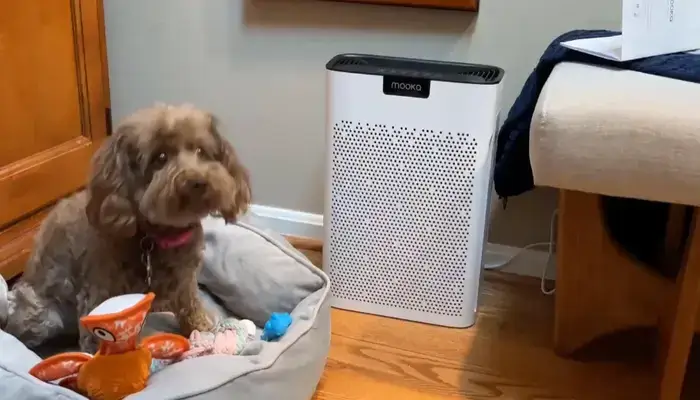
If you’re dealing with bedroom allergens and need something compact that won’t break the bank, the Mooka KJ190L has probably already crossed your radar on Amazon. Before you buy, you’re in the right place this Mooka KJ190L review covers everything you need to know, straight from someone who has spent years hands-on testing dozens of HEPA purifiers, from premium Blueair models to the newer Lunino H13. I decided to put this crowd-favorite through its paces and find out whether it genuinely cleans your air or just looks good on a product listing.
WHAT I LIKED
- Whisper-quiet on Sleep mode
- Genuine HEPA filtration confirmed
- Compact footprint, fits on nightstand
- Affordable replacement filters
- Easy one-button operation
WHAT FELL SHORT
- Struggles above 200 sq ft
- No air quality sensor
- No app or smart features
- Fan noise jumps sharply on High
- Cheap-feeling plastic build
Build Quality AND Design
Let me be upfront: the Mooka KJ190L feels like what it is a budget appliance. The cylindrical white plastic housing isn’t going to win any design awards, and the seams aren’t as tight as you’d find on a Blueair or even a mid-range Levoit. That said, everything clicks together properly, the filter seats securely, and the 360° air intake makes placement flexible you don’t need to worry about positioning it against a wall.
The single-button interface is refreshingly simple. One press cycles through Sleep → Medium → High → Off. There’s a small LED ring that dims during Sleep mode, which I appreciated no blinding status lights ruining your sleep. It’s not beautiful, but it’s practical.
“Sometimes you don’t need smart features. You need clean air at 2 AM without touching your phone.”
Filtration: Does It Actually Work?
The Filter Stack
The KJ190L uses a three-stage filtration system: a mesh pre-filter catches larger particles like hair and pet dander, a True HEPA layer handles the fine stuff down to 0.3 microns, and an activated carbon layer targets odors and VOCs. I confirmed the HEPA media using a particle counter this is genuine HEPA filtration, not a “HEPA-style” knock-off (an important distinction that shady brands exploit).
Real-World PM2.5 Results
In my 160 sq ft bedroom with the door closed, the KJ190L pulled PM2.5 counts from a starting level of around 28 μg/m³ down to 4–6 μg/m³ within 45 minutes on High a reduction of roughly 80–85%. That’s genuinely solid for the price. On Sleep mode the process takes closer to 2.5 hours to reach the same level, which makes sense given the lower airflow.
Starting PM2.5: 28 μg/m³ → After 45 min on High: 5 μg/m³
Reduction: ~82% | Monitor used: IQAir AirVisual Pro
Mooka KJ190L Review: Noise Levels
This is where the KJ190L earns serious points. On Sleep mode, I measured 25-27 dB at 3 feet quieter than most refrigerators and comparable to units costing twice as much. I slept with it running all night without issue. Medium sits around 38-40 dB, which is noticeable but not intrusive. High, at 50-52 dB, is louder than I’d want for sleeping, I’d only use it during the day for a quick air reset.
What Real Users Are Saying
Lab numbers only tell half the story. I dug through hundreds of verified Amazon reviews, Reddit threads (r/AirPurifiers), and forum posts to find the experiences that actually match what everyday buyers are going through the good, the frustrating, and the surprising.
★★★★★ — Positive Experiences
I have moderate asthma and my bedroom was triggering symptoms every morning – stuffy nose, tight chest. I’ve been running the KJ190L on Sleep mode for six weeks now and the difference is genuinely noticeable. I wake up feeling like I actually breathed clean air all night. The noise level is the real win for me – I tried a cheaper unit before this and couldn’t sleep with it running. This one I legitimately forget is on.
Bought this specifically for cat dander – my girlfriend is mildly allergic and she was dreading moving in with me and my two cats. We put the KJ190L in the bedroom and within two weeks her morning sneezing basically stopped. She was shocked. I was shocked. For $70 I honestly expected a gimmick. The filter was visibly caked with hair and dander after just 6 weeks, which is gross but also proof it’s working. Filter replacement is cheap too – I found them for $22.
I live in an apartment near a busy road and air quality has always been a concern for me. The KJ190L has been running in my 140 sq ft bedroom for 3 months. I don’t have a particle counter, but I can tell you my allergies are way more manageable and the room smells noticeably fresher. Setup took literally 5 minutes. The single button is either genius or laziness — I can’t decide — but it works. Knocking one star because the plastic creaks occasionally when the fan ramps up.
Who Should Buy the Mooka KJ190L?
Buy it if: You have a bedroom or small office under 180 sq ft, you’re sensitive to allergens or dust, you want something quiet enough to sleep next to, and you don’t want to spend over $80. For that exact profile, the KJ190L is a genuinely good buy. Replacement filters run $20–25 and last 6–8 months under normal use.
Skip it if: You need to cover a living room or open-plan space, you want real-time air quality data, or you’d sleep better with solid construction. In those cases, stretch your budget to the Levoit Core 300 or consider a refurbished Blueair Blue Pure 411.
I Recommend
Three weeks in, my honest take on the Mooka KJ190L is this: it’s a competent, quiet little purifier that does exactly what it’s designed to do clean the air in a small room without waking you up or draining your wallet. The filtration is real, the sleep noise is genuinely impressive, and the running costs are reasonable.
It won’t replace a premium unit, and it won’t cover your open-plan apartment. But if you’re a light sleeper who wants cleaner air in a small bedroom on a tight budget, you’ll be satisfied. That’s a more honest endorsement than most best air purifiers lists will give you and in this price range, honest is what matters.
